
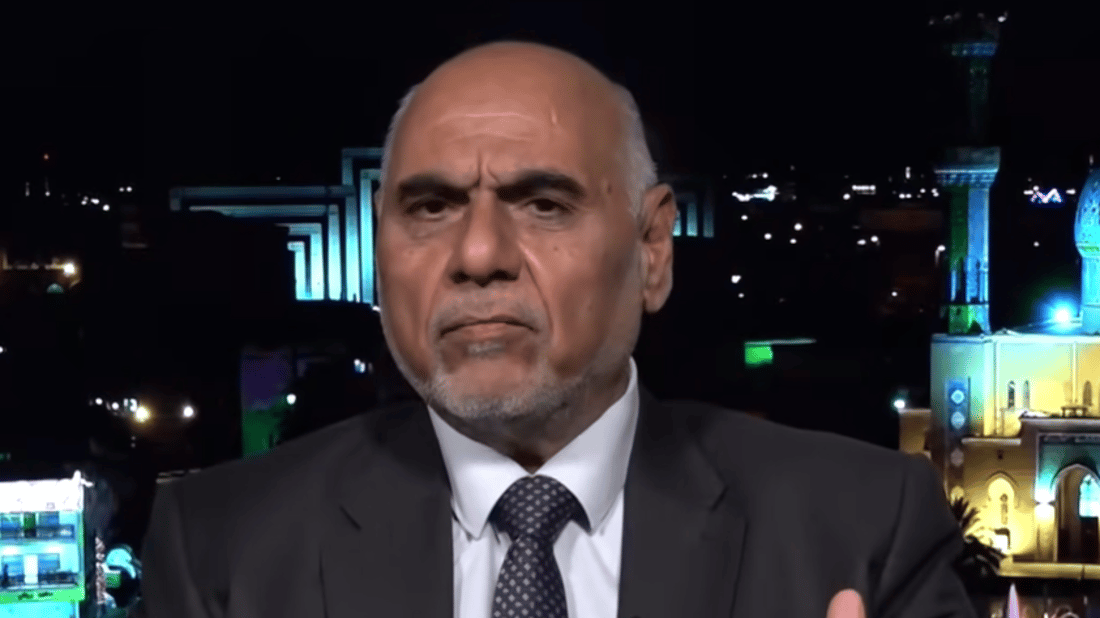
Abbas al-Bayati, a leader in the Dawa Party headed by Nouri al-Maliki, speaks during an interview on Al Fallujah TV.
Dawa Party official: Maliki retains ‘enjoys support’ of 10 Coordination Framework leaders
BAGHDAD — A senior figure in the Dawa Party said Nouri al-Maliki sent a verbal message to Kurdistan Democratic Party leader Masoud Barzani and continues to enjoy the support of 10 out of 12 leaders within the Shiite Coordination Framework.
Abbas al-Bayati, a leader in the Dawa Party headed by al-Maliki, said in an interview on Al Fallujah TV that he did not carry a written letter from al-Maliki to Masoud Barzani. “I did not carry a written message from Mr. Maliki, but rather a verbal message exclusively to President Barzani in his Kurdish domestic capacity and in recognition of the weight and influence he represents,” he said, adding that “there was no indirect message to others.”
He rejected claims that the message was tied to efforts in Washington to persuade U.S. President Donald Trump to lift objections to al-Maliki’s nomination, saying, “Mr. Fuad Hussein’s trip to Washington relates to the agendas of the Foreign Ministry and the government,” and adding that any political discussions there “will occur within the framework of Iraq and national interests and have nothing to do with the details of the political process.”
Al-Bayati said al-Maliki retains broad backing within the Coordination Framework. “Domestically, Mr. Maliki still enjoys the support of 10 out of 12 leaders within the Coordination Framework,” he said, adding that al-Maliki remains committed to “the constitutional context, which states that the largest bloc has the right to nominate its candidate for prime minister.” He added, “We have not been informed of any party withdrawing its support for Mr. Maliki’s nomination.”
Nouri al-Maliki was nominated for prime minister by the Shiite Coordination Framework following the 2025 parliamentary elections, prompting internal debate within the alliance and objections from several political actors. While framework leaders initially backed his candidacy as the nominee of what they describe as the largest bloc, some factions later called for reconsideration in light of domestic and regional reactions. U.S. President Donald Trump warned that Washington may halt support for Iraq if Maliki returns to office, and U.S. officials have signaled concerns about the composition and direction of the next government. Maliki has said he will not withdraw voluntarily, maintaining that any reversal of his nomination must come formally from the Coordination Framework.
Some excerpts from Al-Bayati’s interview on Al Fallujah TV:
Host: The message you carried—was it written from Mr. Maliki to Mr. Masoud Barzani? The message was given to Mr. Fuad Hussein, who traveled to Washington and is now meeting important figures there to persuade Trump to lift the veto on Maliki. Is that what happened?
Al-Bayati: I did not carry a written message from Mr. Maliki, but rather a verbal message exclusively to President Barzani in his Kurdish domestic capacity and in recognition of the weight and influence he represents. There was no indirect message to others. Mr. Fuad Hussein’s trip to Washington relates to the agendas of the Foreign Ministry and the government. There may be political discussions on the sidelines of that visit, but if such discussions take place, they will occur within the framework of Iraq and national interests and have nothing to do with the details of the political process.
We do not need to send messages indirectly. We have channels within the political process, the government and the parties. Some of these channels are inside Iraq. Today, Tom Barrack, the U.S. ambassador to Turkey and temporary envoy to Iraq, was in Baghdad and met with Prime Minister Mohammed Shia al-Sudani. Therefore, we do not need to send indirect messages.
Domestically, Mr. Maliki still enjoys the support of 10 out of 12 leaders within the Coordination Framework. Mr. Maliki is committed to the constitutional context, which states that the largest bloc has the right to nominate its candidate for prime minister.
We have not been informed of any party withdrawing its support for Mr. Maliki’s nomination. The ten blocs that supported the nomination did so freely and by decision, and if they wish to reverse that decision, they must announce it officially.
Host: Information we have received indicates that a meeting took place between four figures who support Mr. Maliki’s nomination and Mr. Maliki himself. They reportedly informed him of the need to withdraw his nomination, and Mr. Maliki left the meeting upset. Later, he is said to have sent a message to those figures that he would withdraw on the condition that one of three individuals—Saleh al-Hasnawi, Tariq Najm or Abdul-Ilah al-Naeli—be nominated. Do you confirm this information?
Al-Bayati: I believe this scenario is imaginary. This is my assessment, and it has no basis in reality. There was no meeting between Mr. Maliki and the four parties, and none of these respected names were discussed.
Mr. Maliki will not withdraw and is not considering withdrawal. He is proceeding with his nomination based on the Coordination Framework’s decision to nominate him, and the framework continues in its official meetings to affirm that its candidate is Mr. Maliki.
We should not turn the matter into one of exaggeration about sanctions, blockades and so on. I believe such readings are overstated and amplified by those who have their own perspective.
As for sanctions or threats of sanctions, we have been hearing about this for some time, even before the elections were held. There was talk of sanctions being imposed on individuals, companies and banks, and sanctions have been imposed previously. Therefore, the issue of sanctions is not related to the formation of the government.