
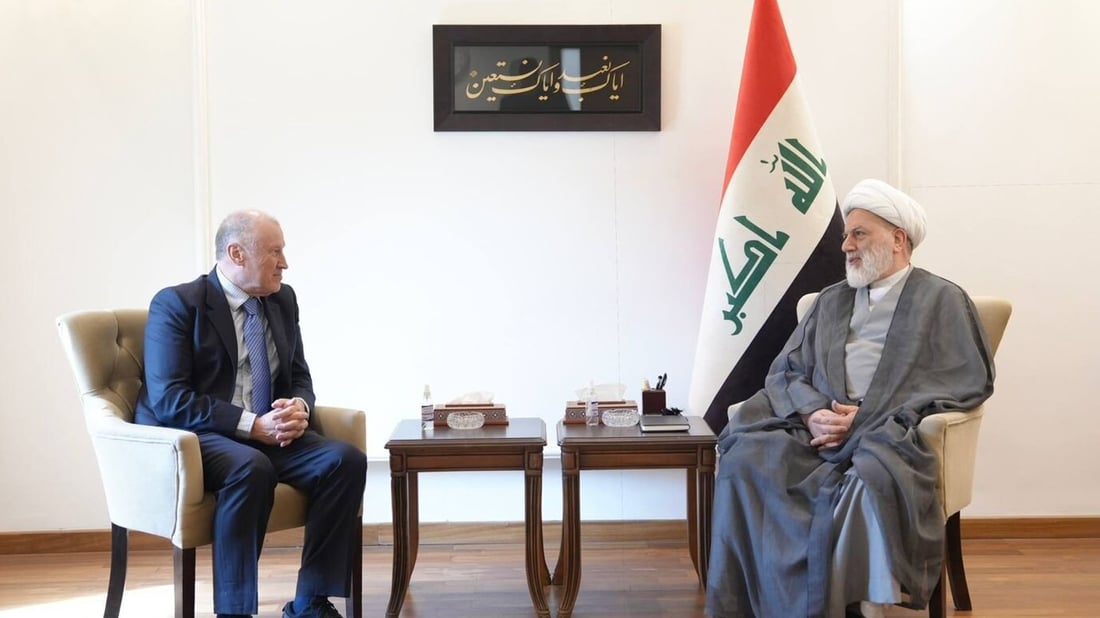
(Photo: Hamoudi’s media office)
Coordination Framework capable of preserving Iraq’s democratic path, senior Shiite leader says
BAGHDAD — Humam Hamoudi, head of the Islamic Supreme Council of Iraq, said Wednesday that the Shiite Coordination Framework has the experience and political depth to preserve Iraq’s constitutional order and the independence of its decision-making.
Hamoudi made the remarks after meeting Australian Ambassador to Baghdad Glenn Miles to discuss regional developments and efforts to complete government formation.
“The depth of experience of the Coordination Framework forces and their accumulated political expertise make them capable of preserving the constitutional democratic path and the independence of the Iraqi decision,” Hamoudi said.
He added that “Iraq does not wish to be a party to any regional tensions, but rather to be an axis of stability, peace and partnership.”
The remarks come as the government formation process remains deadlocked more than three months after the November elections. Parliament has yet to elect a president, the constitutional prerequisite for tasking a prime minister nominee to form a government.
The Coordination Framework nominated former Prime Minister Nouri al-Maliki as its candidate, a move that has fueled divisions within the alliance, drawn opposition from Sunni political forces and prompted public criticism from the United States. President Donald Trump said Washington would not continue support for Iraq if Maliki returned to office.
Maliki, who served from 2006 to 2014 and stepped down after the fall of Mosul, has declined for weeks to attend framework meetings or engage with scenarios involving his withdrawal. In a Feb. 3 interview, he said that if the alliance wished to reverse course, it could withdraw his nomination itself.