
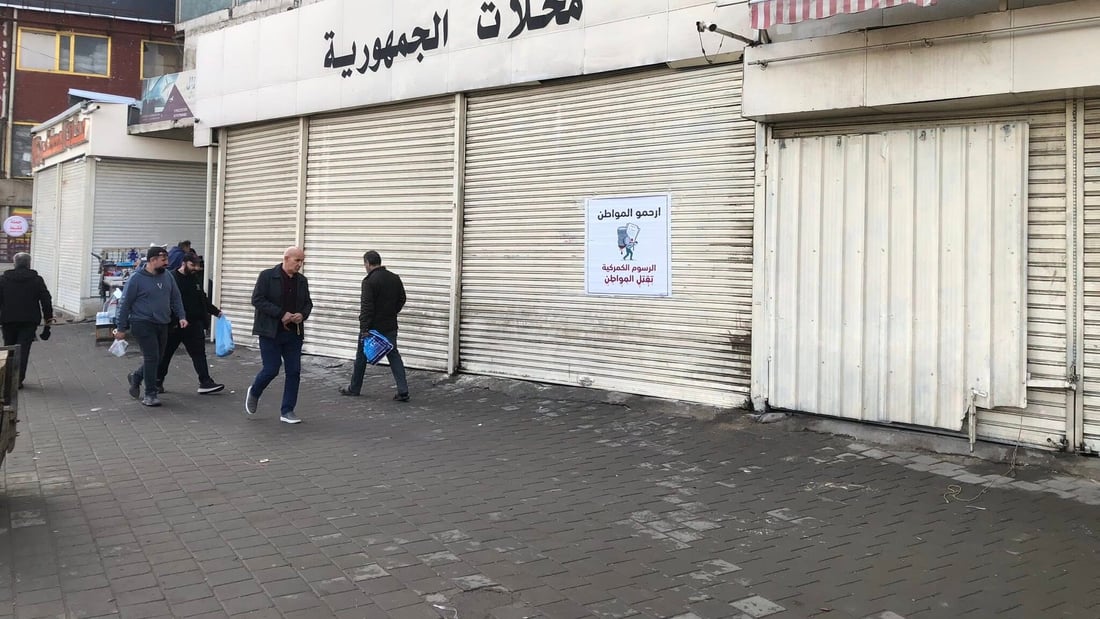
Shops remain closed for a second day in central Baghdad as traders continue a nationwide shutdown in protest against customs tariff increases, with pedestrians passing shuttered storefronts bearing signs calling for relief for consumers.
Protests escalate
Iraqi markets remain closed as traders demand customs tariff rollback
BAGHDAD — The Baghdad Chamber of Commerce announced Monday the continuation of a general closure of markets across all Iraqi governorates as traders intensify protests against raised customs tariffs, saying the shutdown will remain until the fees are canceled.
“We confirm the continuation of the general closure in all Iraqi governorates until these fees are canceled, which have burdened the citizen and caused direct damage to the national economy, market movement and family economy,” the chamber said.
The chamber listed demands including immediate release of containers piled up at ports, unified customs fees “applied fairly from north to south of Iraq,” and recalculating tariffs “at fair rates not exceeding 5%.”
“We affirm our full adherence to these demands, and there will be no retreat or procrastination,” the statement said. “We will continue our peaceful movements with full responsibility until our legitimate demands are met.”
Traders staged protests Sunday in Baghdad outside the General Customs Authority, joined by merchants from Najaf, Karbala and Kut. Demonstrations were also held in Basra. Protesters said tariff measures raised duties on imported goods to nearly 30 percent from about 3 percent, warning of higher prices and job losses.
Trader Ziad Salem said fees that previously cost about 500,000 dinars ($333) had risen sharply. “Customs has reached 30 percent, and now goods are stuck at the port,” he said. Ahmed Abboud said containers that once cost 3 million dinars ($2,000) to clear now face 30 percent duties. “This will double prices for citizens,” he said.
Trader Auras Jabbar said costs per container could reach 30 to 40 million dinars ($20,000 to $26,700). “This is a great injustice,” he said. In Basra, shop owner Mohammed al-Amir said prices have risen up to 30 percent. “The citizen is the biggest loser,” he said.
The government announced at the start of the year a new customs tariff system covering various goods, including hybrid vehicles previously exempt, alongside enforcement of the ASYCUDA electronic customs system.
Officials have denied raising food tariffs. Trade Ministry spokesman Mohammed Hanoun said the government “has not approved any amendment to the customs tariff on basic needs.” Customs Director General Thamer Qassim said “there are no new taxes imposed on imported goods,” adding that ASYCUDA applies existing tariffs under the 2010 customs law.