
(Graphics: 964media)
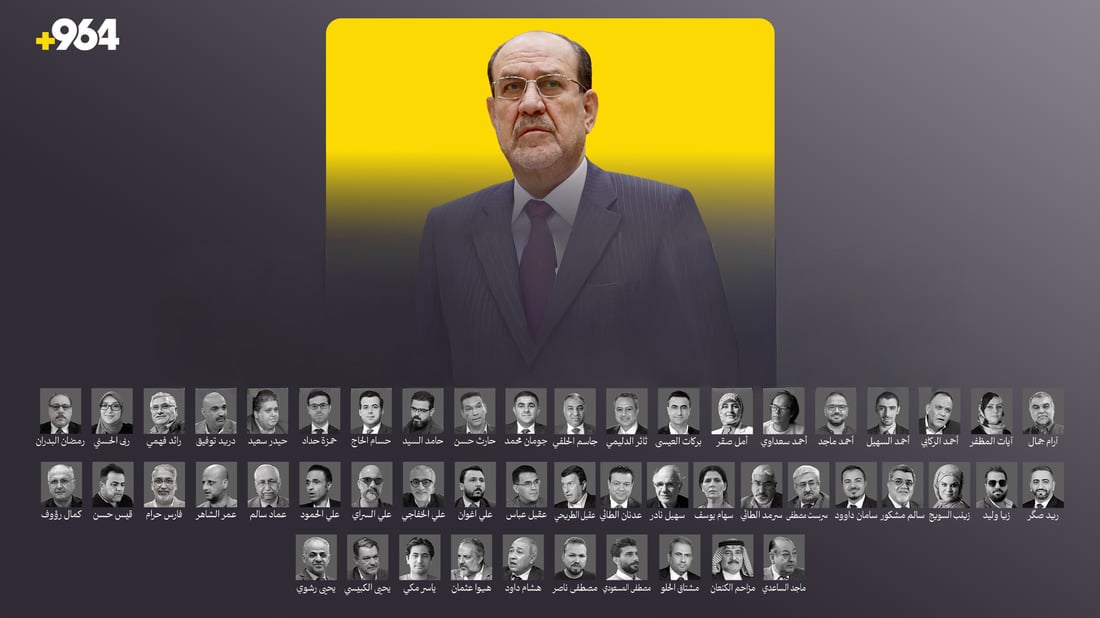
964media publishes special report on Iraq’s ninth government with 50 contributors
BAGHDAD — 964media Arabic has published a special file titled “Iraq’s Ninth Government,” featuring contributions from about 50 researchers, journalists and public figures as Iraq awaits the formation of its next government following the November 2025 elections.
The project gathers perspectives on what contributors want to place before Iraq’s next prime minister, whoever that may be. The full file is available for download in Arabic, with a dedicated page for each contributor.
Iraq is now in its 23rd year since the fall of Saddam Hussein’s Baath regime and awaits its ninth prime minister of the post-2003 era.
The Shiite Coordination Framework nominated former Prime Minister Nouri al-Maliki, who served from 2006 to 2014, sparking debate within Iraq. President Donald Trump said the United States would not continue its support for Iraq if al-Maliki returned to office.
Political science scholar Ayat al-Muzaffar wrote that the ninth government “comes in a complex internal and regional context, marked by an erosion of trust between the citizen and the state, a multiplicity of decision-making centers, and increasing pressure on the existing political model.” She said she favors “a government of decision, not a government of crisis postponement.”
Journalist Ahmed al-Suhaiel wrote that “what Iraq faces today cannot be reduced to an administrative flaw or a governmental crisis” but reflects “a structural distortion in the form of power itself.” He said “the return of Nouri al-Maliki cannot be read as an individual event or an electoral maneuver, but as an indicator of the political system’s inability to produce alternatives.”
Writer Ahmed Saadawi said “the media initially dealt with Maliki’s nomination as a joke or a heavy-handed prank, but then the matter was treated seriously,” adding that this shift “reflects a problem in the political situation as a whole.”
Legal expert Choman Mohammed outlined challenges including “the financial crisis and liquidity shortages, declining oil prices, the budget problem and the dispute with the Kurdistan Region,” as well as “armed groups, the failure to restrict weapons to the state, and attacks carried out by some armed factions.”
Hiwa Osman, general manager of 964media, wrote that “the delay is not a system crisis, but the result of an abundance of unsuitable options and multiple balances that do not balance.” He said the next prime minister “will not rule with a program but with a chance of survival.”
Writer Haider Saeed said the relationship between state and society has become dominated by “clientelism,” with political forces “purchasing loyalty” in exchange for benefits, contributing to an inflated public sector.
Raed Fahmi, secretary of the Iraqi Communist Party’s central committee, said the nomination of a prime minister faces “severe obstacles” tied to external pressure, internal complexity and power-sharing disputes.
Journalist Salem Mashkoor wrote that even if al-Maliki is tasked to form the government, “the possibility that he will be unable to form a government within the constitutional timeframe remains.”
Sarmad al-Taie, head of 964media’s Arabic department, wrote that addressing Iraq’s political trajectory may require examining “the meaning of Saddam Hussein,” arguing that authoritarian patterns are rooted in deeper social structures.
Journalist Ali al-Saray wrote that assigning al-Maliki a third term would reflect “a personal passion controlling the leader of the State of Law” rather than a strategic choice.