
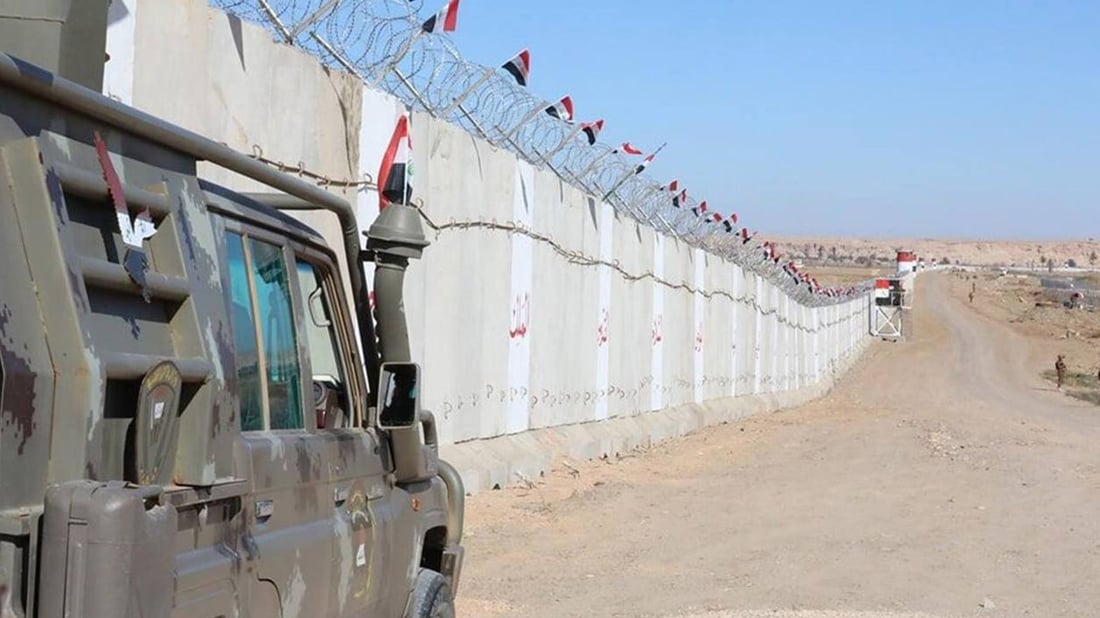
A view of a concrete security wall topped with barbed wire along Iraq’s border with Syria
Security lines surveillance
Iraq interior ministry says Syrian border fully secured
BAGHDAD — Iraq’s Interior Ministry said Friday it has deployed seven layers of border barriers and surveillance systems along the Iraqi-Syrian frontier, asserting there are no security gaps and that the entire border is under constant monitoring.
Interior Ministry spokesman Brig. Gen. Abbas al-Bahadli said the ministry maintains “a high level of readiness, particularly within the Border Forces Command, in light of developments in the region and the situation in Syria,” adding that the 618-kilometer Iraqi-Syrian border is “fully secured.”
Al-Bahadli said border security relies on three defensive lines: “the first led by the Border Forces, the second by the Iraqi Army, and the third by the Popular Mobilization Forces.” He said the ministry has adopted “seven barriers along the border, including fixed-wing electronic thermal aircraft that monitor the entire border strip.”
He said readiness goes beyond routine troop deployments, noting that the ministry developed a preventive strategy more than three years ago to secure the border. That effort included “digging trenches, building earthen berms, installing quadruple inflatable barriers, barbed wire (BRC), concrete towers and concrete walls, in addition to using fixed-wing laser thermal aircraft.”
“The security situation is good, and there are no weak points, gaps or threat areas,” al-Bahadli said. “The situation along the Iraqi-Syrian border is fully reassuring.”
He said the ministry’s approach is not reactive. “The work of the Interior Ministry and the Border Forces Command in preparedness and readiness is not new or momentary,” he said, adding that security fortifications were established “a year or more before the current situation in Syria.”
Al-Bahadli said readiness levels remain “very high and continuous along the entire border strip to the last point,” with no tolerance for infiltration or illegal crossings. He said security measures are based on three main pillars: “the human resource with three defensive lines, the engineering effort represented by fences, barriers and trenches, and technological development through motion sensors, surveillance cameras and laser monitoring that operate day and night.”
He said these systems transmit live feeds to “the National Command Center and control and operations centers within the Border Forces Command,” along with fixed-wing electronic aircraft that “monitor any movement.”
Al-Bahadli also said there is “high coordination with the Joint Operations Command and the Ministry of Defense,” alongside intensified intelligence work, information gathering and field surveys to ensure there are no security breaches.
Developments in Syria in January 2026 have raised regional security concerns, with clashes and political tensions escalating in the country’s northeast between Syrian government forces and Kurdish-led groups, prompting ceasefire efforts to prevent wider fighting. The instability has been compounded by worries over the fate of Islamic State detainees held in Syrian facilities, some of whom have been transferred to Iraq under international arrangements, while others risk escaping as control shifts on the ground. Iraqi officials and security agencies have repeatedly warned that renewed violence in Syria could enable ISIS cells to regroup and attempt cross-border movement, leading Baghdad to stress heightened vigilance, reinforced border defenses and continuous monitoring to prevent any spillover into Iraqi territory.