
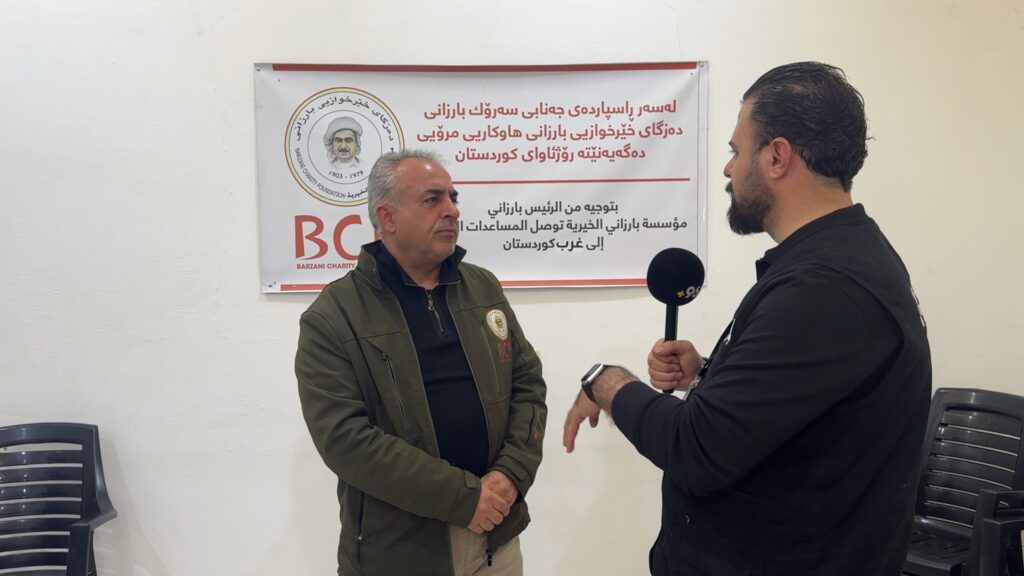
Musa Ahmed, head of the Barzani Charity Foundation, speaks to 964media in Rojava. (Photo: 964media)
Barzani Charity Foundation delivers aid to people in Rojava
ROJAVA — The Barzani Charity Foundation has deployed a large aid team to Rojava, Syria, according to the organization’s head, Musa Ahmed, who said they remain committed to distributing support despite challenges. “Even if it’s difficult, we ensure the assistance reaches the hands of those who need it,” he told 964media.
The assaults on the Kurds by Syrian regime forces and allied Islamist militias in northeastern Syria has driven significant civilian displacement, with tens of thousands sheltering in collective centers or with host families.
The foundation coordinated its efforts with the Kurdish Red Crescent and international organizations. Ahmed said the priority has been delivering heating fuel and daily meals to displaced people.
On Tuesday, the organization distributed winter supplies including heating equipment, blankets, and fuel, along with daily food rations. “We tried to deliver assistance as quickly as possible,” he said.
The Barzani Charity Foundation distributes aid in the form of packages containing various food items.
Ahmed emphasized the foundation’s and Kurdistan Region’s emotional connection with Rojava’s population. “There is deep compassion to support the Kurds of Rojava. That level of solidarity and aid collection is so great,” he said.
“The dedication and passion of our staff is sourced from the people’s passion. That compassion from the people of Kurdistan is what drives our staff to work so hard. Because we feel the passion that exists among our people toward the Kurds of Rojava. We proudly distribute the aid,” he said.
Ahmed also said that reaching people in remote and scattered locations requires time. But their teams are tirelessly committed to delivering the assistance.
He noted that since beginning operations in Rojava, the foundation has delivered 165 aid convoys. A total of 9,180 families, or 57,955 individuals, have received support.
The assistance has included 22 types of household items. Aid has been distributed to 108 schools. Fuel was provided to eight mosques currently sheltering displaced people.
In besieged areas such as Kobani, shortages of basic supplies have become acute. A fragile ceasefire has enabled some deliveries, but residents have reported cuts to water and electricity and shortages of food and fuel.