
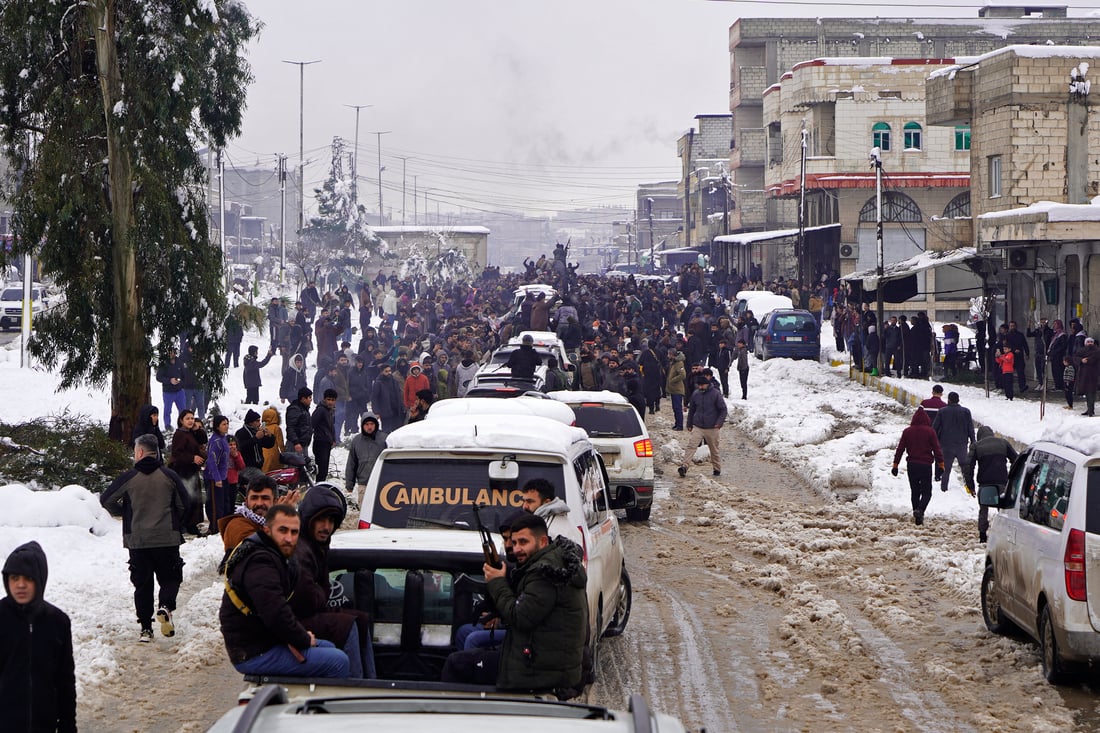
Members of Kurdish-led Syrian Democratic Forces arrive at the Kurdish-held city Kobani on Jan. 23, 2026, after they withdrew from the Al-Aqtan prison in the Raqqa Photo by AFP)
Kobani is under siege. Again.
Eleven years to the day after Kobani declared victory over the Islamic State, the city is once again surrounded.
This time, it is by Syrian government forces and allied Islamist armed groups.
Residents say the siege has tightened into something familiar. Kobani’s basic services, including water, electricity and internet, are cut. For the past week, no aid convoys have been permitted to enter, with only limited United Nations assistance reaching the area on Sunday.
Kobani is not just another Kurdish city on a map. It is a name that became shorthand for resistance, for a fight that drew the world’s attention, and for repelling a siege that was proof that ISIS could be beaten. Now the history is repeating itself, and Kurdish fighters say they will defend the city as they did before.
For many Kurds, the forces surrounding Kobani today are not a new opponent. Residents describe them as acting with the same mentality they associate with ISIS, and with the same treatment toward Kurds.
In a statement marking the 11th anniversary of the city’s liberation, the Kurdish-led Syrian Democratic Forces recalled the 2015 battle as a “fateful confrontation” that not only defended Kobani but also represented a wider struggle for human dignity and freedom.
It credited fighters from the People’s Protection Units and Women’s Protection Units with halting what it described as a “planned genocide” against Kurds and opening the path to liberating wider areas of Syria.
“Historical victory in Kobani marked the beginning of the real collapse of the most brutal terrorist organization the modern world has known,” the SDF said. “It proved beyond doubt that ISIS was not just a military organization, but a transnational extremist project aimed at destroying humanity and its values.”
A 15-day ceasefire agreement between the SDF and the Syrian government was announced, but the SDF said pro-government armed groups have not abided by the terms and have continued attacks on the city.
The statement warned that renewed destabilization in Kobani and across northeastern Syria presents “a direct threat to regional and international security” and could provide terrorist organizations with opportunities to regroup.
The SDF called on the international community to protect what it described as the outcomes of the fight against ISIS. “This is not a political option, but a shared moral and legal responsibility,” it said.
The group concluded: “Kobani will remain an enduring symbol of resistance and resilience. The victory achieved eleven years ago is not merely a memory—it is a renewed pledge to defend freedom and uphold the legacy of those who fell for it.”
Marking the anniversary, Kurdistan Democratic Party leader Masoud Barzani wrote Monday, “On the eleventh anniversary of the defeat of terrorists in Kobani, we salute the brave fighters and Peshmerga who, with the support of the international coalition and their heroic defense, prevented Kobani from falling into the hands of ISIS terrorists.”
Barzani described the 2015 victory as “a great triumph in the history of the Kurdish people,” adding, “It was a victory for all of Kurdistan, and a victory for all humanity against terrorism and darkness.”
During the 2015 siege, the Kurdistan Region Parliament voted to send Peshmerga forces to support Kobani, marking the first vote by the Kurdish parliament to deploy fighters outside Iraq. The decision included the movement of forces through Turkish territory to reach Kobani. As the Peshmerga traveled toward the city that day, thousands of Kurds gathered along the route to welcome them, waving Kurdish flags in a show of national pride, unity and solidarity with their Syrian Kurdish counterparts.