
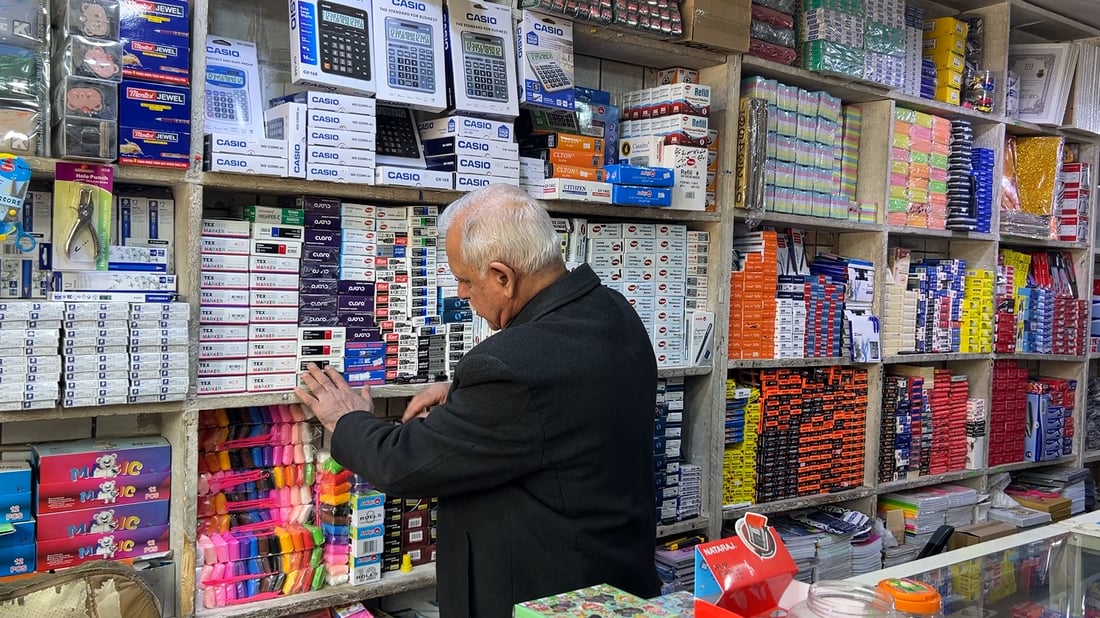
A stationery shop owner rearranges shelves stocked with calculators, pens and office supplies in Karbala, after the store shifted away from selling books due to declining demand for printed reading materials. Photo by 964media.
Changing reading habits
Bookstores fade in Karbala as printed word declines
KARBALA — Karbala’s once-bustling book trade is shrinking, with several bookstore owners closing their shops or shifting to stationery and other businesses, citing declining demand for printed books and changing reading habits among young people.
Nasrallah Abu al-Maali, who opened Al-Maali Bookstore in 2018 after fulfilling a childhood ambition, said he recently shut the shop after years of struggling to keep it afloat. He said reading levels were noticeably higher when the bookstore first opened, with a steady flow of customers that gradually dwindled.
“Young people no longer read paper books except when they are forced to, such as for completing university research,” Abu al-Maali said. He blamed rising book prices, declining quality due to copying and forgery, and a growing shift toward electronic books.
More than 12 bookstores have disappeared from the city in recent years, though some booksellers say the trend reflects a decline in printed books rather than a total collapse in reading, as digital formats continue to expand.
Qasim Hassan, who has run Dar Al-Maaref Bookstore on Abbas Street since 1997, said his shop once stocked magazines and books covering literature, science and fine arts. Over time, he said, demand eroded to the point that even cookbooks no longer sold.
“We stopped selling books and specialized in stationery, along with law books that university students and lawyers are forced to buy,” Hassan said.
He recalled that Karbala once had a dense network of bookstores. “Every street had two or more bookstores,” he said, naming Abbas Street, the route to the Imam Hussein shrine, Abbasiya and Imam Ali Street as areas that once hosted multiple shops.
“All these bookstores disappeared,” Hassan said, attributing the decline to urban expansion projects, road closures that reduced access, falling sales of books, newspapers and magazines, and what he described as a broader shift in Iraqi tastes. “All these factors pushed bookstore owners to move elsewhere or change professions.”
Hassan said there has been “a decline, even a major collapse, in reading printed materials in general,” linking it to deteriorating educational standards that have reshaped students’ cultural interests.
Reviving the city’s cultural life, he said, requires reforming education, strengthening the role of teachers and moving beyond narrow sectarian or religious frameworks toward a shared public space that encourages intellectual, literary and artistic engagement.