
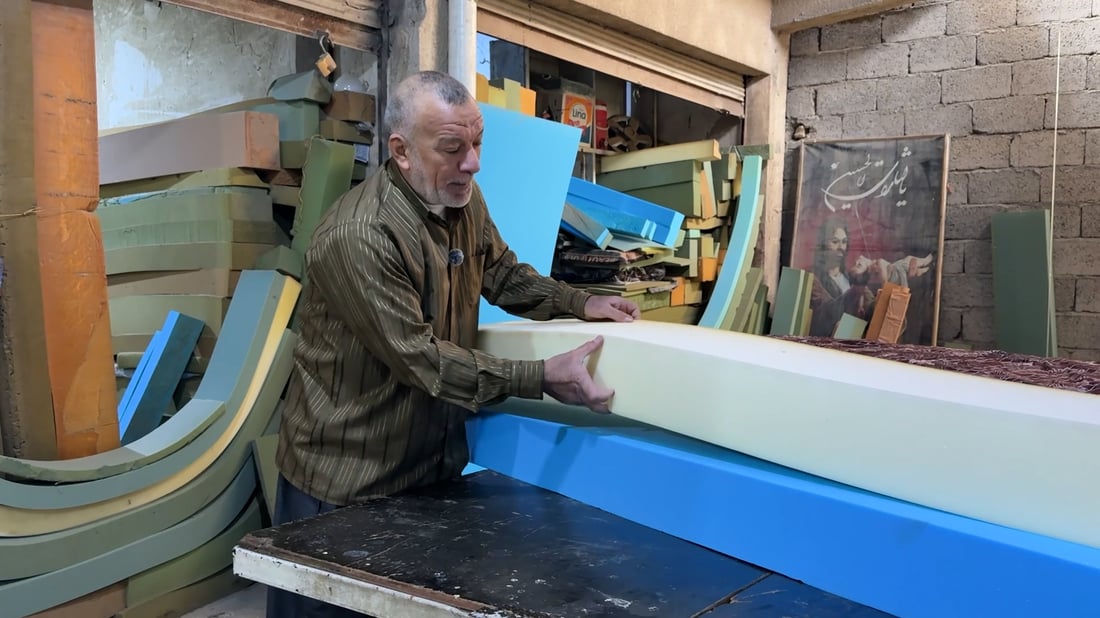
A foam manufacturer inspects locally made sponge sheets inside his workshop at the Khaliṣ market in Diyala governorate, where traders say Iraqi-made foam outperforms imported products in durability and comfort. Photo by 964media.
Iraqi-made foam outperforms imports in durability, dealers say
DIYALA — Foam specialists and mattress dealers in the Khalis market say Iraqi-made foam products outperform imported alternatives in durability and comfort, despite foreign items often arriving in larger sizes and thicknesses.
Adnan Hashim, owner of a local foam factory, told 964media that first-grade Iraqi foam mattresses last far longer than imported ones. “A first-grade Iraqi sp mattress can last up to eight years,” he said, adding that imported products “do not usually last more than a year.” Hashim cautioned buyers against excessive thickness, advising that mattresses should not exceed 15 centimeters because “the higher the mattress, the less comfortable it becomes for the back.”
Hashim said Iraqi foam is preferred because it contains balanced granules with multiple compression levels and grades. “Iraqi foam is desirable because it has suitable particles, different pressure grades and several qualities,” he said. “Imported foam, despite its thickness, is light and short-lived.”
Dealers known locally as dushmajia often favor the “High Extra” type, which Hashim described as firm and suitable for making upholstered seating such as sofas. Softer foam is more popular for sleeping, he said, describing it as very pliable and commonly referred to in the trade as “soft” or “laya.”
According to market prices in Khaliṣ, a standard mattress measuring about 15 centimeters in height sells for roughly 125,000 Iraqi dinars. Hashim reiterated his advice that taller mattresses reduce spinal comfort over time.
Veteran mattress maker Hussein Abdul Abbas recalled earlier production by the State Company for Petrochemicals, which manufactured two main types of foam bedding: high-pressure and low-pressure. “Today, many private companies have entered this industry,” he told 964media, noting that products now vary by use, with firmer types for sitting and softer ones for sleeping. He listed common varieties on the market, including Extra, Dunlop, Mumayaz and Soft.
Although foam bedding is not considered fully medical, dealers say it is currently the most popular option in local markets because it is more affordable than cotton products, whose prices have risen following the reduction or absence of cotton cultivation in Iraq.