
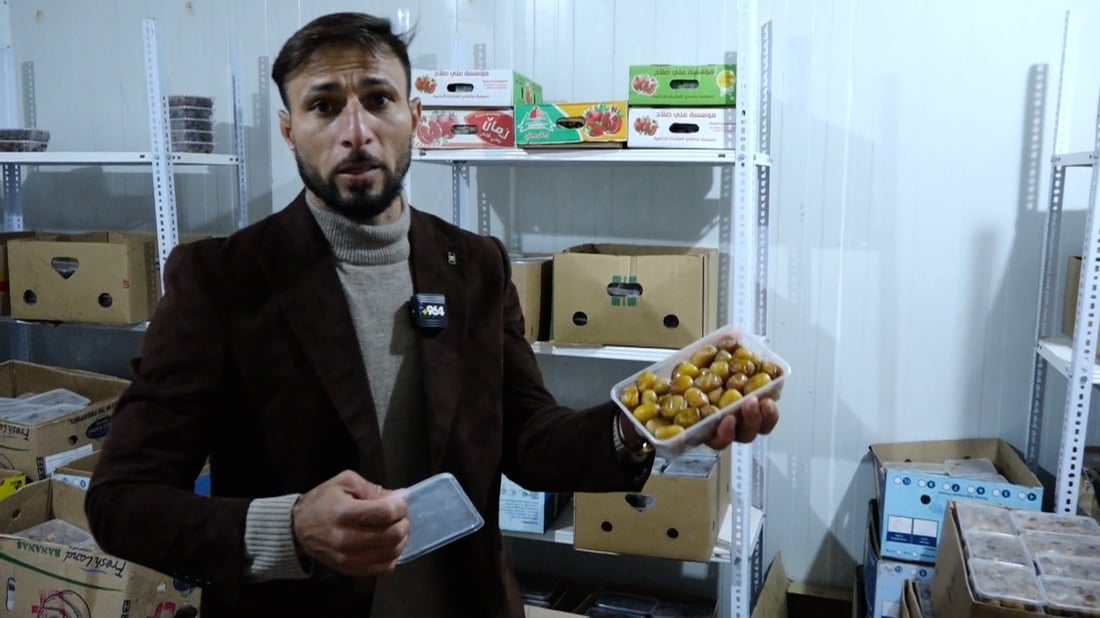
A date trader displays packaged frozen dates inside a cold-storage facility in Suq al-Shuyukh, Dhi Qar governorate, where freezing has become an increasingly popular method for preserving dates while maintaining their color and flavor. Photo by 964media.
Freezing replaces traditional methods to preserve dates in southern Iraq
DHI QAR — Iraqis have long relied on traditional methods to preserve dates after the late-summer harvest so they can be eaten during the cold winter months, but freezing is increasingly replacing older techniques in parts of southern Iraq.
In the past, dates were commonly preserved through “kabs,” a method that involves tightly packing them in airtight containers to extend shelf life. In Suq al-Shuyukh, however, freezing is gaining popularity for its ability to preserve color, taste and texture when done correctly.
Luay Madlul, who runs a date-freezing business in the town, said the process depends on timing and experience. “The work succeeds this way,” he said. “The color of the rutab does not change, as if it was picked today.”
Madlul said the most commonly frozen varieties are Barhi and Bureim, which sell for about 5,000 Iraqi dinars per kilogram. Demand, he said, typically rises ahead of Ramadan. Other varieties he freezes include Jouzi, red Barhi, Bad‘a, Saudi Shafaf, Ikhlas and Maktoum.
Not all dates are suitable for freezing, he said. Varieties such as Istimran, Khudrawi and Zahidi are avoided because their color changes during the process.
According to Madlul, preparation begins before sunrise. Dates are harvested around 4 a.m. to prevent discoloration, then packed into plastic containers and cartons before being placed in cold storage. “I know when to harvest the palm and when to freeze it,” he said. “I do not harvest unless the palm is ripe. Khalal spoils in freezing because it is unripe, while ripe rutab succeeds in freezing.”
Madlul said his products are sold beyond Suq al-Shuyukh to other cities in Dhi Qar and elsewhere in the country, with some shipments sent abroad as gifts, including to the United Arab Emirates.
With nearly a decade of experience, Madlul said careful handling and timing are essential as frozen dates gain wider acceptance alongside traditional preservation methods.