
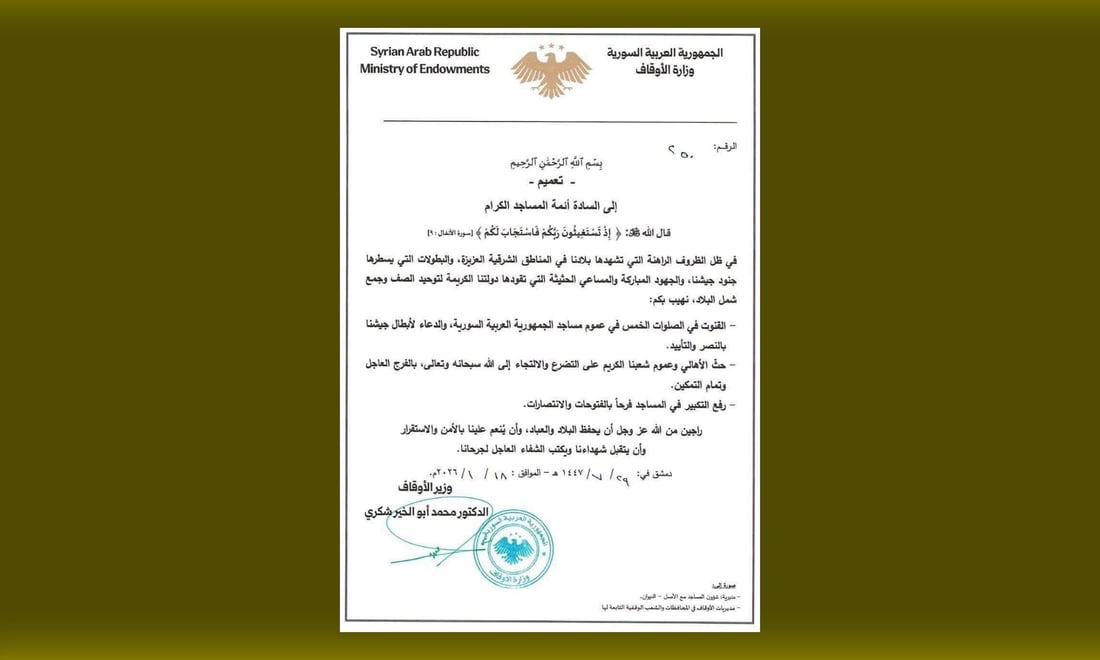
A copy of the directive issued by Syria’s Ministry of Religious Endowment, citing a verse from Surah Anfal. (Graphic: 964media)
Syrian religious ministry condemned for invoking ‘Anfal’ verse to back assaults on Kurds
NEWSROOM — Syria’s Ministry of Religious Endowments has drawn sharp criticism after issuing a directive calling on mosque imams to invoke Quranic verses and prayers in support of government forces and allied armed groups carrying out assaults against Kurds in northeastern Syria and Rojava.
The directive, dated Jan. 18 and signed by Minister Mohammad Abu al-Khair Shukri, urges clerics across Syria to raise takbeers in mosques in celebration of what it described as ongoing “victories and conquests,” citing a verse from Surah Al-Anfal: “[Remember] when you asked help of your Lord, and He answered you.”
Al-Anfal, the eighth chapter of the Quran meaning “The Spoils of War,” carries deep historical trauma for Kurds. The term is closely associated with the 1988 Anfal campaign carried out by Saddam Hussein’s regime in Iraq, which involved chemical attacks, mass executions and the destruction of thousands of Kurdish villages.
According to Human Rights Watch, the Anfal campaign resulted in the killing of an estimated 50,000 to 100,000 Kurds, while Kurdish sources have put the death toll as high as 182,000.
The controversy comes as Syrian government forces and allied armed groups continue operations against Kurdish-held areas in northeastern Syria, prompting fears among Kurds that religious and historical language is once again being used to legitimize violence against their communities.
The ministry’s framing of current military operations as religious “conquests” has prompted widespread concern, as similar language has historically been used to cast armed campaigns as divinely sanctioned. Critics note that such rhetoric has often been employed to legitimize violence, even though the majority of Kurds are themselves Muslim.
Religious scholars and imams in the Kurdistan Region strongly condemned the directive, rejecting the use of Islamic language to justify violence against Kurdish communities.
Khalis Kawani, a cleric in the Kurdistan Region, told 964media, “Many times we have been killed in the name of ‘Allahu Akbar,’ in the name of ‘Anfal,’ just like ISIS killed us chanting ‘Allahu Akbar.’ Now in Syria, again in the name of religion and conquest, the blood of our brothers and sisters is being made permissible. They should fear God—God does not accept injustice, especially not injustice done in His name and in the name of Islam.”
Another cleric, Abdulmalik Sargati, said the directive echoed past atrocities. “What the Syrian Ministry of Religious Endowments is saying is against Islam. This is not a religious war—it is a war over land, nationhood, language, and culture,” he told 964media. “Today in Syria, just like during Saddam’s rule, they are using the language of Anfal again. They want to occupy the land of Kurdistan in the name of religion.”
Aram Talabani, a religious scholar, described the directive as “deeply illegitimate, un-Islamic, irresponsible, and inhumane.”