
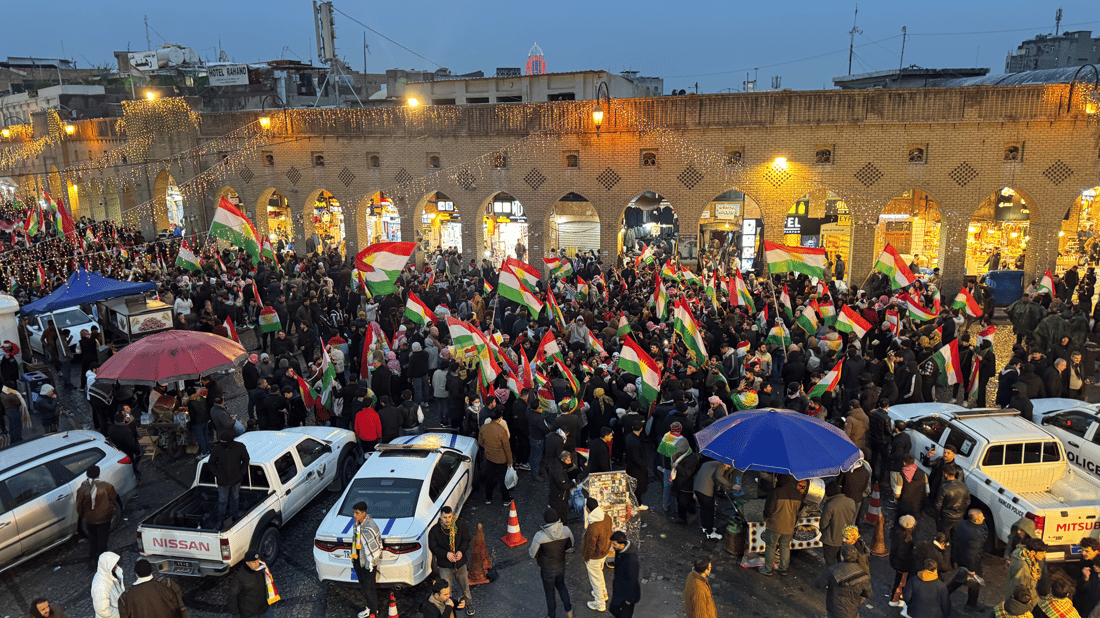
Protesters in Erbil during a demonstration in support of Kurds in Rojava, January 23, 2026. (Photo: 964media)
Opinion
A Kurdish Spring in the depths of winter
By Hiwa Osman
In his most recent interview, Mazloum Abdi, the commander in chief of the Syrian Democratic Forces, looked markedly different from his previous public appearances.
Despite mounting tensions, escalating clashes and an opaque political horizon, he came across as calmer, more self-assured and far less inclined toward defensive or pleading rhetoric. This composure was not a denial of danger. It was the expression of accumulated awareness, a moment in which he understands that Kurds across the Middle East and the diaspora now stand behind his forces.
I first met Abdi in 2020: Rojava was an open arena for four armies operating on the same land: the United States, Russia, Turkey and the Syrian regime. At the time, I wrote, and genuinely believed, that he had learned the skills of maneuvering required to survive within this unprecedented complexity. He was managing power balances usually handled only by states. Yet even then, he could not escape the “curse of geography” that has haunted Kurds throughout history: always at the heart of conflict and always on the margins of decision-making.
Five years later, that geography appears to be shifting.
The attacks launched by the Syrian army on the Ashrafieh and Sheikh Maqsoud neighborhoods of Aleppo, followed by their expansion into areas under SDF control, were not merely a military escalation. They redefined the Kurdish question in Syria. What had been framed as a local security issue became a unifying Kurdish cause, touching Kurds everywhere.
The decisive factor was not politics but the nature of the violence used. The videos documenting abuses were not read in the Kurdish collective consciousness merely as contemporary war crimes, but as a direct invocation of the memory of genocide.
After the Syrian Ministry of Endowments described the army’s actions against the Kurds as “conquests,” and the minister used a verse from Surat al-Anfal, the specter of the Anfal campaigns returned to Kurdish collective awareness, not as a concluded historical episode but as a recurring pattern: dehumanization, the breaking of symbols, and turning the Kurdish body into a message of intimidation. This kind of violence was not random. Yet once again it produced the opposite result of what was intended.
From that moment, protests did not cease. Across Kurdish cities throughout the Middle East, people poured into the streets. This was not just the result of party mobilization or centralized organization, but a visceral reaction by a people who felt that this time the targeting was existential, not merely political.
Very quickly, the movement went beyond protest. Hundreds of young Kurdish volunteers crossed borders to join fighters on the ground. This was not yet a massive numerical influx, but it carried deep significance: the psychological and symbolic readiness to engage had returned forcefully. Alongside it was a clear awareness, emphasized by Abdi in his recent interview, that the conflict must not be allowed to turn into an Arab-Kurdish war.
Tens of thousands of Kurdish women turned to social media, posting videos of themselves braiding their hair. It was a simple symbolic act, heavy with meaning, reclaiming dignity in the face of deliberate attempts at humiliation.
Then came material support. Fundraising campaigns, medical aid and logistical support networks were launched from all parts of Kurdistan and from the West, and they continue as this article is being published. Unlike previous phases, this solidarity was not fleeting. It was sustained, driven by a sense that what is happening today will leave long-lasting effects.
Politically, the repercussions were swift. Kurdish leaders in the Kurdistan Region of Iraq and beyond expressed full solidarity, leading to a rare moment of Kurdish political convergence. Masoud Barzani emerged as a key interlocutor with both Washington and Damascus, placing the safety and security of Rojava’s population at the top of the agenda. This role was complemented by the intensive diplomatic activity of Kurdistan Region President Nechirvan Barzani, whose communications with world leaders did not cease in an effort to avert a humanitarian catastrophe and push toward a political settlement. At the same time, the Patriotic Union of Kurdistan sent counterterrorism units to Hasakah to assist in defense and opened space for volunteers to travel to Rojava.
This new reality has changed the rules of the game. Syrian Interim President Ahmed Sharaa is no longer able to deal with the Kurds as an isolated Syrian entity, easily contained. He now faces a broader Kurdish equation. Turkey encouraged this escalation and may soon discover that it, too, miscalculated. Accusing the Kurds of ties to the PKK was a narrative easy to manage. Confronting a unified Kurdish cause, with an international political front led by Masoud Barzani, is an entirely different matter.
On the ground, Kurdish forces now stand at the borders of their region with a new awareness: collective resilience, when backed politically and socially, can alter equations. Perhaps most significant is what did not happen this time. Unlike previous moments in Kurdish history, American disengagement did not produce a sense of collapse in morale. It fostered greater cohesion and an effort to reorganize and unify the Kurdish House from within.
This Kurdish Spring was not born of a military victory, but of an internal breaking of a historical fear. That, perhaps, is the deepest transformation.
Returning to General Abdi, his own transformation is clear. The commander who learned years ago the art of surviving among four armies now appears to have entered a different phase. He is no longer merely managing imposed power balances, but standing at the front of a historical moment: one of collective Kurdish consciousness transcending the geography that bound his predecessors.