
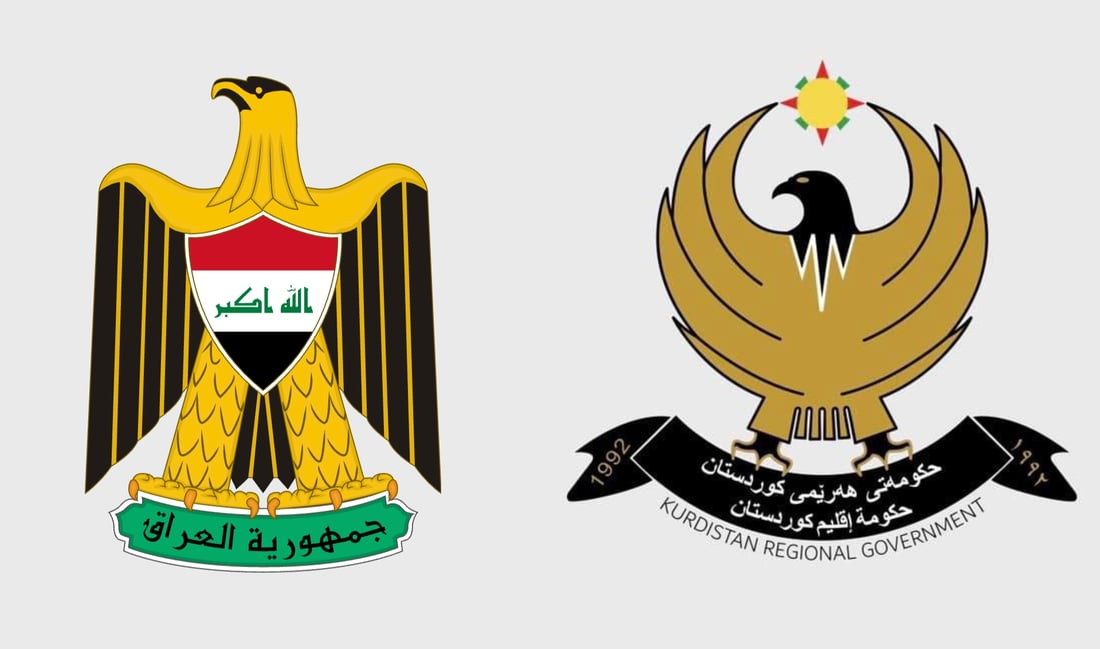
Emblems of the Iraqi Federal Government (left) and the Kurdistan Regional Government (right).
KRG finance ministry rejects blame for drop in federal border revenues
ERBIL — The Kurdistan Regional Government’s Ministry of Finance and Economy on Thursday rejected accusations that the Kurdistan Region was responsible for a decline in federal border revenues, pushing back against remarks made in parliament by the head of Iraq’s Border Ports Authority.
In a statement dated Jan. 15, the ministry said comments made by Border Ports Authority chief Omar al-Waeli during a parliamentary session on Jan. 11 were delivered “outside established legal and administrative norms” and without the presence of any Kurdistan Region representative.
The ministry said al-Waeli blamed the Kurdistan Region for reduced revenues at federal border crossings, making what it described as “accusations and allegations with no basis in fact.” It added that he also addressed files related to salaries and oil exports, issues the ministry said fall outside his institutional authority.
If a decline in revenues at federal crossings has occurred, the ministry said, it is attributable to problems within the federal system itself, including “the spread of administrative and financial corruption,” weak government control at some crossings and alleged involvement of smugglers and certain tribal actors.
It pointed to uncounted cargo weights as “a clear indicator of organized corruption,” and said customs duties at federal crossings were previously assessed in a discretionary manner based on containers rather than their contents. Under the current customs tariff system, duties are calculated on actual goods, which in some cases has increased fees “to three times their previous level,” the statement said.
The ministry also said al-Waeli’s comments contradicted his earlier public statements in which he claimed federal border revenues had risen by 100%. That increase, it said, was previously attributed by al-Waeli himself to container-based customs calculations that shifted an estimated 50% to 60% of trade activity from Kurdistan Region crossings to federal crossings last year.
The Kurdistan Region operates several official border crossings with neighboring countries, mainly Iran and Turkey, handling trade, passenger traffic and customs activity. The ministry said revenues from these crossings are regularly reported to Iraq’s federal Ministry of Finance.
Responding to allegations that banned goods enter Iraq through Kurdistan Region crossings, the ministry said the claim was “unfounded,” arguing that prohibited goods “enter easily through federal border crossings and are later smuggled into the Kurdistan Region.”
It added that when goods enter through Kurdistan Region crossings due to lower tariffs, federal customs authorities collect the tariff difference, meaning traders, not the federal treasury, bear the cost — a point it said undermines claims of revenue losses.
On tariff unification, the ministry said it has repeatedly expressed readiness to resolve the issue, including by forming a specialized committee, but accused the federal government of failing to act seriously. It said tariff unification is a prerequisite for implementing ASYCUDA or any joint customs system, noting that “technically, it is not permissible to operate more than one customs tariff within a single system.”
The ministry also said it has repeatedly asked the federal government to formally recognize Kurdistan Region border crossings.
It said federal audit teams have visited Kurdistan Region crossings over the past two years, reviewed revenue data and received monthly reports submitted to the federal Finance Ministry. At the same time, it accused the federal government of reducing customs revenues by establishing internal customs checkpoints between the Kurdistan Region and federal governorates, calling the practice illegal and a driver of “financial and administrative corruption.”