
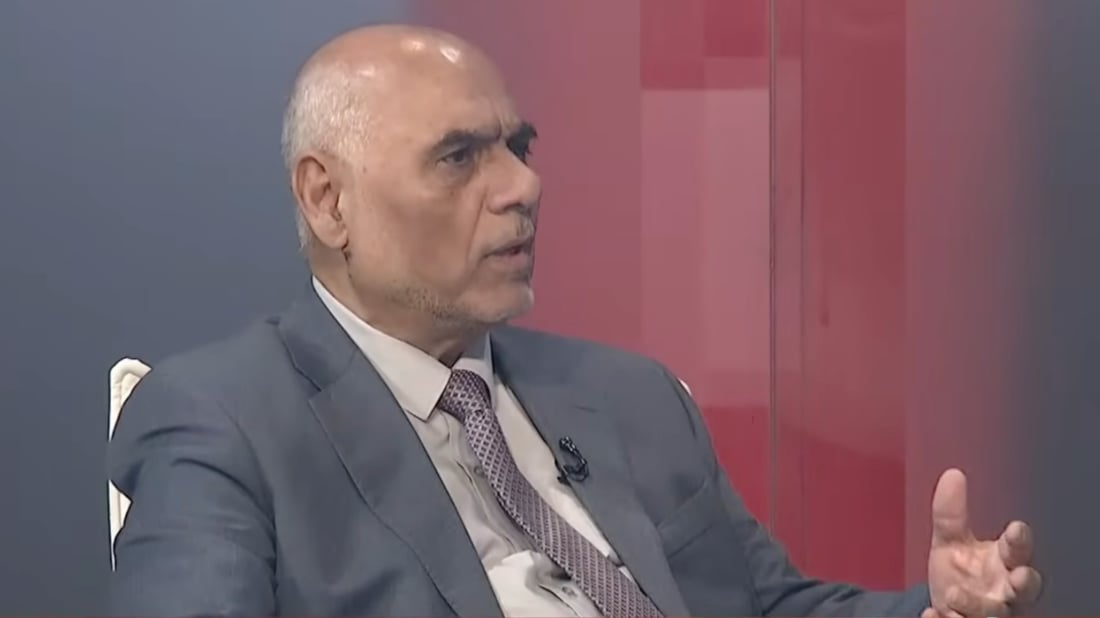
Abbas al-Bayati, a senior leader in the State of Law coalition, speaks during a televised interview in which he outlined a proposed approach to restricting weapons and managing armed factions.
Media Monitor
State of Law’s Bayati says Maliki would use ties, law and politics to manage militias
BAGHDAD — Abbas al-Bayati, a senior leader in the State of Law Coalition, said former Prime Minister Nouri al-Maliki would rely on personal channels with armed groups, legal mechanisms and their role in parliament to advance efforts to limit weapons to state authority if he is tasked with forming the next government.
“Al-Maliki will address the issue of restricting weapons and the armed factions through three points,” al-Bayati said in an interview with INEWS. “First, his positive relationship with these respected entities; these parties respect his stance and engage with his positions.”
He said the second element would rely on state institutions. “Second, the legal cover, through the law, the constitution and state institutions,” al-Bayati said.
The third point, he said, centers on political participation. “Third, their presence in parliament is clear evidence that they want to engage in the political process, and this is a positive message,” he said.
The remarks come as the Shiite Coordination Framework continues negotiations on naming a prime minister following the Nov. 11, 2025 election. Reports in recent days have suggested Prime Minister Mohammed Shia al-Sudani may step aside, while figures within the framework have spoken of advanced discussions over potential candidates. The framework has not named a nominee, and Sudani’s camp has not publicly confirmed ending his bid.
Growing U.S. pressure on Iraq to restrict weapons to state authority has sharpened internal political debate, particularly over the future of Iran-backed armed factions. U.S. officials have reiterated calls for dismantling such groups, saying they undermine Iraq’s sovereignty and stability, while Iraqi leaders say limiting weapons is a domestic decision tied to the government program.
Armed factions have publicly rejected disarmament, with the Iraqi Resistance Coordination Committee saying it opposes any discussion of giving up weapons “even with the government” until what it described as “full sovereignty for the country” is achieved, adding, “The weapon of the resistance is a sacred weapon,” and that dialogue on the issue would only occur after the end of all foreign presence.
Abbas al-Bayati in an interview on INEWS:
What happened on Saturday was a major step forward and a culmination of efforts. The public viewed it with optimism and is awaiting the formation of a framework committee that would receive delegations, accommodate views, and consider observations on the government program that will be presented.
Our discourse is one of an ‘extended hand,’ which Mr. al-Maliki has repeatedly emphasized. In the political bureau of the Islamic Dawa Party, we refer to it as the principle of the ‘extended hand.’ The aim is that we are open to everyone. The respected mujahid brothers in the Sadrist movement — now known as the National Shiite Movement — have weight, a role and influence that cannot be ignored. They seek the interest of Iraq, and when they see that the nomination of al-Maliki serves Iraq’s interest, they certainly will not obstruct it. They may not announce this explicitly, but they are now a national movement, and through their positions, whenever they find, in any place, any person or any candidate who serves this people, they will certainly not object.
Al-Maliki will address the issue of restricting weapons and the armed factions through three points. First, his positive relationship with these respected entities; these parties respect his stance and engage with his positions. Second, the legal cover, through the law, the constitution and state institutions. Third, their presence in parliament is clear evidence that they want to engage in the political process, and this is a positive message. We are not ‘in love’ with weapons, but we carried them because of the presence of terrorism.
The factions want guarantees from a man who has a ‘word,’ ‘decisive authority’ and ‘affection for them,’ and an understanding with them, that he will not betray them or hand them over, but rather engage in dialogue with them to reach a way to address this issue.