
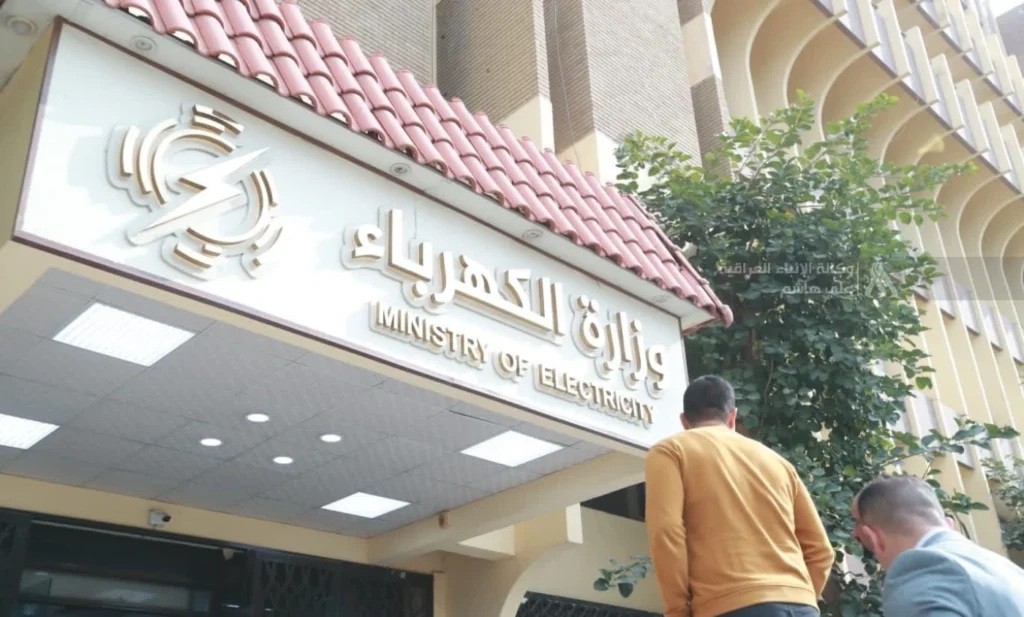
The entrance of Iraq’s Ministry of Electricity headquarters in Baghdad
Iraq says power system stable as 500 megawatts set to come online via Gulf link
BAGHDAD — Iraq’s Ministry of Electricity said Thursday the national power system is operating steadily in terms of work and production, while announcing that 500 megawatts will enter service early this year through the Gulf interconnection.
Ahmed Mousa, the ministry’s spokesperson, told the Iraqi News Agency that the ministry is coordinating with the Ministry of Oil to secure alternative fuel so generation units are not affected by low gas pressure in transmission pipelines during the winter season. He said some gas-fired units were affected when supplies stopped.
“The ministry is working on a rapid restoration to control loads,” Mousa said.
Mousa said the system is stable in operation and production, but the impact is showing in supply hours. He said combined-cycle stations rely on heat produced by simple-cycle units, and that some units do not depend on gas alone, also working on exhaust and heat generated from simple-cycle operations.
He described the Gulf interconnection as part of a broader diversification push.
“The Gulf interconnection project is a step to diversify energy sources and to bring Iraq into the energy market,” Mousa said, adding that “at the beginning of this year, the first 500 megawatts will enter service through Basra governorate.”
Iraq continues to face electricity shortages linked to fuel disruptions and seasonal demand. On Dec. 27, 2025, the ministry said total generation stood at about 17,000 megawatts and that Iraq lost between 4,000 and 4,500 megawatts after Iranian gas supplies halted.
Mousa said at the time that the cutoff was attributed to “emergency conditions,” adding that deliveries had already been reduced to about 5 million cubic meters per day out of 25 million agreed upon, with supplies to the central region and Baghdad halted and pumping limited to the south. He said the ministry was notified through an urgent cable and that Iranian officials cited low temperatures and freezing as causes of technical issues, but that Iraq did not receive a clear explanation on whether the problem involved frozen pipelines, maintenance or technical faults.
On Dec. 30, 2025, the ministry said Iraq had succeeded in stopping 71% of gas flaring linked to oil production and using it to support electricity generation. Mousa said the system was relying on national gas and fuel to generate between 18,000 and 18,700 megawatts to compensate for the halt of imported gas supplies, which he said dropped to zero due to emergency conditions and maintenance work on the Iranian side.