
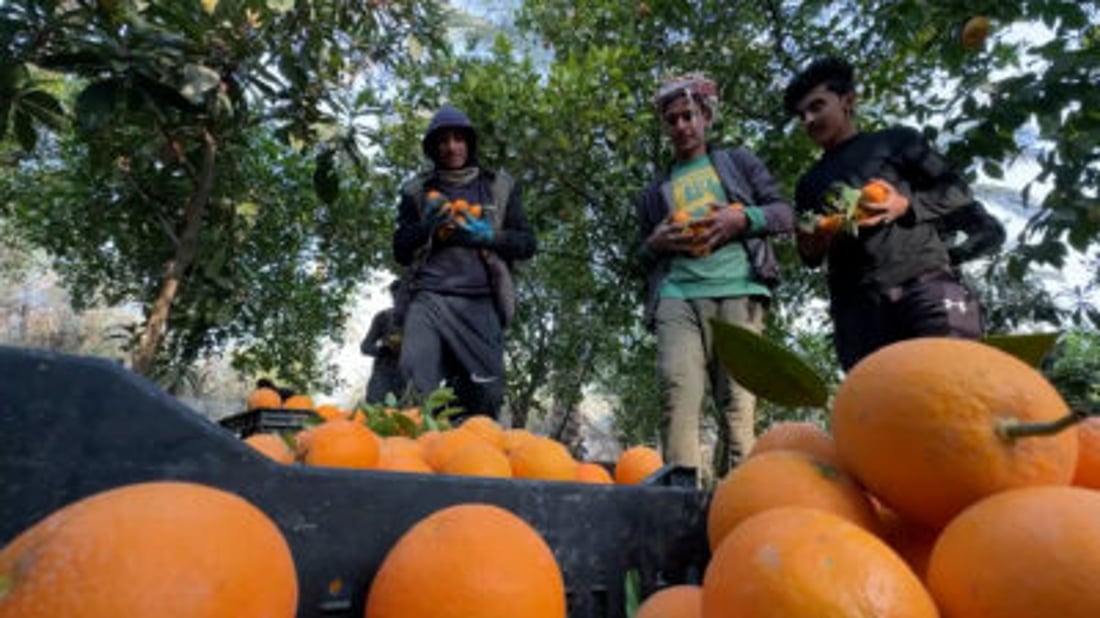
Anbar farmers harvest oranges as the season continues through late January. (Photo: 964media)
Anbar orange growers report lower harvest despite expanding orchards
ANBAR — Anbar is home to 67,271 orange trees, representing about 10% of Iraq’s total citrus stock of more than 6 million trees, according to Anbar Agriculture Directorate media head Omar Abdul-Munim.
Abdul-Munim told 964media the highest concentration of orange trees in the governorate is found in Hit, which has more than 23,000 trees spread across the city center, Al-Baghdadi subdistrict, Al-Furat area and Al-Mohammadi.
As harvest season continues through late January, farmers in Hit are picking several varieties, including those locally known as Abu Surra and the red-fleshed Mowardi. Anbar farmers have also made repeated attempts to grow the large Karbala orange, known for its size and taste, but say it does not thrive in local conditions.
Farmer Youssef Al-Nahi told 964media that while orange farming is expanding in Anbar, particularly through lease agreements between landowners and investors, overall production has declined this year.
“Last year we harvested about 150 tons. This year, it’s under 100 tons,” he said, citing a condition causing fruit to yellow and fall before ripening. The cause remains unclear, though farmers suspect cold weather or pest activity.
Al-Nahi said the Hit orange is considered the top choice among local farmers for its climate resilience, productivity and market demand. “It has a balanced sweetness and acidity, with a texture distinct from Diyala’s orange,” he said.
Farmers noted that orange trees are sensitive to both cold and intense sunlight, which makes them difficult to grow in Iraq’s climate. Traditionally, citrus orchards were planted in the shade of palm trees to soften environmental extremes.
In recent weeks, farmers in Anbar have echoed growers in other governorates such as Salah Al-Din, arguing that their citrus crops compete with the output of Diyala, long regarded as Iraq’s citrus capital.