
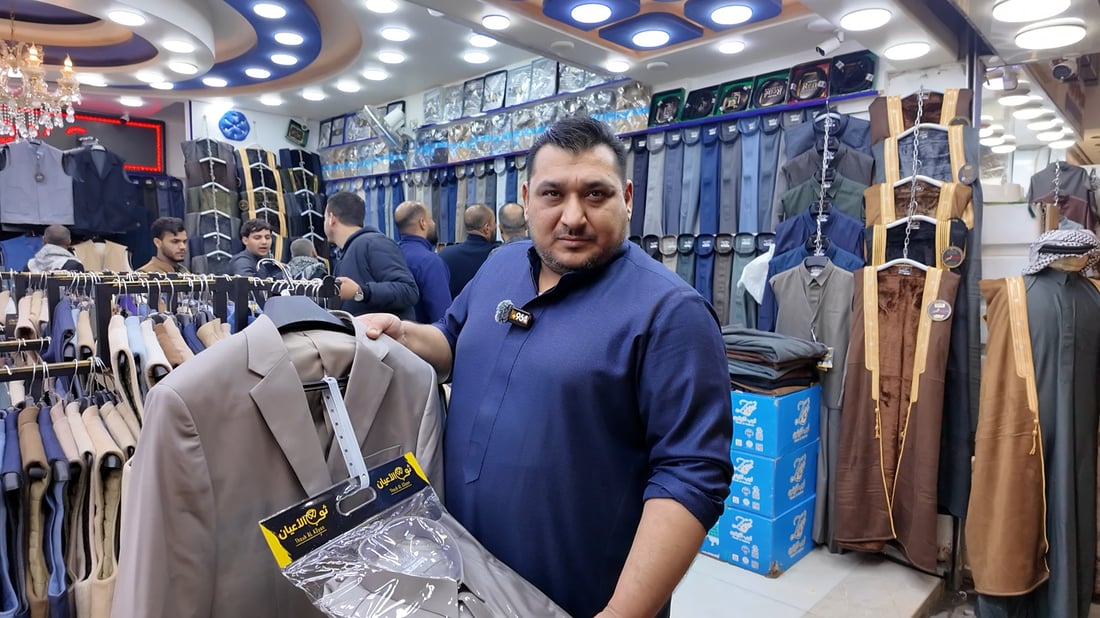
A clothing seller displays a men’s dishdasha inside a crowded shop at Najaf’s Grand Market, where demand for traditional Arab dress has increased with the winter season. Photo by 964media.
Najaf traders say traditional dishdasha is back as Iraqis blend regional styles
NAJAF — In Najaf’s Grand Market, tailors and clothing sellers say renewed interest in traditional Arab dress is reshaping how Iraqis view and wear the dishdasha, blending regional influences while rebuilding what many describe as a distinctly Iraqi identity.
After decades in which many Iraqis favored the “effendi” style, traders say men are returning to the dishdasha, ghutra and agal. They say Najaf has become a center for redesigning the full look, from the garment’s cut to its smallest details. Qatari-style collars, Kuwaiti yelaks and agals sourced from different places are now combined in what sellers describe as a modern Iraqi Arab style.
Tailor Ibrahim Hawad said his work differs from ready-made clothing. “We sew each piece according to the customer’s request,” he said. “Some ask for the Gulf Arab style with the ‘abu al-kisra,’ a front pleat, or a hidden zipper, in addition to the ‘finger collar,’ a narrow upright collar.” He said tailored dishdashas typically cost “between 50,000 and 100,000 dinars ($35–$71).”
Hawad said the process has become faster. “The dishdasha now takes about 90 minutes,” he said, adding that his customers come “from all governorates.” He said his shop uses Italian, Chinese and Pakistani fabrics “depending on the customer’s choice.”
Sellers of ready-made dishdashas argue that cost and fabric quality are their advantages. Hazem al-Khafaji, who owns a traditional clothing shop, said, “We have several types of fabrics, in addition to the Qatari collar, a shirt-style neckline, and the classic concealed style. Solid and striped designs are available, and today the demand is for the ‘honeycomb’ pattern,” a textured fabric, “tailored at the waist.”
Al-Khafaji said ready-made garments offer better value. “The ready-made sizes are better than tailoring, and the fabric used is first-grade and better than what tailors use,” he said. Prices, he added, “start from 20,000 to 35,000 dinars ($14–$25).” He said the Italian and English fabrics used in imported dishdashas are sourced “from China and Dubai.”
He said tailoring fees average 25,000 dinars ($18), with fabric costs ranging from 15,000 to 50,000 dinars ($11–$35). “You can buy a ready-made dishdasha for 25,000 dinars ($18), which can equal the price of three tailored ones,” he said. Al-Khafaji said sales peak in winter, summer and during the month of Muharram.
Customers said choice and quality drive their purchases. Ali Maher, a shopper in the market, told 964media, “I bought a honeycomb-pattern dishdasha made of English fabric, and I preferred the Kuwaiti yelak, a winter outer layer. It is first-grade, single-faced and fur-lined, and there are several types available in the market.”