
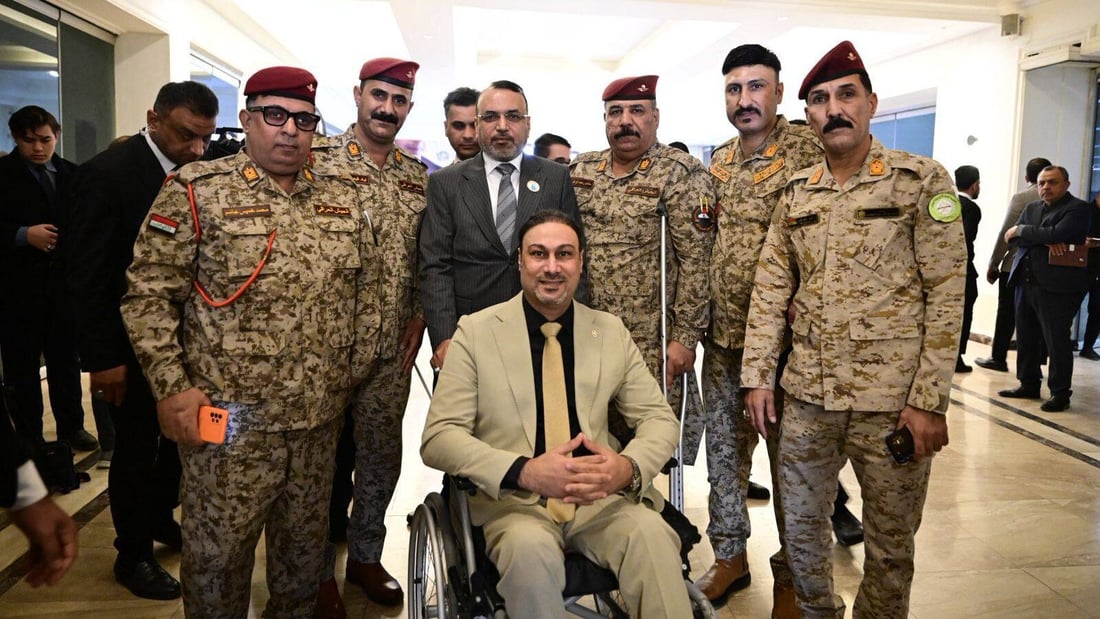
Labor and Social Affairs Minister Ahmed al-Asadi sits with Iraqi security personnel during an event marking the International Day of Persons with Disabilities in Baghdad.
Iraq unveils long-term disability inclusion plans, shifts focus to economic empowerment
BAGHDAD — Labor and Social Affairs Minister Ahmed al-Asadi said Saturday that his ministry is committed to supporting and empowering people with disabilities, stressing a shift from a care-based approach to seeing them as active partners in society and decision-making.
Al-Asadi spoke at an event marking the International Day of Persons with Disabilities, organized by the Iraqi Gathering of Persons with Disabilities on Dec. 13, 2025. “The Ministry of Labor and Social Affairs is committed to supporting and empowering people with disabilities and strengthening their role as active partners in society and in decision-making,” al-Asadi said, adding that this group “is not merely a recipient of care, but a real partner in decision-making and in creating social impact.”
He announced the launch of the National Plan for Economic Empowerment of Persons with Disabilities for 2026-2029, along with the National Strategy for the Inclusion of Persons with Disabilities for 2026-2030, framing them as part of a broader move to embed disability rights into state policy rather than short-term projects.
Al-Asadi said the plans were developed with the participation of organizations, leaders and activists from the disability movement. “Gatherings and associations of persons with disabilities in Iraq had an important and appreciated role in providing advice, vision, and observations,” he said, describing their involvement as central to shaping the new approach.
He said the ministry has set out a national path based on three main pillars, which he described as “the transition from care to economic empowerment and opening the labor market to effective and productive participation,” “preparing a barrier-free environment through developing legislation, improving infrastructure, and expanding digital transformation,” and “guaranteeing basic rights in health, education, protection, and community participation in line with international standards and precise follow-up mechanisms.”
Al-Asadi said the new frameworks are “not temporary promises, but state commitments and practical steps being implemented according to clear timelines and measurable performance indicators.” He added, “We believe in the necessity of keeping the voice of persons with disabilities present and a partner in decision-making, not a number in reports nor a margin in documents.”
In a separate note during the event, al-Asadi congratulated Iraq’s amputee national team on qualifying for the 2026 World Cup in Costa Rica, calling the achievement “a bright page in the record of Iraqi sports” and “clear evidence that willpower can make the impossible possible.”
In Iraq, the rights and salaries of persons with disabilities are governed mainly by Law No. 38 of 2013, which guarantees equality, protection from discrimination, access to health care, education, rehabilitation and participation in public life, as well as a 5 percent public-sector employment quota. Those unable to work receive monthly benefits from the Ministry of Labor and Social Affairs, usually ranging from about 250,000 to 500,000 Iraqi dinars (around $175 to $355) depending on the degree of disability, with extra allowances for severe cases. Persons with war- or terrorism-related disabilities receive higher benefits, though access to jobs and services still varies by governorate.