
(Photo: Al-Sudani's media office)
Monitor
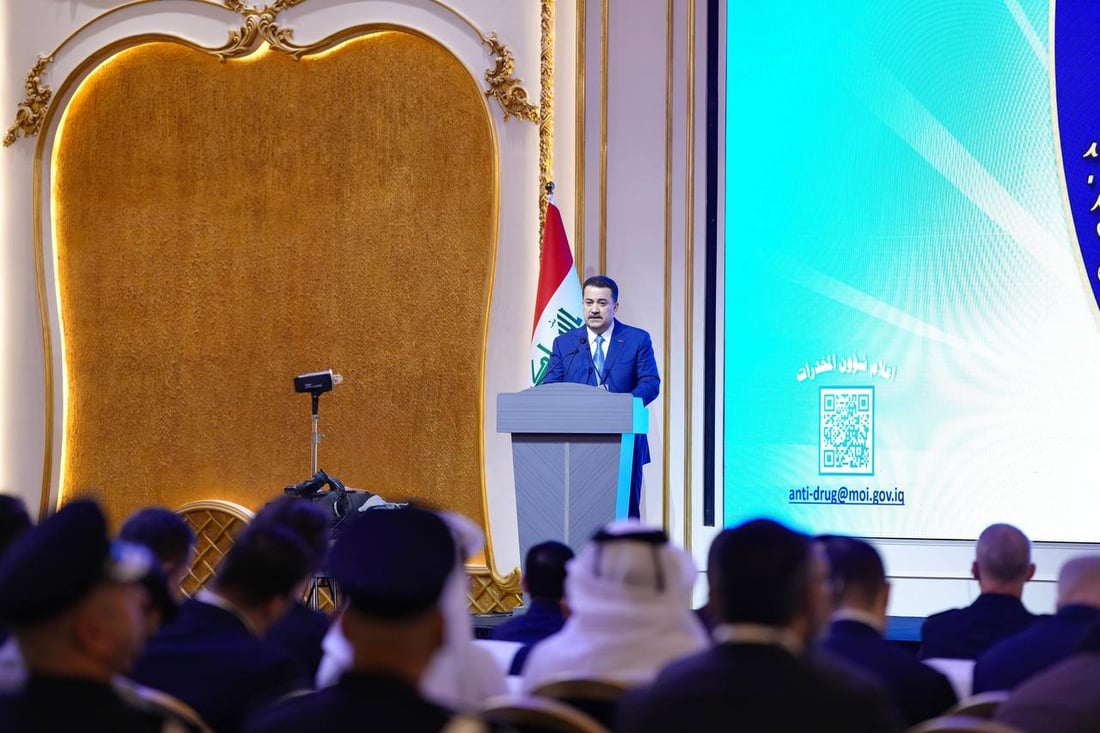
Sudani opens Baghdad drug-control conference, vows tougher fight on trafficking
BAGHDAD — Prime Minister Mohammed Shia al-Sudani on Sunday opened the Third Baghdad International Conference on Drug Control, presenting the event as a cornerstone of Iraq’s national and regional strategy to confront narcotics, while Interior Minister Abdul Amir al-Shammari detailed expanded security measures, rising enforcement capabilities and deeper international cooperation.
Delegations from 12 countries attended the two-day conference, held Dec. 7–8 in Baghdad.
Al-Sudani warned that drug trafficking and addiction are driving broader instability in Iraq. “The dangerous scourge of drugs contributes to the spread of crime, corruption, and social and familial disintegration,” he said, stressing that combating narcotics requires dismantling networks and protecting vulnerable groups through both security and rehabilitation programs.
He said the government had adopted the 2023–2025 National Anti-Drug Strategy, enacted legal amendments, and expanded treatment capacity, including “15 compulsory drug rehabilitation centers in Baghdad and the provinces.” More than 5,000 personnel have completed 184 specialized training courses, he said, alongside new international agreements to strengthen cooperation and intelligence sharing.
Speaking at the same conference, Interior Minister Abdul Amir al-Shammari said Iraq has strengthened its security architecture to counter what he described as “a cross-border” challenge requiring sustained collective action. He said the annual conference provides a professional platform for exchanging expertise, identifying emerging threats and developing evidence-based solutions.
Al-Shammari said prior editions of the conference had established “a new model of security cooperation based on transparency and a unified vision,” improving direct channels for intelligence sharing on trafficking networks, launching training initiatives, and reducing bureaucratic barriers that slowed information exchange.
He cited recent Interior Ministry data illustrating the scope of the threat and the scale of enforcement. On Nov. 25, 2025, the ministry reported dismantling 1,201 drug-trafficking networks — 1,030 local and 171 international — over the past three years, and seizing more than 14 tons of narcotics. Courts issued 23,118 rulings in drug cases, including 300 death sentences and 1,147 life sentences. The ministry reported 274 armed clashes linked to counter-narcotics operations, seven officers killed and 90 wounded, and the seizure of 3,307 weapons and 4,462 vehicles.
Al-Shammari said these figures reflect both the scale of the problem and the state’s intensified response. He said the Baghdad conferences have become “a stable annual platform” that deepens trust among regional and international partners, allowing security agencies to review achievements, update priorities and coordinate future operations.
He said confronting drugs remains “a continuous battle” that requires intelligence-sharing, border and port control, unified analytic tools, updated legislation, specialized training and international cooperation. He added that Iraq’s engagement with interior ministries in partner countries has delivered “positive and tangible results,” including joint operations and the disruption of networks exploiting regional gaps.
Both leaders said Iraq will continue expanding its multi-level approach combining security, prevention, treatment and cross-border coordination, with al-Sudani calling the country’s anti-drug effort a central component of safeguarding public health and national stability.