
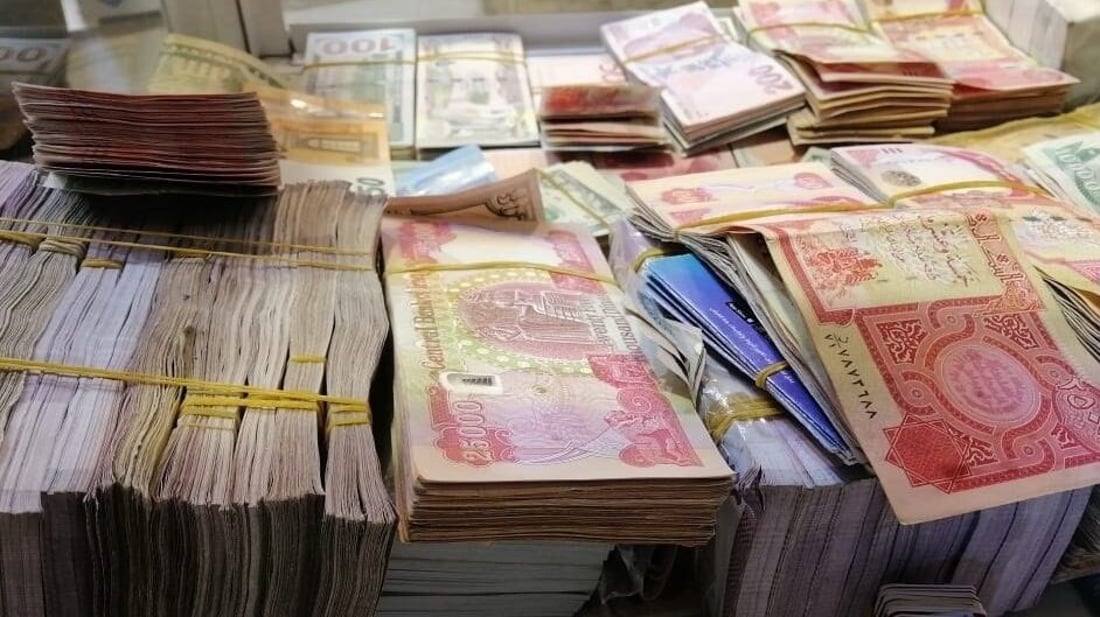
FILES: Stacks of Iraqi dinar and U.S. dollar banknotes at a currency exchange in Baghdad.
Payment dispute escalates
Diyala contractors say finance minister bears responsibility for treatment of union chief
DIYALA – The Diyala Contractors Union on Saturday said it holds Iraq’s finance minister responsible for any harm that might befall the head of the national contractors union, escalating a confrontation over long-delayed payments for completed public projects.
In a statement, the Diyala union said it “holds the finance minister fully responsible for any insult or harm that may befall Mr. Ali Fakher al-Sanafi, president of the Iraqi and Arab Contractors Union, as he is the first defender of contractors’ rights and the voice expressing their just demands.” It said al-Sanafi performs his duties “within legal and official procedures,” and warned that any attempt to target him “directly or indirectly” because of his positions “will be considered unacceptable conduct, and those behind it bear legal and moral consequences.”
The statement came a day after the Finance Ministry rejected comments al-Sanafi made in a televised interview about stalled payments. In its response, the ministry said the minister “did not receive any female member of parliament to negotiate debts,” calling the claim baseless.
The ministry said it had provided the union’s representative with Cabinet Decisions 435 and 721 of 2025, which allocated 2 trillion dinars (about $1.43 billion), along with tables covering 25 percent of contractors’ dues. It said it had financed 1,371,451,904,190 dinars (about $979.6 million) for ministries and 1 trillion dinars (about $714 million) for governorates, and that remaining delays were linked to requests from the Planning Ministry. It added that all measures were taken “with the knowledge and approval of the union’s representative and his personal attendance at meetings,” and said it reserves the right to pursue legal action against media outlets promoting “misleading information.”
In his interview on INEWS, al-Sanafi said the government paid “only 30% of the dues for bottleneck-relief projects,” and claimed the minister had avoided meeting contractors “for two months.” He said a female lawmaker had been sent, as he described it, to relay a message from the Finance Ministry telling contractors that “there is no money” and that projects should be halted.
He said companies working on bridges were “the most harmed,” with many receiving “20 to 25% at best,” and alleged that some officials told companies to secure direct approval from the Finance Ministry for payments.
Contractors’ unions across multiple governorates have issued similar warnings over the past weeks. On Wednesday, the Diyala branch said workers would bring machinery into the streets and block roads if payments remain frozen. Union member Ismail Barhoumi said dues owed to contractors nationwide had reached 30 trillion dinars (about $21.4 billion) over the past year and a half and warned that key projects in the governorate, including hospitals, water systems and road paving, would stop.
Barhoumi cited the case of a contractor jailed over 120 million dinars (about $85,700) in debts while the government still owed him 1.7 billion dinars (about $1.21 million). “The government must fulfill its promises. All these projects were built with contractors’ money, not its own,” he said.
In Dhi Qar, deputy head of the contractors union Hussam Aqil al-Sakkar al-Saeedi said more than 30,000 families tied to the sector had lost their income due to halted payments. He said 800 of the governorate’s 1,200 vital projects face collapse and that companies may halt all work if dues are not released.
Contractors have also protested in Baghdad. On Oct. 15, unions from across Iraq demonstrated outside the Finance Ministry to demand the release of unpaid dues. Basra union head Hussein al-Maliki said delays threaten thousands of jobs and could cause “near-total paralysis” in service projects, adding that protests will continue until funds are paid.