
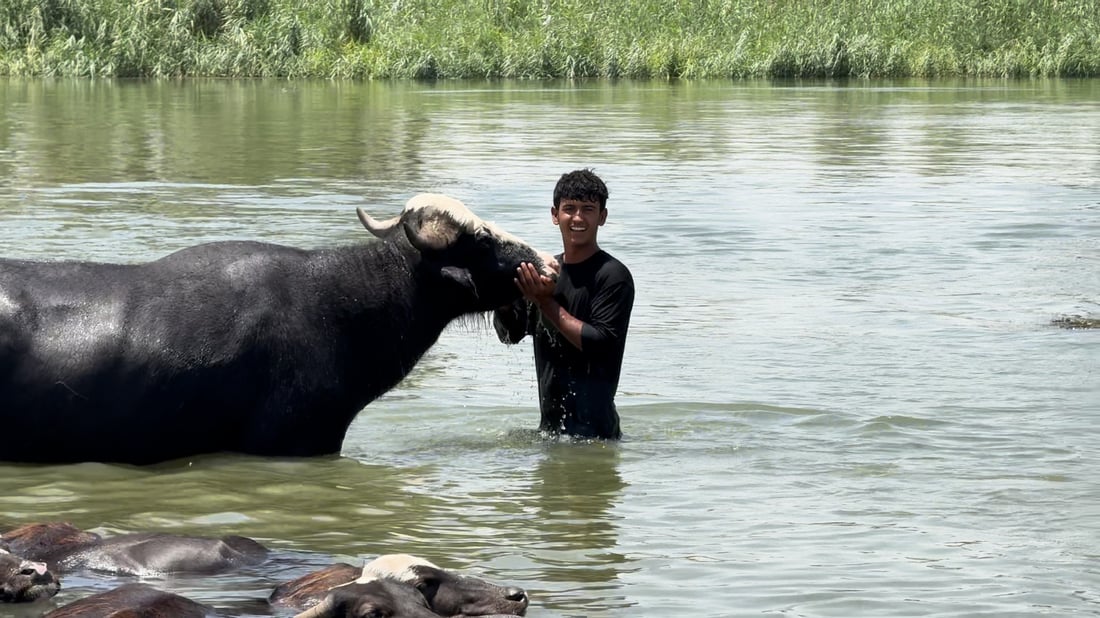
A buffalo herder cools off with his animals in Shatt al-Mishkhab, south of Najaf, as water levels rise following increased discharges from the Kufa Barrage. Photo by 964media
UN agency urges urgent support for Iraq’s buffalo herders as water crisis deepens
BAGHDAD — The UN Food and Agriculture Organization in Iraq said Wednesday the government has launched programs to support buffalo herders and urged urgent measures to help families stay in their communities as water shortages worsen.
Salah El Hajj Hassan, the organization’s representative, told the Iraqi News Agency that “buffalo herders in the marsh areas are facing challenges due to water scarcity and quality,” noting that those who rely on water and buffalo breeding as their main income “have faced challenges that forced some of them to move to other areas.”
He said the government “contributed by launching programs to support herders through the distribution of feed materials,” and that talks are underway on how to expand assistance “at all levels” to soften the impact of shifting conditions. He called for “short-, medium- and long-term measures to ensure herders and farmers remain in their areas and limit movement from one location to another,” stressing that “buffalo breeding is tied to the water source, and if there is no water, the herder will have to move to another place within the marshes.”
Iraq has long been home to water buffalo raised for milk, meat and traditional dairy products such as kaymak, cheese and yogurt. Families in areas including Kut, Baghdad and the southern marshlands depend on buffalo breeding as a primary livelihood, often using skills passed down over generations. In places such as Al-Battar in Wasit governorate, residents continue to produce buffalo dairy using milk that is heated, cooled and skimmed through a lengthy process that has supplied local markets for decades.
Because the animals spend long periods in water to regulate their body temperature, herders historically settled beside rivers, wetlands and muddy banks of the Tigris and Euphrates. As natural water sources dried up, many have shifted to wells, artificial ponds or trucked-in water from distant filtration plants. Herders in Najaf said they moved from the Euphrates banks to desert farms, digging wells and building ponds to keep herds alive. Some have reduced herd sizes due to high feed costs, while others say buffalo can adjust to well water over several days.
The country’s prolonged water crisis has pushed marsh communities to the brink. Wetlands in Dhi Qar and Maysan have shrunk sharply, leaving herders without reliable natural water and forcing some families to sell their animals or relocate. Residents have warned they have “no water to drink” and described their areas as “disaster zones” as marshes turn to dry land. Local officials say buffalo numbers in some districts have fallen by nearly half, while water authorities report that reserves are at their lowest levels in decades and inflows from major rivers have dropped, directly threatening Iraq’s buffalo population and the families who depend on it.