
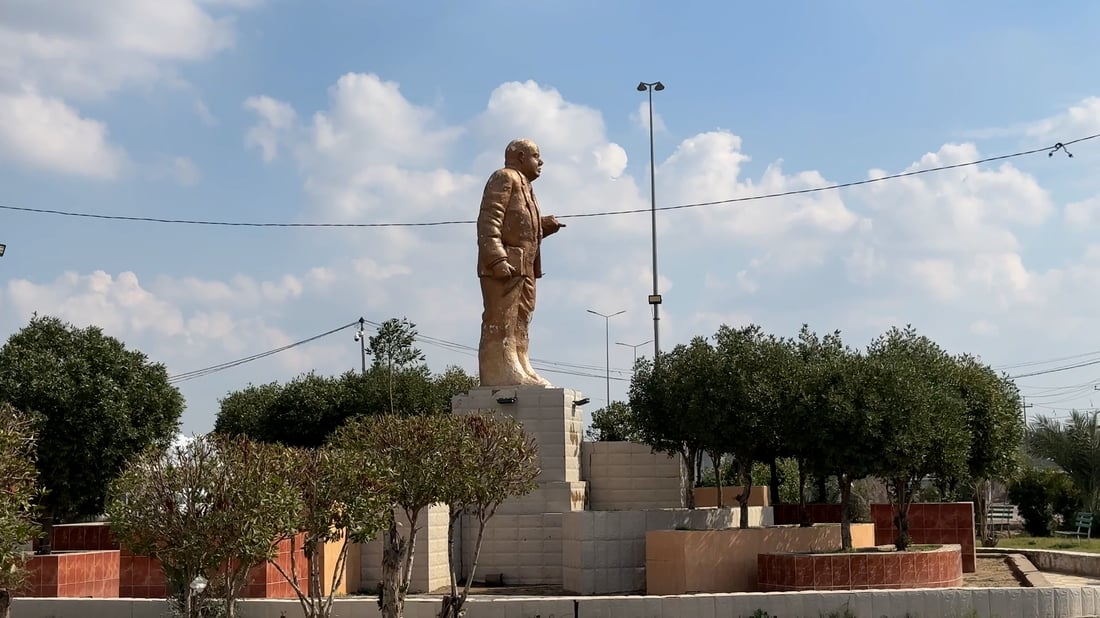
The statue of Mustafa Jawad in Khalis stands on a raised platform surrounded by trees and walkways. Photo by 964media.
New Mustafa Jawad statue model sparks backlash in Diyala
BAGHDAD — The Ministry of Culture has unveiled the first model of a new statue of renowned Iraqi scholar Mustafa Jawad to replace a previous monument removed from the Khalis roundabout, but the design has already drawn sharp criticism from sculptors in Diyala who say it fails to resemble him and lacks presence.
Artists have also rejected the use of fiberglass for the piece, insisting the final statue must be cast in bronze.
Mustafa Jawad (1904–1969) was one of Iraq’s most prominent linguists, researchers and historians and is widely remembered for his radio program “Say It, Don’t Say It,” which shaped public understanding of classical Arabic.
Objections to the new maquette quickly reached Diyala Governor Adnan al-Shammari, who met several local sculptors and said he would recommend that the Culture Ministry assign an artist from Diyala to execute the final work and abandon fiberglass in favor of bronze.
In mid-November, the Khalis municipality said the removal of the previous statue was part of renovation efforts at the roundabout and that a new monument would be created “in a form befitting his stature.”
Mushtaq Abbas al-Khadran, a sculptor and academic, told 964media that the old monument had been worn down by “accumulated factors, environmental conditions, and repairs,” making replacement necessary. He said it is possible to separate the pose of the new model from its weak likeness.
“If we want to be fair to the artist who made the maquette, we only take from it the movement, not the detail,” he said. “The resemblance is absent, and you cannot show features in an 80-centimeter model.” He added that he does not imagine Jawad with the hand gesture shown in the model, saying that while each sculptor has a personal vision, the final statue must reflect the scholar’s standing.
Al-Khadran said the material is just as important as the form. Bronze, he argued, is the appropriate choice for a public monument.
“Bronze is a sacred material and better than fiberglass,” he said, adding that fiberglass might be suitable for indoor pieces but not for prominent outdoor works. He said the governor rejected the use of fiberglass and “stressed that it be made of bronze.”
Dhurar al-Fadaam, a sculptor from Khalis, told 964media the proposed design “is far from the original and lacks many elements, most importantly the resemblance,” adding that the statue must carry visual weight because it will stand in the center of the town.
Shakir al-Rubaie, an educator, said Jawad’s legacy has been tied to Khalis for decades and that residents expected a stronger work.
He said the new model “was not appropriate and bore no relation in likeness or shape,” and urged a review of the design, noting that photos and Jawad’s relatives are available as references to improve accuracy.
Governor Adnan Mohammed told sculptors during their meeting that honoring local creators is a duty and that “a statue of a figure of Mustafa Jawad’s stature must be in the proper form.” He said the artist entrusted with the work should pay attention to all details because “any mistake will be our responsibility — the local administration, the syndicate, and the sculptors.”