
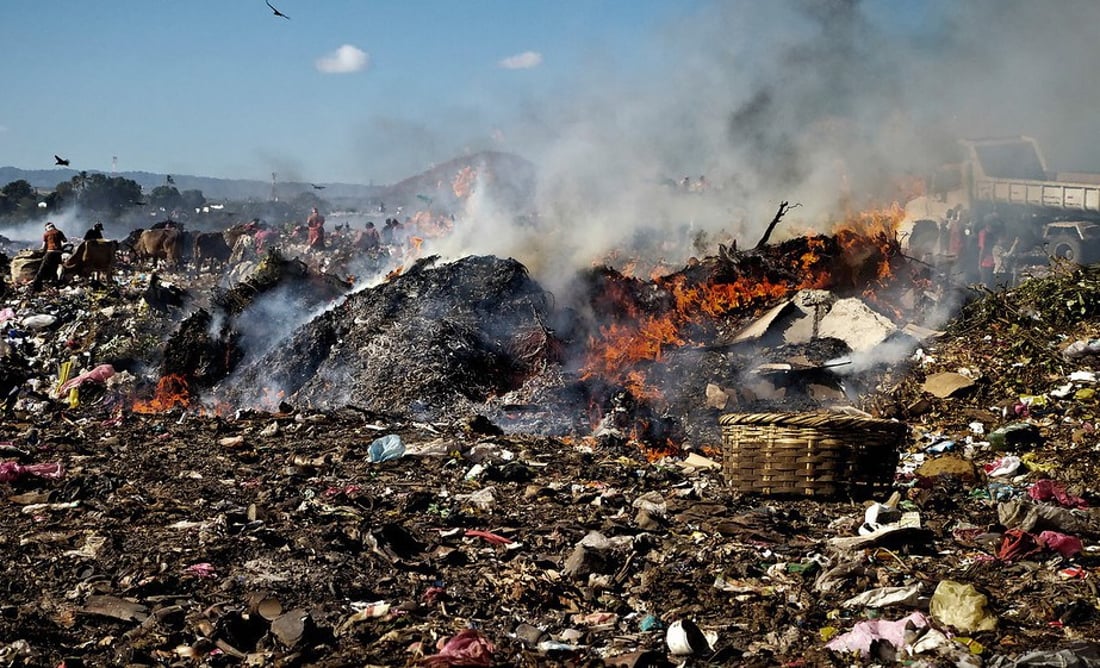
Burning waste at an open landfill
Baghdad plans waste-to-energy plants to process 3,000 tons of garbage a day
BAGHDAD – Baghdad Municipality said Saturday it has secured land in Nahrawan and Abu Ghraib for large waste-to-energy projects, including a plant that will burn 3,000 tons of garbage per day to generate 100 megawatts of electricity, in a shift away from traditional landfill dumping.
Municipality spokesperson Uday al-Jundeel told the state news agency that Mayor Ammar Musa Kazem has approved a plan to “benefit from waste instead of burying it using traditional methods.” He said the municipality worked with the National Investment Commission to offer waste sites as investment opportunities, and that a specialized Chinese company “won the project and received the worksite” and has begun soil testing.
Al-Jundeel said the facilities in Nahrawan will rely on fourth-generation waste-to-energy technology similar to systems used in Germany and will operate under “advanced environmental standards.” At present, Baghdad trucks garbage to sanitary landfill zones outside the capital, but officials say the goal is to turn municipal waste into power while cutting reliance on dumping and open burning.
He added that a second project is being prepared in Abu Ghraib, where a comprehensive plan is under study for what would be Iraq’s first modern waste-recycling plant. Once technical reviews are complete, he said, that project will also be offered to investors.
Waste disposal has long been one of Iraq’s most persistent environmental and public-health problems. In many areas, garbage is dumped in open sites and routinely set on fire, sending toxic smoke into nearby neighborhoods. In Babil governorate, residents of Siyaha say more than 100 cancer cases were recorded in the past year alone and link the illnesses to repeated fires at the Siyahiya landfill. Similar complaints have emerged from Nineveh’s Rabia subdistrict, where a landfill established in the 1960s is now hemmed in by housing and blamed for respiratory problems.
Local officials acknowledge that Iraq still relies heavily on unregulated or temporary dumping grounds, with few recycling or treatment facilities in service. The Najaf Environment Directorate says the governorate has more than 24 landfill sites, most of them unauthorized and environmentally noncompliant, leaving municipalities dependent on makeshift solutions. In Babil’s Neel area, residents say scavenger-set fires at the Siyahiya dump have created long-standing hazards, while in many cities waste is simply buried under soil in the absence of modern processing systems.
Baghdad Municipality says the planned waste-to-energy plant is expected to ease pressure on overloaded landfills and add 100 megawatts to Iraq’s strained power grid, providing cleaner waste handling alongside a modest boost in electricity supply.