
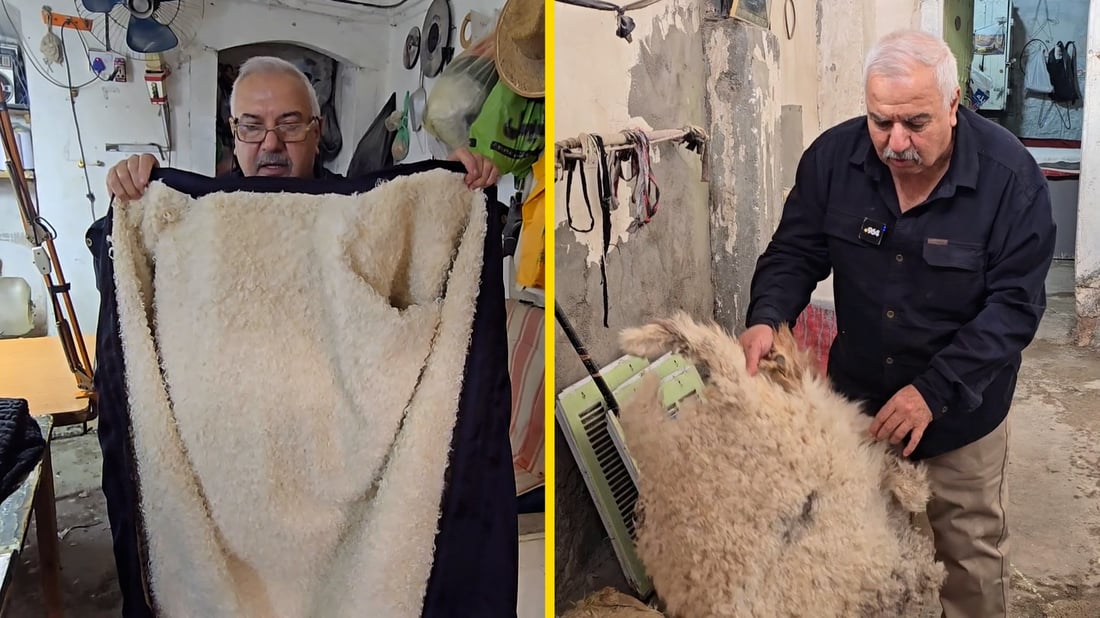
Craftsmen in Mosul prepare and display sheepskin hides as they make traditional winter frawi coats in workshops in Bab al-Tob and Faisaliya. Photo by 964media.
Mosul craftsmen race to meet winter demand for farwa sheepskin coats
MOSUL — As winter approaches, craftsmen in Mosul are working to meet rising demand for farwa coats, the long sheepskin garments traditionally worn for warmth across Iraq and the Gulf. A farwa is made from lamb or sheep hides with the wool kept on the inside, producing a heavy, insulating coat that remains popular among shepherds and desert communities.
In the Bab al-Tob area on the city’s right bank, artisans Nafi Mohammed and Issam Tali run a workshop that turns raw hides from southern governorates into coats that can sell for up to 1.5 million dinars ($1,071).
Hides arrive from Maysan, Wasit and Najaf, as well as from the Jazira area west of Nineveh. The material undergoes more than two months of preparation before becoming a finished piece roughly 120 to 125 centimeters long and one meter wide.
“We bring the sheep hides from Najaf and Maysan or from the Jazira area west of Nineveh,” Nafi Mohammed told 964media. “They go through stages: we put them in water, then we add salt, then they are hung in the air for 24 hours. After that, the remaining meat and fat are removed, then the hide is softened by machine, and then the sewing begins.”
He said the hides are stored “after washing with water and salt, and they stay for 40 days.” Mohammed added, “We have customers from Gulf countries such as Qatar, Saudi Arabia, and Kuwait, and from Iraqi governorates, especially Baghdad, and from districts and subdistricts of Nineveh, especially al-Ba’aj. Prices range between 100,000 dinars and 1.5 million dinars ($71 to $1,071).”
Once prepared, the pieces are taken to workshops in the Jowader market in the Faisaliya area on the left bank, where dark fabric linings are added and finished coats are displayed for buyers, including shepherds from the steppe stretching from Rabia to Zubair. The workshop also exports to Saudi Arabia and other Gulf states.
Tali described the finishing stages. “The farwa is usually 125 centimeters long and one meter wide,” he said. “After washing and drying the hide, it goes through a stage of removing extra fat and meat by hand for 10 minutes. Then it enters the ‘jawzlan’ process, which makes the hide soft like cloth using a machine, and the process takes 10 minutes.”
He said tailoring involves “cutting the hide into squares and sewing them together to form a full coat.” The finished piece weighs between 1 and 4 kilograms. “The lighter it is,” he said, “the higher its price.”
Craftsmen say demand rises sharply as temperatures drop, and the coat’s durability and warmth make it one of the most sought-after winter garments in Iraq and the wider region.