
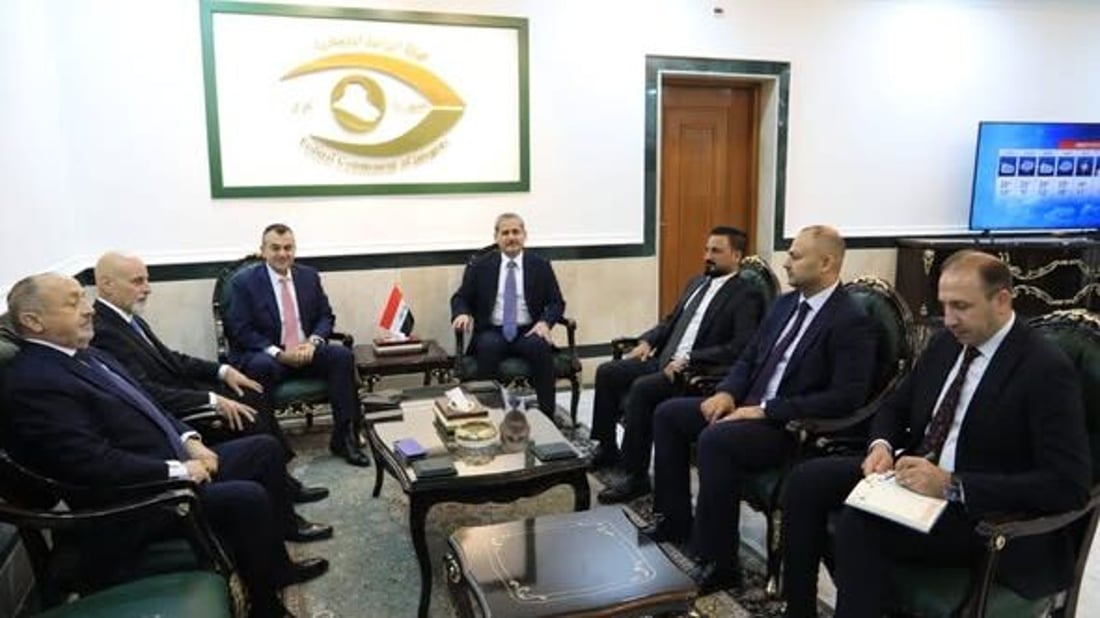
Iraq’s Integrity Commission chief Mohammed Ali al-Lami meets with Soufan Group director Ali Soufan during a session focused on asset recovery and corruption cases.
51 corruption suspects returned as Iraq expands global asset-recovery push
BAGHDAD — Iraq’s Integrity Commission chief said Monday the body is intensifying efforts to recover smuggled funds and bring back fugitives wanted on corruption charges, announcing that 51 suspects were recently returned to the country as part of ongoing international cooperation.
The commission said its head, Mohammed Ali al-Lami, “seeks to complete the procedures for handing over those wanted in corruption cases and recovering smuggled funds,” praising support from judicial, executive, and international partners.
In a meeting with Ali Soufan, director of the Soufan Group, al-Lami said Iraq’s past instability allowed illicit funds and corruption suspects to slip abroad, but stressed that authorities are now pursuing cases “in all parts of the world.” He said the commission “managed during the past period to recover 51 of those wanted in corruption cases from outside Iraq.”
The Soufan Group, an international intelligence and security consultancy headquartered in New York, signed a cooperation agreement with the Integrity Commission during the meeting. The partnership aims to strengthen Iraq’s asset-recovery efforts through capacity-building, legal and technical support, and the integration of modern investigative tools.
According to the commission, the agreement covers cooperation on tracing and recovering assets, repatriating convicted individuals, and expanding diplomatic and law-enforcement coordination. It also includes support for drafting bilateral agreements and memoranda of understanding to facilitate international cooperation.
The partnership focuses heavily on training — including digital transformation, financial-crime investigation, use of AI-based tools, detection of forged documents, and advanced interrogation and behavioral-analysis techniques — as well as improving communication channels with foreign authorities, including Interpol.
The commission said the agreement is intended to strengthen its institutional capacity and accelerate efforts to retrieve stolen public funds and apprehend fugitives abroad.