
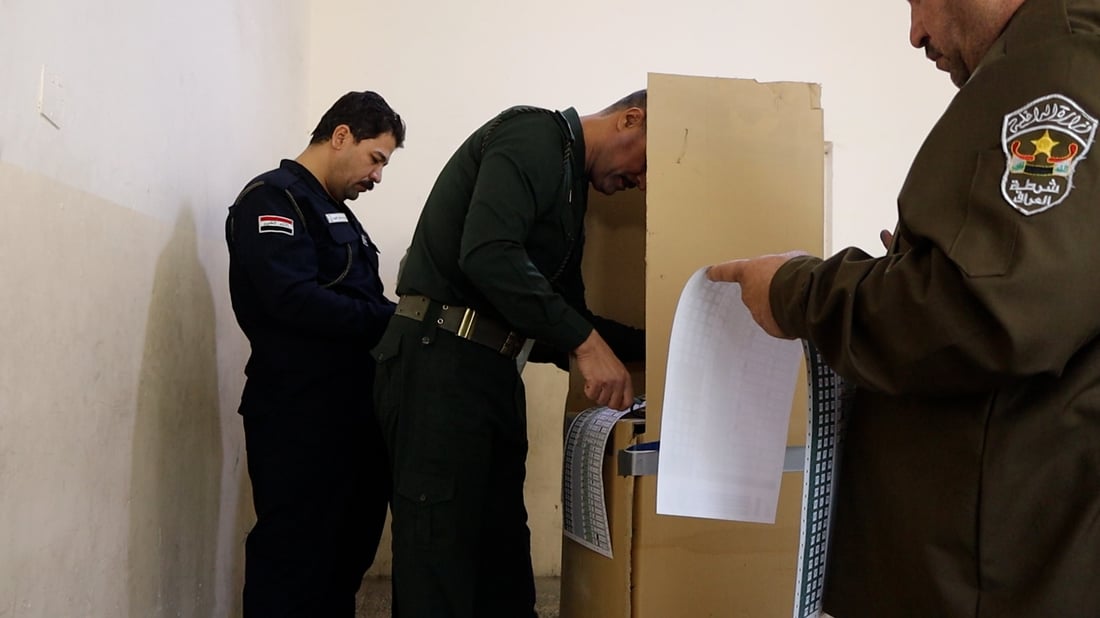
Members of Iraq’s security forces cast their ballots at a polling station during special voting for the 2025 parliamentary elections on Sunday, November 9, 2025.
Observers log 1,841 procedural violations during Iraq’s special voting, mostly over ballot secrecy
BAGHDAD — The Iraqi Election Monitoring Networks Coalition said Sunday it recorded 1,841 violations across all governorates by noon during the special voting process, noting that most cases involved breaches of ballot secrecy, such as group voting or the use of mobile phones inside polling stations.
Hogir Chato, general coordinator of the Shams Network, told 964media that the group does not classify the cases as breaches but rather as procedural violations. “By 12 p.m., the total number of cases, which we do not call ‘breaches’ but ‘violations’ for not following procedures, reached 1,841 across all Iraqi governorates,” he said.
“These violations mainly focused on issues related to the lack of ballot secrecy, often due to group voting or bringing mobile phones into polling stations,” Chato said. “Another portion of the violations was related to the continuation of election campaigns during the silence period, as several cases were observed in this regard.”
He added that monitoring teams also recorded incidents linked to vote buying. “Our field teams documented the presence of vehicles and individuals outside polling centers who, based on footage captured by observers, were seen distributing money,” he said. “These scenes were also shared widely on social media.”
Chato said other violations included the incomplete application of electoral procedures, such as not explaining the process to all attendees, and delays in opening some polling centers caused by staff arriving late or minor technical malfunctions in devices. “Some representatives of political entities and observers were also excluded from certain polling stations,” he said.
The coalition noted that voter turnout by midday was high, particularly among security forces. “Reducing the number of voters per station to 300 helped ease pressure on the commission and facilitated the management of the voting process,” Chato said.
He added that the biometric and facial recognition systems functioned smoothly. “Most fingerprint and face-reading cases were handled satisfactorily, with only one or two isolated issues reported,” he said, adding that each polling station is allowed up to a five percent margin for bypassing fingerprint verification.
Earlier in the day, Hasan Hadi, a member of the Independent High Electoral Commission’s media team, said the special voting process was proceeding “in complete secrecy and without any pressure from any party.” He clarified that the mid-day report issued by the commission contained only general data, such as the number of voters and the type of polling stations, stressing that no individual voting information could be accessed.
Interior Minister Abdul Amir Al-Shammari said during a visit to Baghdad that the voting was taking place “smoothly across all governorates.” He noted that security personnel were transported to polling centers “in organized groups to ensure ease of voting,” adding that the “security situation around all centers is stable and fully controlled.”
Judge Omar Ahmed, head of the commission’s Board of Commissioners, also confirmed that all polling stations were “fully equipped with logistical materials, electronic devices, and trained staff to guarantee transparency and smooth operations.”
According to the Independent High Electoral Commission, special voting began Sunday at 7 a.m. across Iraq and the Kurdistan Region, allowing 1.3 million security personnel and 26,000 displaced voters to cast their ballots ahead of the November 11 parliamentary elections. By midday, turnout had reached 60 percent, with the highest participation recorded in Sulaymaniyah (78%), followed by Erbil (77%), Duhok (76%), Diyala (69%), and Nineveh (68%).