
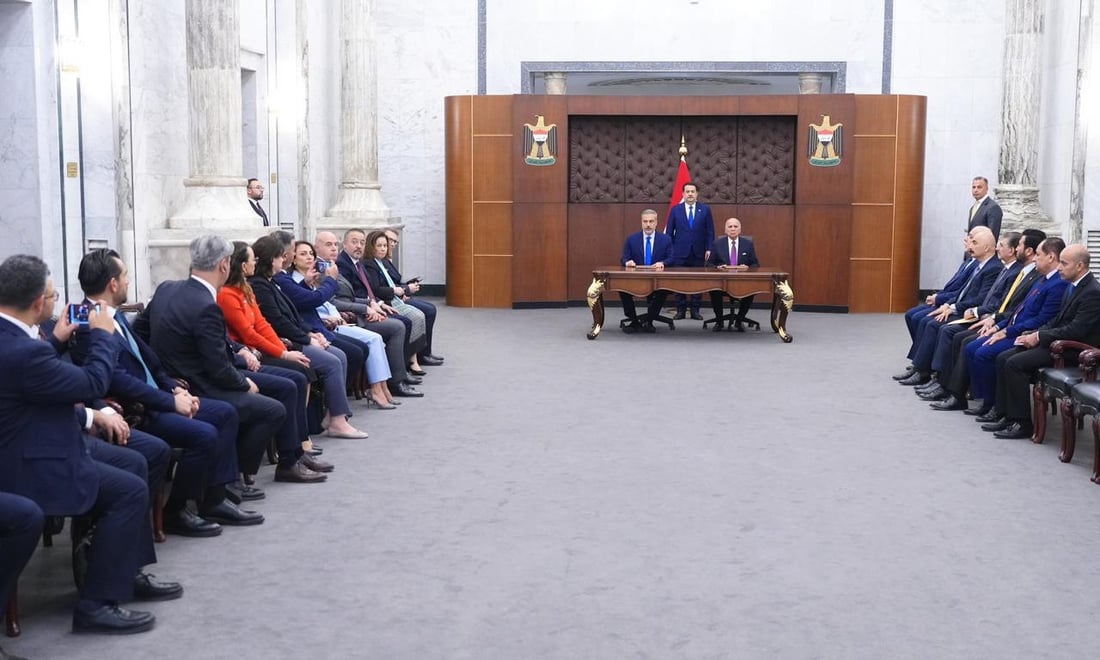
PM Al-Sudani oversees the signing ceremony of the Iraq-Turkey executive water cooperation agreement in Baghdad on Sunday.
Media Monitor
Iraq must tie newly-signed water deal to Turkish commercial interests, says economic expert
BAGHDAD — Economic expert Ziad Al-Hashimi said Iraq’s critical water shortages cannot be resolved without a binding agreement with Turkey that ties increased water flows to Turkish commercial operations inside Iraq.
In a statement published Wednesday on his Facebook page, Al-Hashimi argued that the presence of Turkish companies would compel Ankara to release more water, as these firms cannot function without sufficient supply.
Al-Hashimi noted that Iraq has entered a state of severe water emergency and does not have the luxury of waiting years for international arbitration outcomes. He said prior governments failed to secure water quotas due to the lack of binding protocols and Turkey’s refusal to ratify several international treaties.
On Nov. 2, Iraq and Turkey signed an executive mechanism for their water cooperation agreement in Baghdad, attended by Prime Minister Mohammed Shia Al-Sudani and Turkish Foreign Minister Hakan Fidan.
Al-Hashimi concluded that a water agreement alone is not sufficient unless it is structured to align with Turkish economic interests in Iraq: “This agreement will not benefit Iraq water-wise without Turkish companies operating in Iraq — and their presence is what will compel the Turkish government to increase water releases.”
Iraq is facing its most severe water crisis in 80 years, with reserves at historic lows following another weak rainy season. Officials have attributed the shortages to climate change, prolonged drought, and upstream dam construction in Turkey and Iran.
The newly signed agreement between the two countries outlines a series of practical steps for cooperation between Iraq’s Ministry of Water Resources, Ministry of Construction, Housing, and Municipalities, local governorates, and Turkish partners. It identifies four main areas of focus: improving water quality and stopping river pollution, modernizing irrigation systems, rehabilitating agricultural lands, and enhancing governance in water management and conservation.
Full statement by economic expert Ziad Al-Hashimi:
As is well known, Turkey has built numerous dams and water reservoirs over the past decades for two main purposes: first, to generate electricity through dams and reduce its dependence on purchasing oil and gas for power generation; and second, to supply wider agricultural areas with water.
In recent seasons, Turkey has experienced a significant decline in rainfall and snowfall levels. Rainfall decreased by more than 27% this year compared to the reference average, leading to unprecedented low water levels in Turkish dams and reservoirs.
This drop in water levels in Turkey directly affected the volume of water releases to the Tigris and Euphrates rivers, causing a serious deterioration in Iraq’s water share from these rivers.
Previous Iraqi governments failed to compel Turkey to allocate sufficient water shares for Iraq, due to the absence of binding bilateral protocols and Turkey’s refusal to ratify many international treaties — even voting against some, such as the 1997 Convention.
The natural course for addressing such issues would be to resort to international arbitration by Iraq to demand binding water quotas from Turkey. However, this route takes many years and may push Turkey toward even more rigid water policies toward Iraq. Moreover, the outcomes are uncertain, given Iraq’s weak diplomatic standing.
Iraq is now suffering after officially entering a state of severe water emergency, and there is an urgent need for the return of water to its rivers. Iraq does not have the luxury of waiting for years to see what international courts may decide about its water rights.
In light of this dire water and diplomatic situation, the only option left for the Iraqi government is to enter into an agreement with the Turks regarding water quotas and their management, to reduce waste and direct water use more efficiently.
Through this agreement, the Turks will be able to create opportunities for their companies in new markets, positively impacting the Turkish economy. At the same time, Turkey will be compelled to increase water releases to Iraq.
This element of compulsion will be tied to the Turkish companies themselves, not to Iraq. Turkey wants to help its companies operate and succeed in Iraq, which cannot happen without consistent and impactful water releases to Iraq. Without sufficient water, those companies will not be able to function in Iraq.
As for funding Turkish companies through oil sales, this is the only financial source Iraq has to pay — whether for Turkish or other companies. However, if this matter is managed professionally, Iraq can achieve real gains in securing adequate water, improving water management efficiency, reclaiming more agricultural land, employing hundreds of youth, and more.
Still, the issue of the $1.47 billion debt owed by Turkey must not be part of any water agreement. This debt is a financial penalty on Turkey related to violations involving oil exports through the Ceyhan pipeline. It can be repaid in installments by deducting its value from the fees for exporting Iraqi oil through the pipeline, not canceled without repayment.
In summary, Iraq is in a critical water situation, and Turkey will not respond positively without an agreement. This agreement will not benefit Iraq water-wise unless Turkish companies operate in Iraq — and the presence of these companies is what will compel the Turkish government to increase water releases to Iraq to keep its companies functioning.