
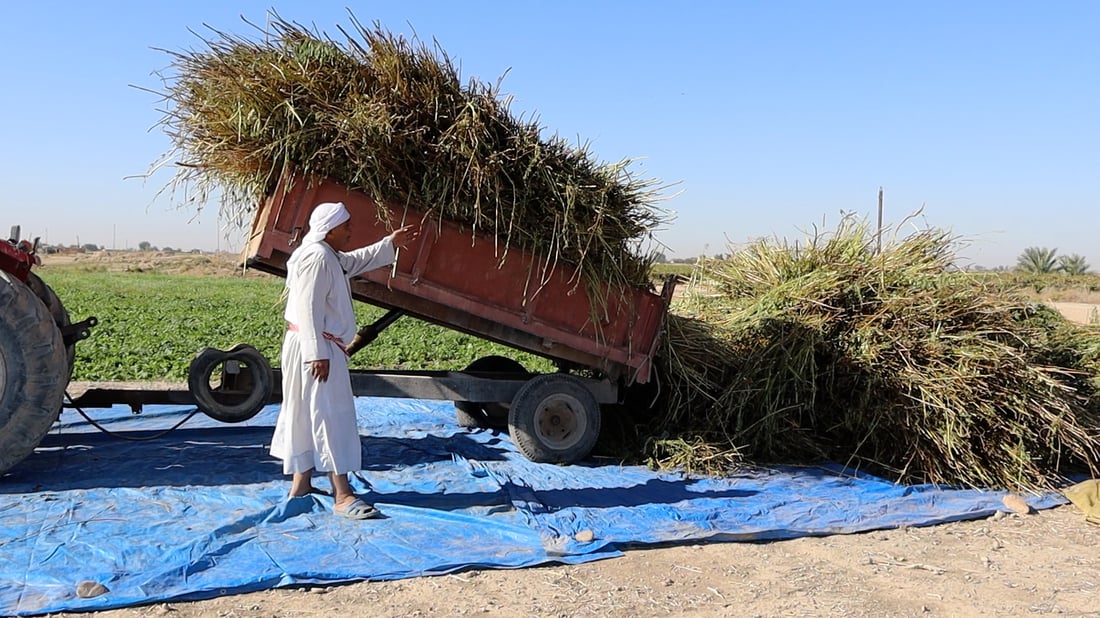
A farmer unloads sesame plants to dry under the sun in al-Farhatiya, south of Salah al-Din, during harvest season. (Photo by 964media)
Sesame farmers in Salah al-Din struggle with water shortages, lack of machinery
SALAH AL-DIN — As sesame harvest season begins across Iraq, farmers in Salah al-Din are working long hours under the sun, relying on family labor and traditional methods in the absence of modern equipment and government support.
Sesame production in Iraq has risen in recent years, from about 200 tons in 2018 to roughly 800 tons in 2022, with Anbar, Salah al-Din, and Babil ranking among the top producing governorates. But this year’s output may fall, farmers say, due to delayed irrigation and limited resources.
In al-Farhatiya, south of Salah al-Din, farmer Riyadh Hilal and his family were seen harvesting their sesame crop by hand. “We plant sesame in the Ishaqi area of al-Farhatiya, and the season runs from June to November,” Hilal told 964media. “We face difficulties because there are no modern machines and water is scarce. We need state support to ease the burden on farmers.”
Hilal said he fears the growth trend will reverse. “We worry production will decline because there is no government support for sesame,” he said. “The government focuses only on wheat—wheat and nothing else.”
A single dunam (2,500 square meters) of sesame can yield around 300 kilograms of seeds, selling for about 3,000 dinars ($2.14) per kilogram, or roughly one million dinars ($714) per dunam. Still, few farmers grow sesame because it requires intensive manual labor from planting to harvest.
Farmer Samah Qasim said water shortages delayed her work this season. “The harvest was late this year because we waited for water releases,” she said. “Last year by this time I had already finished harvesting.”
Qasim added that she carries out nearly all the work herself. “I scatter the seeds, water the land, spray pesticides, harvest, and transport the crop,” she said. “It’s exhausting because there are no modern machines for sesame farming. We start at seven in the morning and work all day.”
The sesame harvest involves cutting the plants by hand, drying them in the sun, shaking out the seeds, and bagging them for sale to local traders — a process farmers say will continue to decline unless the government invests in irrigation systems and modern farming tools.