
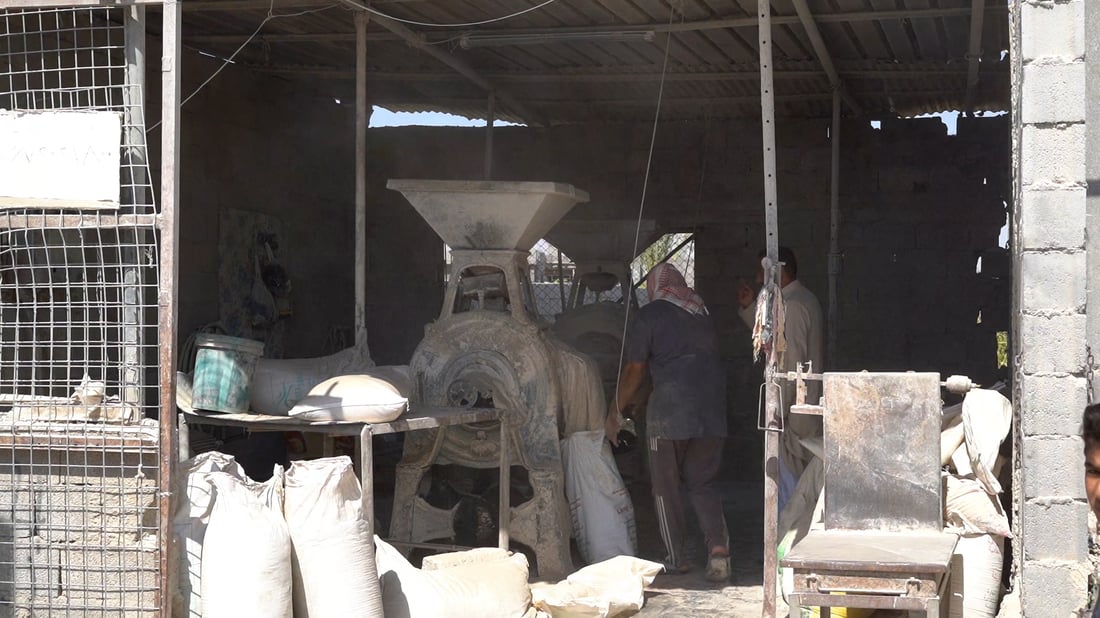
A worker operates a traditional stone mill in the village of Rummana near Qaim, where locals still prefer bran-mixed flour known as taheen al-Arab. Photo by 964media.
Stone mills in Anbar village keep tradition alive with bran-rich ‘Arab flour’
AL-QAIM – In the village of Rummana, near Anbar’s Al-Qaim district on the Syrian border, residents continue to prize dark, bran-rich flour known locally as taheen al-Arab or “Arab flour,” resisting the widespread trend across Iraq favoring whiter, more refined loaves.
At stone mills like those operated by Mohammed Hashim and Abu Abdul Malik, wheat is ground using coarse stones in a process that recalls traditional hand mills, despite being fully mechanical. The result is flour that retains its bran content and is preferred for its taste and supposed health benefits.
“People here like bread made from this flour and believe it benefits the stomach and colon, unlike today’s highly refined flour that has no smell or old flavor,” said Abu Abdul Malik, who inherited the village’s oldest stone mill from his father. The same equipment has been in operation since 1976.
In addition to flour for bread, the mills produce coarse wheat for traditional dishes like kibbeh, bulgur to replace rice, and livestock feed. “We inherited this mill from my late father and are still working in this profession, benefiting ourselves and the people of the area,” Hashim said.
He noted the simplicity of the operation. “This mill has no filters, unlike modern mills that are complete factories. It is a simple machine consisting of gears, belts, and stone, working bag to bag — from mixed wheat to flour directly.”
Hashim said he maintains the machine himself by periodically servicing the stones, which can become too smooth to grind efficiently. “I’ve worked here for 15 years, and people in the area know me. I also have customers from outside, from Karabla, Ubaidi, Suma, and other nearby villages.”
Locals say the bran-rich flour is not only easier on the stomach but also preferred for its aroma and flavor — a holdover from older ways of eating that still survive in this border village.