
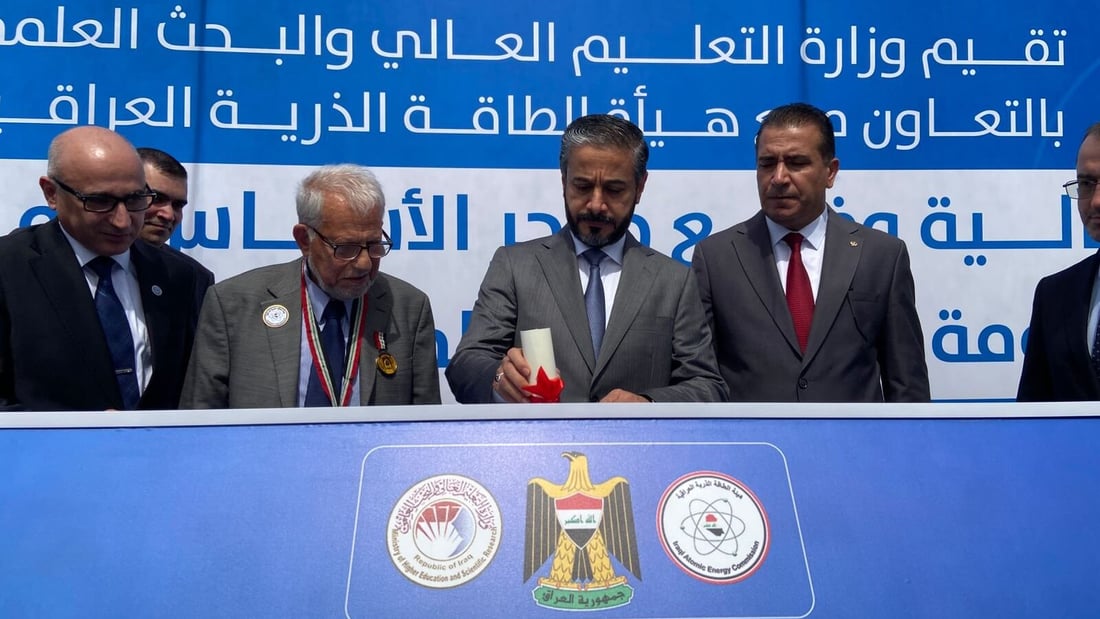
Iraq’s Minister of Higher Education Naeem al-Aboudi lays the foundation stone for the country’s first subcritical nuclear system during a ceremony in Baghdad. Photo by 964media.
Iraq lays foundation stone for first subcritical nuclear assembly
BAGHDAD — Iraq’s Minister of Higher Education and head of the Iraqi Atomic Energy Commission, Naeem al-Aboudi, on Wednesday laid the foundation stone for the country’s first subcritical nuclear assembly, a training reactor designed for peaceful applications.
The project is being developed in cooperation with the Atomic Energy Commission, the National Authority for Nuclear and Radiological Regulation, and the International Atomic Energy Agency, with international experts and diplomats in attendance.
“This is a historic moment that crowns years of integrated achievements by the Ministry of Higher Education and Scientific Research,” al-Aboudi said. He described the initiative as part of Iraq’s effort to advance education and research, noting the country’s growing scientific output, international academic agreements, and higher global rankings for Iraqi universities.
The minister said the facility will train students and researchers in nuclear science while supporting peaceful uses of nuclear energy in medicine, agriculture, industry, and environmental protection. He emphasized that the project aligns with the United Nations’ Sustainable Development Goals on education and clean energy.
Al-Aboudi also confirmed Iraq is preparing to sign a strategic agreement with China’s Atomic Energy Commission for nuclear research and training.
Hamed al-Bahli, adviser to the prime minister for nuclear energy, told 964media that “for the first time, a minister has paid serious attention to nuclear energy, sending envoys to China, Russia, and other countries for discussions.” He said Iraq cannot meet future electricity demand without nuclear energy.
Salman Ajil, director of the nuclear decommissioning department at the Atomic Energy Commission, noted that dismantling Iraq’s damaged nuclear facilities has taken more than a decade per site. He said joint teams from the commission and the regulatory authority continue monitoring and decontamination work at remaining facilities to ensure safe handling of radioactive materials.
In June, the Atomic Energy Commission said three sites at the Tuwaitha complex southeast of Baghdad had been declared free of radioactive contamination after inspections.