
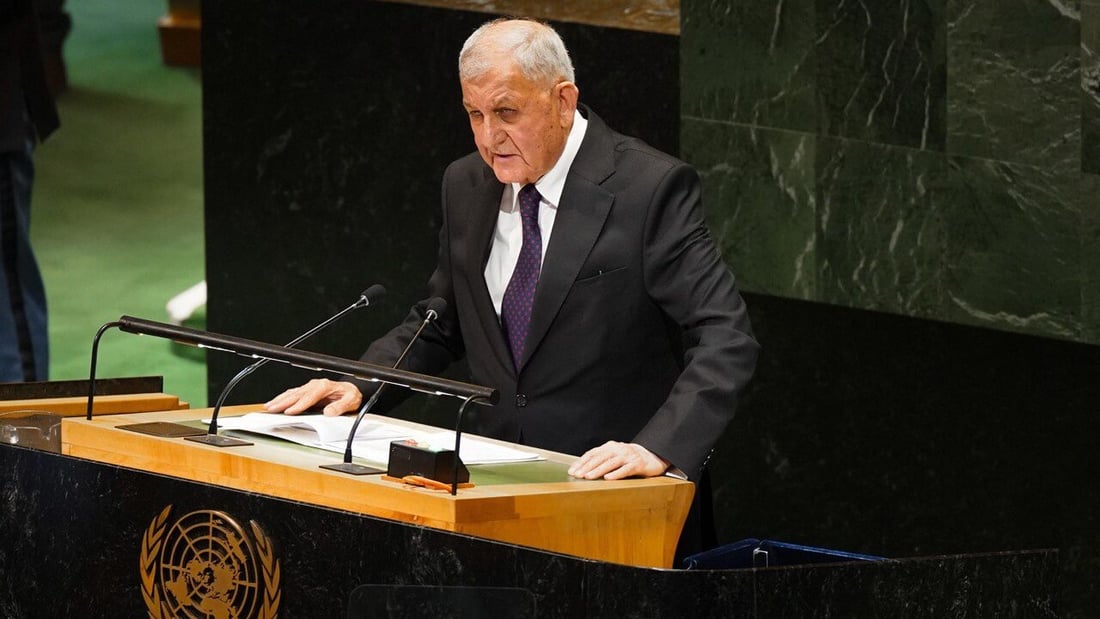
Iraqi President Abdul Latif Rashid delivers Iraq’s address at the 80th session of the United Nations General Assembly in New York, Sept. 24, 2025.
Monitor
Rashid calls for regional de-escalation, highlights Iraq’s recovery at UN
NEWSROOM — Iraq’s President Abdul Latif Rashid told world leaders at the United Nations General Assembly on Wednesday that Iraq has “regained its natural position in the international community” and is working to consolidate internal stability, while calling for an immediate halt to the war in Gaza and regional escalation.
Speaking at the 80th session in New York, Rashid described his country’s efforts to rebuild after years of conflict. “Iraq, with the support of friends, succeeded in defeating the most dangerous terrorist threat the world has witnessed,” he said. “We are now moving forward to erase all traces of the brutal terrorist attack.”
Rashid also warned of environmental threats, describing water scarcity as an “existential threat” and urging Turkey and Iran “to consider not harming Iraq, where the Tigris and Euphrates rivers extend from the far north to the far south.”
Excerpts from President Rashid’s speech at the 80th session of the United Nations General Assembly in New York:
Iraq has regained its natural position in the international community and in its relations with neighboring countries. It currently chairs the Arab League summit and the Group of 77 and China, in addition to playing an active role in international and regional organizations.
The country is preparing to hold its sixth parliamentary elections in the coming weeks to continue the peaceful transfer of power and the building of constitutional institutions, which is a bright example in the region.
Iraq, with the support of friends, succeeded in defeating the most dangerous terrorist threat the world has witnessed. The country is now moving forward to erase all traces of the brutal terrorist attack, relying on the unity of its people and developmental plans to address the consequences of the past.
Iraq continues its efforts to return displaced persons to their original areas after liberating them from terrorist control. This requires international support for the reconstruction of liberated areas and to reassure components that were subjected to genocide, enslavement, and displacement, such as Yazidis, Christians, and others.
Iraq is currently working to achieve sustainable economic and social development by activating investment in the country’s vast potential, aiming to reduce dependence on oil and open new fields for diversifying the economy in agriculture, industry, and renewable energy.
The country offers significant investment opportunities in water, electricity, and infrastructure projects, and invites all countries to enter into fruitful partnerships with Iraq. We also call on the international community to cooperate with Iraq to recover funds smuggled abroad.
Iraq conducted a successful population census — the first in decades — revealing that the population exceeds 46 million, with an annual increase of one million. This situation presents both opportunities and challenges.
Iraq is among the countries most affected by climate change. Desertification is spreading across green areas, water scarcity has become an existential threat, and dust storms are increasing.
The country is addressing climate challenges by developing renewable energy projects, improving water management, reducing carbon emissions, and expanding green spaces.
Iraq stresses the importance of adhering to the principle of “common but differentiated responsibilities” in confronting climate change, especially the crisis of declining water resources in shared and cross-border rivers.
Iraq acknowledges the impact of climate change and population growth on water availability. At the same time, it calls on Turkey and Iran to consider not harming Iraq, where the Tigris and Euphrates rivers extend from the far north to the far south.
What is happening to Palestinian civilians — killing, starvation, displacement, the destruction of infrastructure, and the demolition of their institutions — is a situation unworthy of humanity and a disgrace to all mankind. The government said this must be stopped immediately.
Iraq reiterated its call to the international community to achieve a just and comprehensive solution to the Palestinian issue by activating UN resolutions and enabling the Palestinian people to build their independent state.
The country condemned the Zionist entity’s attacks on regional countries, including Syria, Lebanon, and most recently, the State of Qatar. The attacks are brutal acts of aggression and clear violations of international law and the UN Charter.
Iraq renewed its call for a Middle East free of weapons of mass destruction, while recognizing all countries’ rights to develop peaceful uses of nuclear energy. It called for international oversight of all nuclear facilities in the region, including those of the Zionist entity.
Iraq welcomes all diplomatic efforts to resume and succeed in the dialogue between the Islamic Republic of Iran and the international community to reach an understanding that guarantees Iran’s right to develop a peaceful nuclear program in line with treaties and international obligations.
Iraq affirms its full support for the peace process in Turkey and the Kurdistan Workers’ Party’s initiative to abandon arms. We look forward to establishing a political and legal framework that enables peaceful political participation for all in Turkey.