
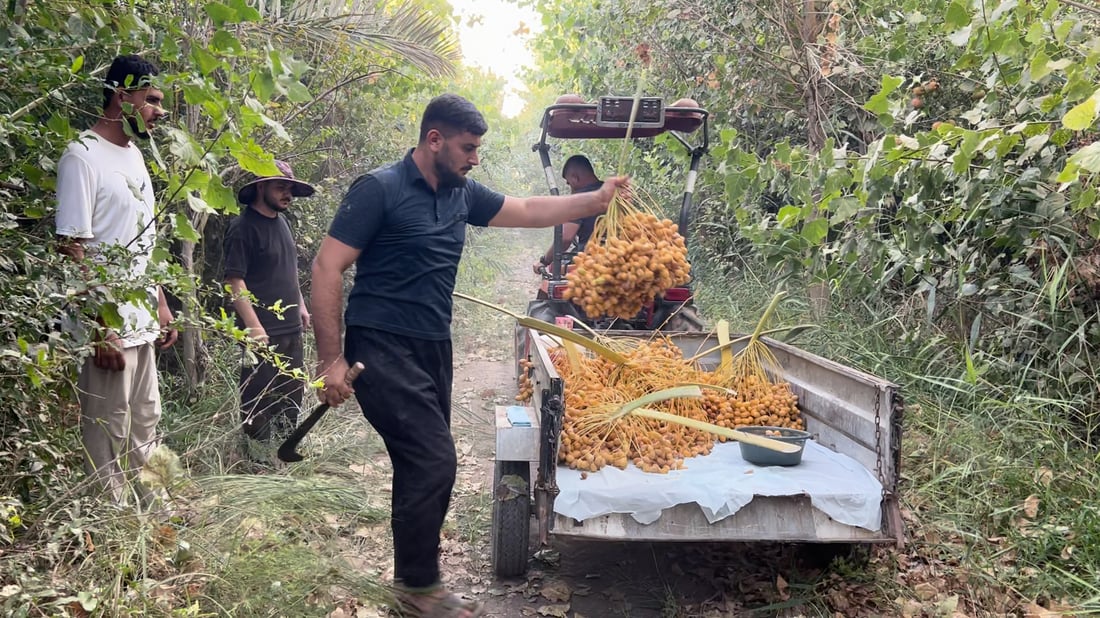
Farmers in Daquq harvest dates from palm trees planted to shade pomegranate orchards, marking the first season of successful production. Photo by 964media
Kirkuk
Palm trees planted for shade yield surprise date harvest in Daquq
KIRKUK — When Roj Azad planted 200 palm trees in his orchard in Daquq four years ago, his goal was to protect his pomegranate trees from the sun. This year, the Kurdish farmer was surprised to find the palms had produced a full crop of dates, with each tree yielding between 100 and 120 kilograms.
“I own a 10-dunum pomegranate orchard in the villages of Iftikharat, and I was facing difficulties with the crop, which is the most famous fruit across the Kurdistan Region and Kirkuk,” Azad told 964media. “We brought 200 seedlings from Diyala, and the goal was only to protect the pomegranates, but we did not expect the palms to produce so many dates.”
Azad said this year’s harvest included about 10 varieties, including Barhi and Khastawi, as well as types he hasn’t yet identified. The family distributed the dates to neighbors, friends, and relatives. Some dates were dried at home after birds fed on the fruit before it fully ripened.
“We did not carry out manual pollination,” he said. “But according to information, pollination occurred naturally through birds and bees.”
The experiment also improved pomegranate yields. “Their production improved in color, shape, and size thanks to the shade of the palms,” Azad said. “It proved the success of this idea in our area.”
Other farmers in Daquq say the district’s fertile land and rising temperatures in recent years have created favorable conditions for palm cultivation. “Daquq’s dates are now competing with dates from the southern governorates in terms of quality, type, and taste,” farmer Ibrahim Khalil told 964media.
He said the results show that palm farming is not only sustainable but profitable. “The palm tree has always been a symbol of generosity among Arabs, and here it started as a way to protect pomegranates from the sun,” Khalil said. “But the results showed that palms are a rewarding crop that requires patience and offers countless benefits.”