
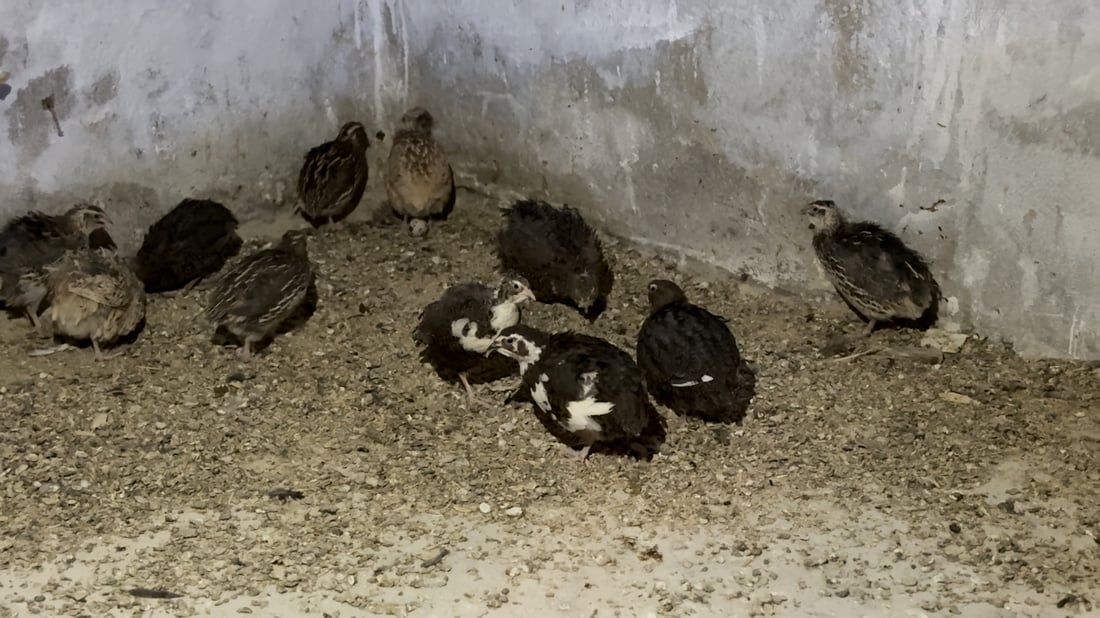
Quail kept by a local farmer in Bartella, Nineveh Plains, where interest in raising the bird is increasing. Photo by 964media.
Quail farming gains ground in Nineveh’s plains
NINEVEH — Poultry farmers in the Nineveh Plains are increasingly raising quail instead of chickens, encouraged by local beliefs that quail eggs may help children develop speech more quickly. While demand for the eggs appears to be rising, agricultural officials say farming remains small-scale and unregulated.
“Quail farming requires good space, proper ventilation, stable temperatures between 35 and 37 degrees Celsius, and exposure to direct sunlight, which is very important,” said Behnam Matti, who operates a hatchery in Bartella. “It also needs protein-rich feed at about 15%. Quail hatch in 17 to 18 days, compared to 21 for chickens, and they start laying eggs between 35 and 45 days, while chickens take six to nine months.”
Matti said demand for his hatchery’s output has been steady. “It is said quail eggs are useful for children, especially in stimulating speech, and that allergies to quail eggs are less common than with chicken eggs. These are things published in specialized media, though I am not a specialist myself,” he told 964media. A tray of 30 quail eggs currently sells for about 3,500 dinars ($2.46).
Health experts say there is no scientific evidence to support claims that quail eggs help children speak earlier.
Quail, known locally as salwa or fari, are small migratory birds found across Europe, Asia, Africa, and the Americas. They favor open fields and shrubs, feeding mainly on seeds and grains but also insects and worms during breeding season.
Despite the growing interest, authorities say quail farming has not developed beyond individual breeders. “Nineveh lacks formal fields for quail production,” said Ahmed Ammar al-Husseini, director of agricultural research in the governorate. “Farming is random, limited to some small breeders here and there, and there are no official committees from agricultural departments or institutions in the city to study the economic and productive aspects or to record statistics.”