
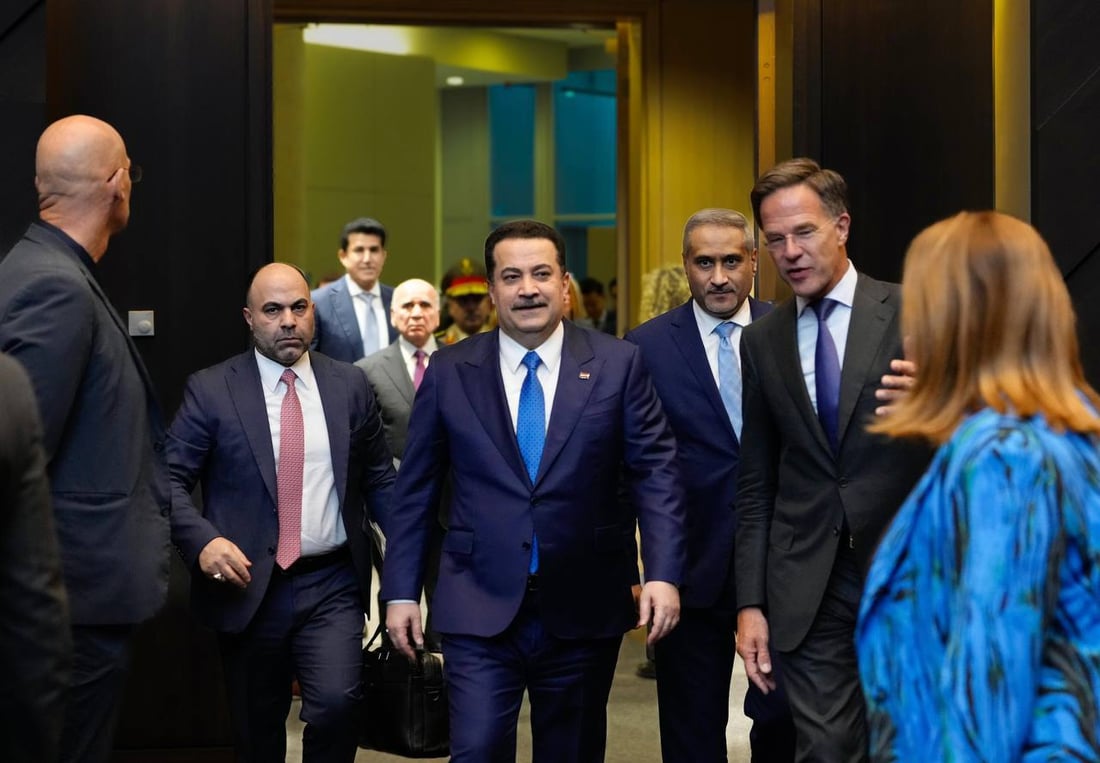
(Photo: Al-Sudani's media office)
Monitor
Al-Sudani tells NATO Iraq seeks partnership built on sovereignty
BAGHDAD — Prime Minister Mohammed Shia Al-Sudani on Monday addressed leaders and representatives of the North Atlantic Council at NATO Headquarters in Brussels, stressing Iraq’s desire for a partnership with the alliance based on sovereign decision-making.
The visit came at the invitation of NATO Secretary General Mark Rutte, according to a statement from Al-Sudani’s media office.
Al-Sudani said the meeting took place “amid profound turbulence and transformations in the Middle East, alongside violations of international principles, crimes against humanity, and threats to regional safety.” He underlined Iraq’s commitment to building a “constructive partnership with NATO based on a sovereign decision,” describing it as comprehensive and extending across multiple fields.
He also highlighted the importance of evaluating NATO’s mission in Iraq, saying bilateral cooperation had become a model that could be “emulated in the region.”
Al-Sudani portrayed Iraq as a democratic example for the Middle East. “Iraq today represents a prominent model in the Middle East, within its democratic, pluralistic, and federal system,” he said, adding that the country’s transition toward democracy had been “strong and resilient, despite the challenges and crises in our region.”
Statement from Al-Sudani’s media office:
Prime Minister Mohammed S. Al-Sudani delivered a speech today, Monday, before the leaders and representatives of the North Atlantic Council at NATO Headquarters in Brussels, at the invitation of NATO Secretary-General Mr. Mark Rutte.
In his address, Prime Minister Al-Sudani stated that the meeting is convened amid profound turbulence and transformations in the Middle East, alongside violations of international principles, crimes against humanity, and threats to regional safety. He affirmed Iraq’s commitment to building a constructive partnership with NATO based on a sovereign decision, aiming for a comprehensive and long-term relationship across multiple fields.
The Prime Minister stressed that Iraq is no longer a source of security concern but rather a strategic partner that can be relied upon, noting that relations with NATO have proven this partnership. He emphasized the importance of assessing the NATO Mission in Iraq, highlighting bilateral cooperation as a model to be emulated in the region, and underscored Iraq’s aspiration to be a regional partner to NATO within mutually beneficial arrangements.
Below are the key highlights of Prime Minister Al-Sudani’s speech:
🔷 Iraq today represents a prominent model in the Middle East, within its democratic, pluralistic, and federal system.
🔷 The Iraqi people’s transition toward democracy has been strong and resilient, despite the challenges and crises in our region.
🔷 Our government is committed to building solid and sustainable relations with countries and international institutions that share our political values of pluralism and freedom.
🔷 We adopt the principle of balance in our foreign policy, avoiding alignment with blocs or axes, and remain guided by Iraq’s national interest.
🔷 We seek to strengthen relations with NATO countries, participate in planning and implementing regional security initiatives, and develop our capabilities in air defense and deterrence, ensuring Iraq’s sovereignty and contributing to regional stability.
🔷 We stress the importance of cooperation with NATO in addressing terrorism, border security, organized crime, cyber threats, and other sources of regional instability.
🔷 Iraq looks forward to NATO support in developing deterrence capabilities, while ensuring Iraq’s distancing from regional conflicts.
🔷 Conflicts must be resolved through diplomacy and international law. Instability in the region poses risks of terrorism, displacement, and humanitarian crises that will inevitably extend to Europe and beyond.
🔷 Our government’s priority is the reconstruction of Iraq and strengthening its civilizational and developmental role in the region and the world.
🔷 We are preparing for legislative elections, and the government is committed to supporting this process and ensuring it is conducted fairly and transparently.
🔷 Our pluralistic system ensures free competition in elections, with governments formed on the basis of results and through peaceful transfers of power.
🔷 We are capable of overcoming economic and environmental challenges, particularly securing water resources and strengthening the non-oil economy.
🔷 We are committed to confining weapons under the state’s authority and reforming security institutions to protect citizens and uphold law and order.
🔷 Our government has focused on economic diversification, promoting entrepreneurship, encouraging foreign investment, and protecting local industries.
🔷 National unity, youth and women empowerment, support for marginalized groups, as well as education and healthcare, are top priorities to ensure equality and inclusive progress.
🔷 Aggression and unlawful use of force pose dangers that extend beyond the Middle East, and the international community must act responsibly to provide protection.
🔷 Iraq seeks peaceful resolution of the Iranian nuclear file within the framework of international law, UN Security Council resolutions, and the Nuclear Non-Proliferation Treaty.
🔷 Iraq reaffirms support for Syria’s stability, ensuring inclusivity and pluralism form the basis of its future.
🔷 The violations in the occupied Palestinian territories contravene UN Security Council resolutions and must end immediately, along with the genocide in Gaza.
🔷 Iraq seeks to build a regional system based on interdependence, conflict resolution through peaceful means, and cooperation in addressing shared challenges.
🔷 Our vision is based on partnerships that integrate economic, political, and security dimensions, as well as coordination to support stability and collective development.
🔷 Iraq’s relationship with NATO stands as a model partnership, ensuring Iraq remains a source of regional stability and a contributor to global peace and security.