
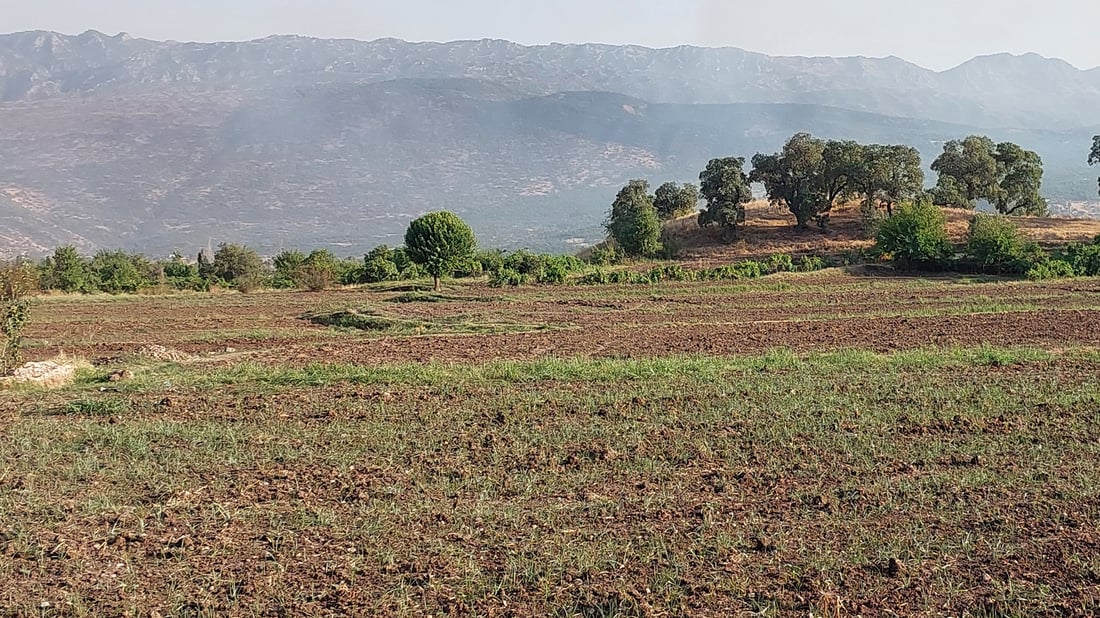
Farmlands of Goharze village
'Nothing was left'
Turkish forces briefly detain villagers in Duhok who were attempting to visit evacuated homes
DUHOK — Turkish forces briefly detained nearly 45 displaced residents from Goharze village in Amedi district on Saturday as they attempted to visit their former homes, the village mukhtar said. They were released after two hours.
Turkish troops maintain bases inside Iraqi territory in Amedi, extending up to 40 kilometers beyond the border under agreements tied to operations against the Kurdistan Workers’ Party, or PKK. Campaigns such as the 2022 “Claw-Lock” displaced hundreds of villages in Duhok governorate through airstrikes, incursions, and evacuations.
The PKK declared a cease-fire in March, agreed to disband in May, and held disarmament ceremonies in July, raising villagers’ hopes of returning to abandoned homes.
“After the peace process and stability in our area, about 45 of us wanted to visit our old village,” said Ahmed Saadulla, mukhtar of Goharze. “When we arrived, a number of Turkish soldiers came and detained us all in one place. After two hours and several attempts to negotiate, we were released and are now returning to our village.”
He said soldiers told them the area remained under military control. “They said we cannot visit unless we receive permission from them,” he added.
Reber Sadiq Bargaari, director of Deraluk subdistrict, described the incident as a “misunderstanding.” He said villagers were stopped after entering restricted territory. “There are ongoing discussions with the Turkish side to resolve the issues, and within the next two to three days, the villagers will be able to return to some specific areas of their villages,” he told 964media.
Residents said the incident reflects broader restrictions still in place across dozens of evacuated villages along the Amedi border. Though clashes have eased in recent weeks, movement remains tightly controlled.
On Friday, Aug. 22, roads to 15 villages in Bamarne subdistrict were temporarily reopened from 6 a.m. to 5 p.m., including Mije, Kivna Mije, Spindare, Gerkash, Derashe, Gizi, Sarake, Biye Sherana, Ek Male, Rdeni, and Zewka Sheikh. A formal source told 964media the routes will be opened on a limited basis, stressing villagers must return before evening.
Video recorded by a resident of Kivna Mije showed collapsed homes and walls marked by bullet damage. “Nothing was left inside,” the resident said.
Azad Hamzo, mukhtar of Mije and representative for Bamarne villages, said residents had pressed for access during harvest season. “The road to our villages was opened, but it is not clear for how many days,” he said. “Every day we are informed whether it will be open or not, and we notify the villagers.” He said orchards and farms have been left untended for more than a year.
A formal source in Amedi said calm has prevailed for about a month but urged caution. “We ask residents to remain cautious and avoid dangerous areas to protect their lives,” the source told 964media.
The Kurdistan Regional Government’s General Directorate of Mine Action has also warned that evacuated areas are heavily contaminated with mines. Director Jabar Mustafa told 964media that civilians remain barred from returning until clearance begins. “We need to know the density and type of minefields in order to add them to our records and prepare future clearance plans,” he said. “These places still pose a threat to the people of Kurdistan.”
Bamarne, renowned for its orchards and farmland, typically produces 150 to 200 tons of sumac and nearly 100 tons of figs each year. Villagers say prolonged restrictions are endangering both livelihoods and the survival of rural communities.