
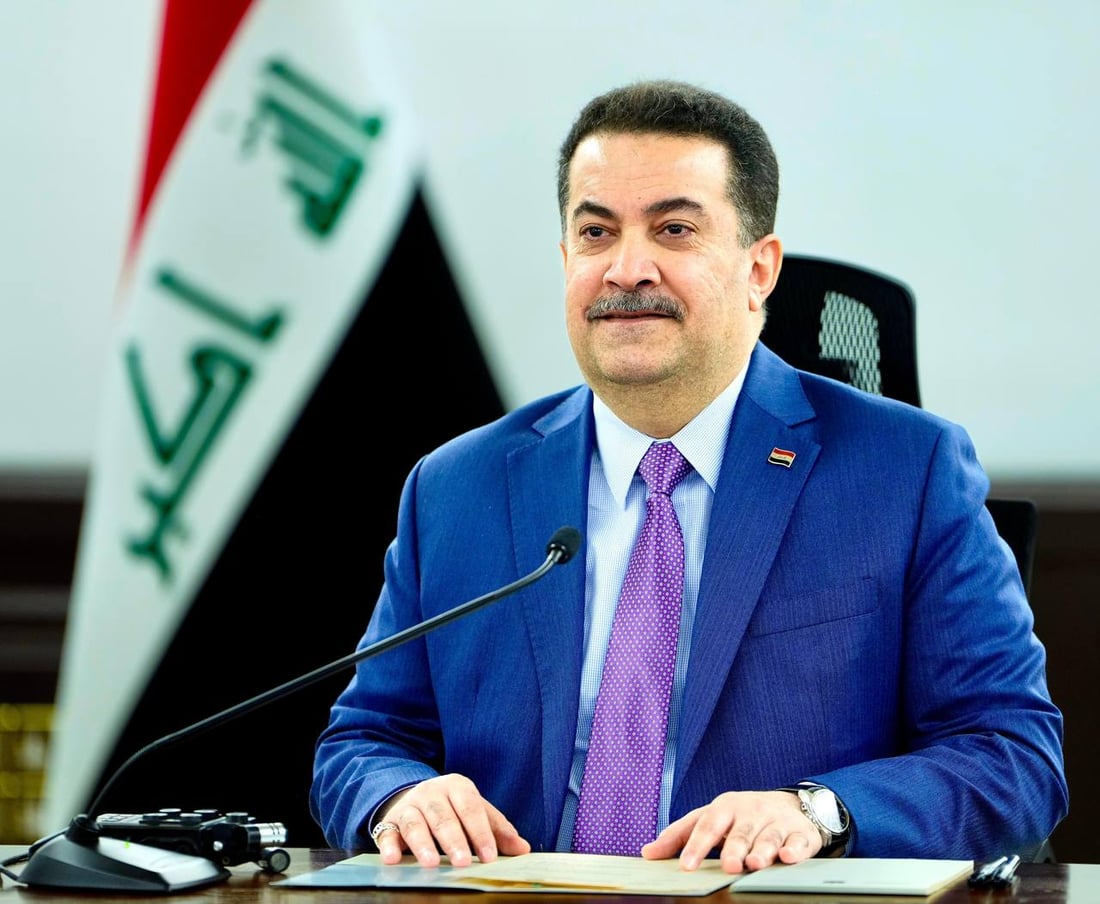
(Photo: Al-Sudani's media office)
Monitor
‘A partner in implementing development plans,’ says Al-Sudani on Iraq’s private sector
BAGHDAD — Prime Minister Mohammed Shia Al-Sudani on Wednesday directed ministries and relevant state bodies to “remove obstacles facing the private sector” and adjust laws to align with Iraq’s industrial “development” plans, emphasizing the sector’s role as “a partner in implementing development plans.”
Chairing a regular meeting of the Industrial Coordination Council, attended by ministers, industry representatives, and environmental officials, Al-Sudani approved recommendations to amend existing regulations, including granting environmental approval to public and private sector activities with developmental, economic, and social benefits, provided they use environmentally friendly technologies.
Statement from Al-Sudani’s media office:
Prime Minister Mohammed S. Al-Sudani chaired the regular meeting of the Industrial Coordination Council, attended by the Ministers of Oil and Trade, the President of the Iraqi Federation of Industries, and representatives from the Ministries of Industry and Environment as well as the Civil Defense Directorate.
The Prime Minister stressed the importance of the private sector in Iraq as a partner in implementing development plans, directing all ministries and relevant entities to remove obstacles facing the private sector and adapt laws to serve the plans and projects of industrial development across Iraq.
The meeting discussed the items on the agenda and approved the recommendation to amend the Council of Ministers Resolution No. (427 of 2017) to include the following:
A. All activities of both the private and public sectors that achieve developmental, economic, and social benefits shall be granted environmental approval based on an environmental impact assessment report, pending the amendment of the Environment Protection and Improvement Law No. (27 of 2009), provided they use environmentally friendly technologies in accordance with the best environmental standards.
B. Industrial activities established before and after the issuance of the Environmental Guidelines for Project Establishment and Monitoring of Their Implementation No. (3 of 2011).
C. Tightened environmental monitoring and enforcement of environmental improvement conditions, with the activity owner committing to establish green belts and contribute to awareness activities.Approval was granted for the Ministry of Industry and Minerals / General Directorate of Industrial Development to issue a certificate of completion of establishment for the Italian Modern Tiles Factory for the production of porcelain, artificial granite, and concrete products in the Baghdad Economic City in Nahrawan, based on the environmental impact assessment report and prior environmental approvals.
It was also decided to recommend amending the Council of Ministers Resolution No. (24930 of 2024) to include financing industrial projects that have an investment license under the Investment Law No. (13 of 2006, as amended), as well as projects licensed (under establishment) by the General Directorate of Industrial Development under Law No. (20 of 1998) that are established on state-owned lands.
As part of supporting industrial projects, the provinces were obligated to implement Industrial Coordination Council Resolution No. (29 of 2025) regarding the preparation and allocation of (1,000) dunams for industrial projects nominated by the General Directorate of Industrial Development.
In the framework of supporting industrial development programs in Iraq, approval was granted to launch the electronic portal created by the General Directorate of Industrial Development to facilitate the procedures for granting completion of establishment licenses for industrial projects meeting all requirements within (15) days from the date of application. Ministries and sectoral entities were also instructed to handle correspondence related to project establishment exclusively through the electronic portal and to refrain from corresponding with other sectoral bodies to prevent duplication of approval requests.
The meeting also decided to form a legal-technical committee from the relevant sectoral entities to study the technical regulatory framework for applying occupational health and safety requirements in the labor market and to submit its recommendations to the Council of Ministers within (30) days.