
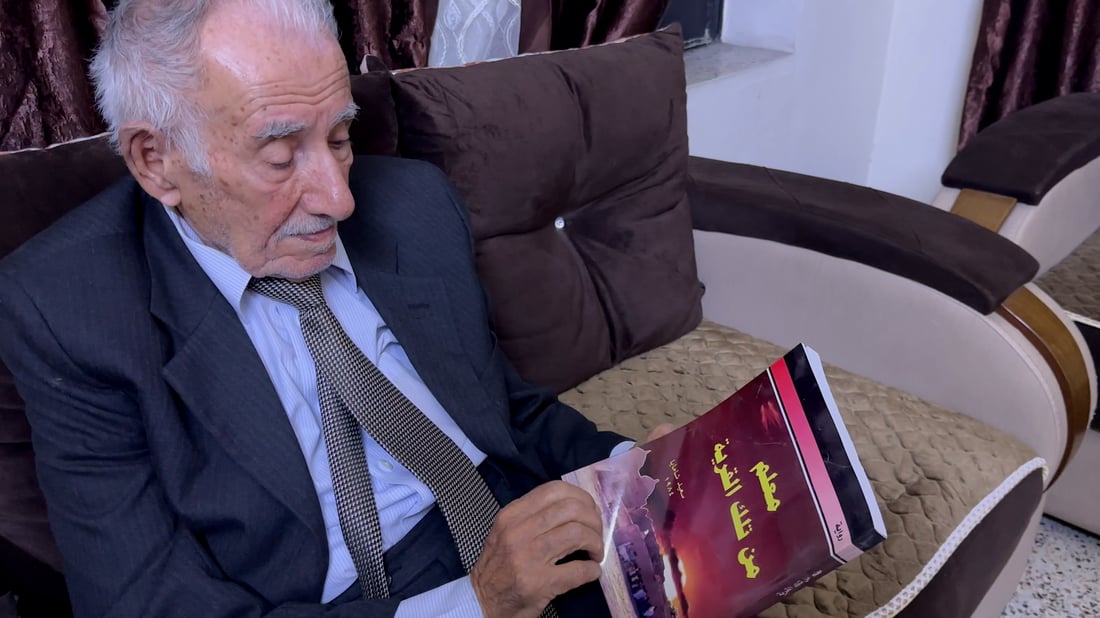
Iraqi author Saeed Shamaya, 96, reads a copy of his new novel City of Sh at his home in Ankawa, Erbil. Photo: 964media
'City of Sh'
At 96, Iraqi author Saeed Shamaya publishes new novel fiction and personal memories
ERBIL — At 96, veteran Iraqi writer Saeed Shamaya continues to write and chronicle, carrying a lifetime of collective and personal memory. Born in 1929 in the northern town of Alqosh, north of Mosul, he has spent decades in education, theater, political organizing, and literature. His latest work, “City of Sh”, has been published in Baghdad, combining fiction and reality to reflect political and social events he experienced firsthand.
Shamaya, who lives currently at Erbil’s Ankawa, said the idea for the novel came from a 1959 trip to Baghdad as part of a delegation from Alqosh to congratulate the leaders of the July Revolution. Passing through Tikrit, they encountered children chanting slogans against the revolution. “It was clear the chants were against the July Revolution, and this pushed me to write something expressing my rejection of that stance,” he said. The first notes for the story were made in the 1970s, and the novel was completed in the 1980s while he was in hiding.
In the City of Sh, Shamaya imagines a place where children, youth, and adults work together for the public good, guided by values of justice and equality. The plot contrasts this ideal with a Western city described by visiting children; when they return home and try to build a similar city, local elites resist, but the children persist until the City of Sh becomes a model for defending ordinary people from exploitation.
His career has included teaching in villages and cities across northern Iraq, founding committees to unite Chaldean, Syriac, and Assyrian political parties, and publishing novels, short stories, poetry in Syriac, and cultural studies in both Arabic and Syriac. His works include “A Teacher from That Village”, “He Died Twice”, “The Black Boy’s Whisper”, and “Sona”, as well as a heritage book on Alqosh and the bilingual cultural study “Renki Renki” (“Colors”).
Shamaya hopes to publish his remaining manuscripts, including “On the Banks of Wisdom”, which he considers his best, and to establish a cultural complex and museum for Alqosh’s heritage while developing the nearby village of Bandwaya into a tourist site.