
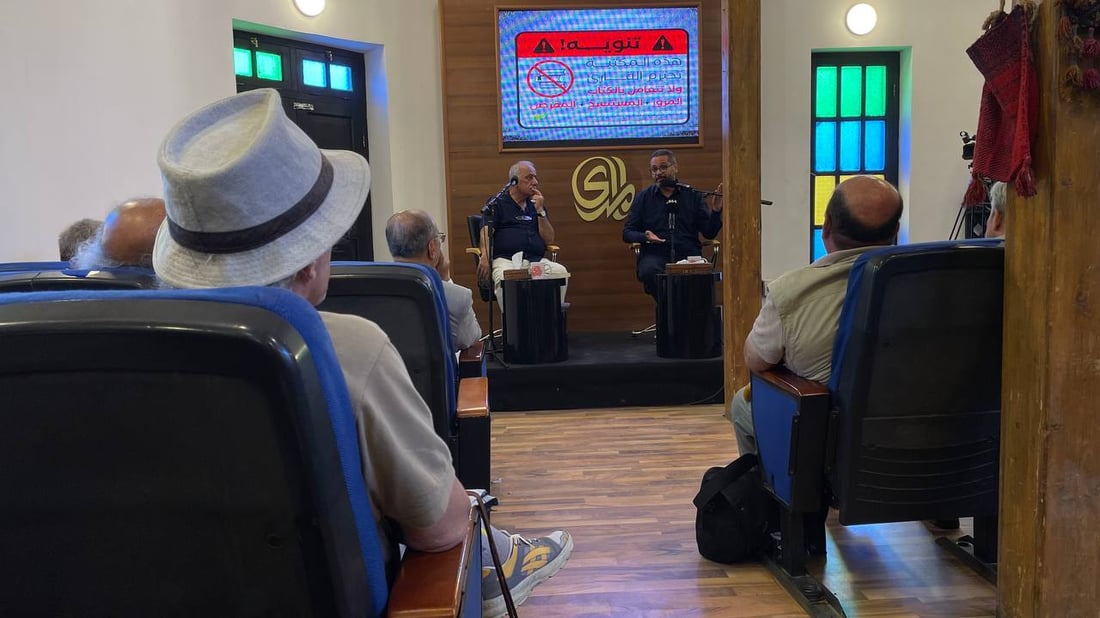
Panelists speak during a symposium at Al-Mada Foundation for Culture and Arts on Mutanabbi Street in Baghdad.
Baghdad
Panel warns of deepening book piracy problem in Iraq
BAGHDAD — The Al-Mada Foundation for Culture and Arts, in cooperation with the Iraqi Publishers and Booksellers Association, held a panel discussion on Mutanabbi Street in Baghdad to address the growing problem of book counterfeiting and piracy in Iraq.
Academics and specialists examined the legal and cultural effects of piracy, calling for practical measures to protect the publishing industry, authors’ rights and cultural institutions.
Ali Hassan Fawaz, deputy secretary-general of the Union of Iraqi Writers, told 964media that a weak legal and cultural environment has enabled widespread counterfeiting, plagiarism and fraud. “There are professionals who excel in bypassing oversight, which is already severely limited, if not completely absent,” he said.
Fawaz said piracy spans academic theses, printed books and scientific materials, with some publishing houses turning into “centers of corruption.” The absence of a clear legal framework for publishers, he added, has allowed the forgery of content and titles, creating a parallel environment to institutional culture.
“These practices have driven some Iraqi authors to stop publishing or turn to publishers abroad,” Fawaz said. He added that legal procedures to address cultural piracy are mired in bureaucracy, leaving victims unable to secure justice. He cited his own experience of having an article reprinted without permission in more than 20 newspapers and magazines.
Legal expert Ali Al-Rifai told 964media that advances in technology have made book piracy easier, enabling the direct theft of authors’ and translators’ work. “The danger lies not only in printing and packaging but in altering the book’s content, which is the core of the author’s intellectual work,” he said.
Al-Rifai said both original and translated works, as well as library collections, should be covered under intellectual property laws. He added that the Ministry of Culture should work to reduce the prices of original books to compete with low-cost pirated copies, encouraging readers to buy legitimate editions.