
(Photo: Al-Sudani's media office)
Monitor
Al-Sudani: government has set ‘clear and comprehensive’ standards to evaluate officials
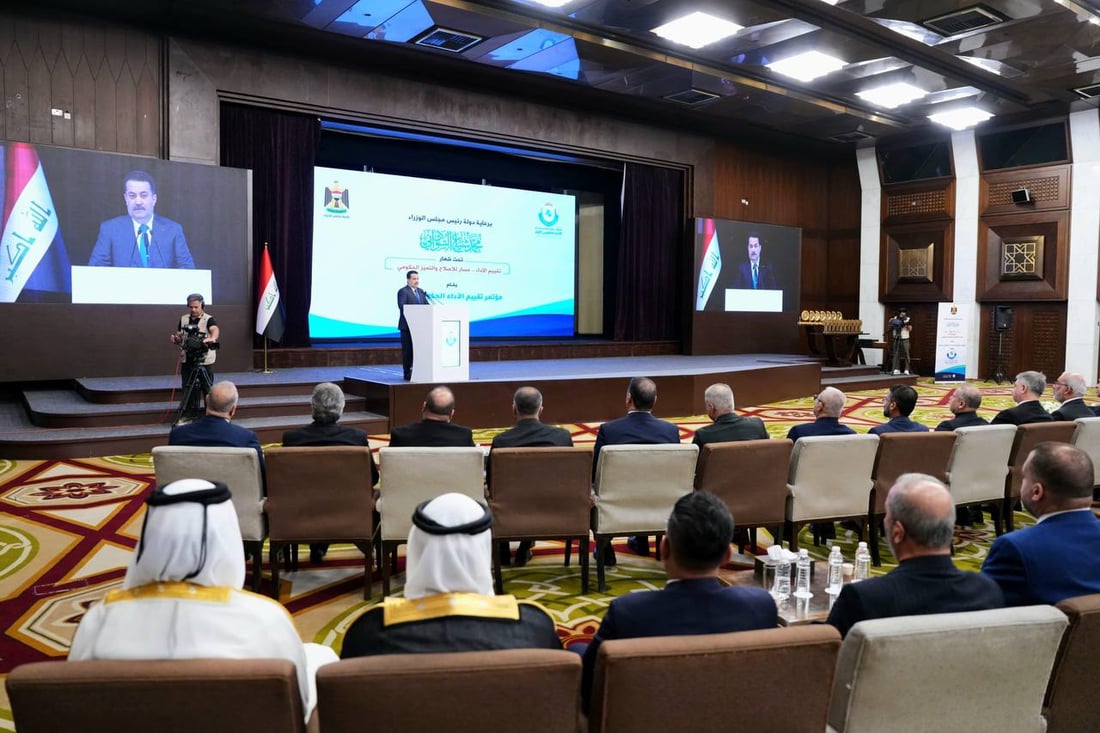
BAGHDAD — Prime Minister Mohammed Shia Al-Sudani said Saturday that the government has succeeded in establishing “clear and comprehensive” professional standards for evaluating the performance of senior officials.
Speaking at the First Government Performance Evaluation Conference, Al-Sudani said the effort began with directors-general and extended to deputy ministers, advisers, heads of independent commissions, and ministers. “The rate of change exceeded 21% of the total number of those evaluated,” he said, noting that the process resulted in the dismissal of 41 directors-general in permanent posts and the termination of 89 acting assignments.
He said 1,135 semi-annual evaluations had been completed at the directors-general level, while 52 deputy ministers and 12 advisers were also assessed.
Al-Sudani acknowledged that planned cabinet reshuffles promised in the government program were stalled due to “political obstruction,” but stressed that the evaluation process “provided added momentum to government performance and created an accelerated pace and heightened focus at all leadership levels.”
Statement from Al-Sudani’s media office:
Prime Minister Mohammed S. Al-Sudani chaired today, Saturday, the First Government Performance Evaluation Conference, held under the slogan “Performance Evaluation: A Path towards Reform and Government Excellence.” The conference presented the results of the work of the Higher Committee for Performance Evaluation and its subcommittees, which have been implementing the commitments of the government program to continuously monitor, review, and assess the performance of officials.
In his opening remarks, the Prime Minister stressed the government’s commitment to reforming Iraq’s state institutions as a central goal to enhance performance, avoiding hasty decisions that do not serve the public interest, despite shortcomings in the performance of administrative leaderships in previous phases.
His Excellency underlined that corruption indicators were dealt with through immediate measures outside the evaluation framework, which sometimes faced political obstacles, including the nomination of individuals less competent than those who had undergone evaluation.
Key points from the Prime Minister’s speech:
🔷 We planned for the evaluation criteria to be clear and comprehensive, starting with directors-general, moving up to deputy ministers, advisers, heads of independent commissions, and ministers.
🔷 The cabinet reshuffle we pledged in the government program, based on our government performance evaluation, was stalled due to political obstruction.
🔷 We formed higher committees from the Prime Minister’s Office, with the participation of oversight bodies and some ministries, supported by specialized technical teams and university professors, to complete the work with professionalism and transparency.
🔷 At the level of directors-general, 1,135 semi-annual evaluations were completed, resulting in the dismissal of 41 directors-general in permanent posts and the termination of 89 acting assignments.
🔷 The evaluation process provided added momentum to government performance and created an accelerated pace and heightened focus at all leadership levels.
🔷 The rate of change exceeded 21% of the total number of those evaluated.
🔷 Deputy ministers and advisers were evaluated, with 52 deputy ministers and 12 advisers assessed. Based on the results, the Council of Representatives approved the permanent appointment of several of them—an unprecedented step since 2003.
🔷 We extend our thanks and appreciation to the outstanding officials identified through the evaluation process, and we support their continued service to the country.
🔷 Thanks and appreciation go to everyone who contributed to this national project, starting with the Prime Minister’s Chief of Staff, the Adviser for Government Performance Evaluation, and all members of the technical teams and specialized committees.