
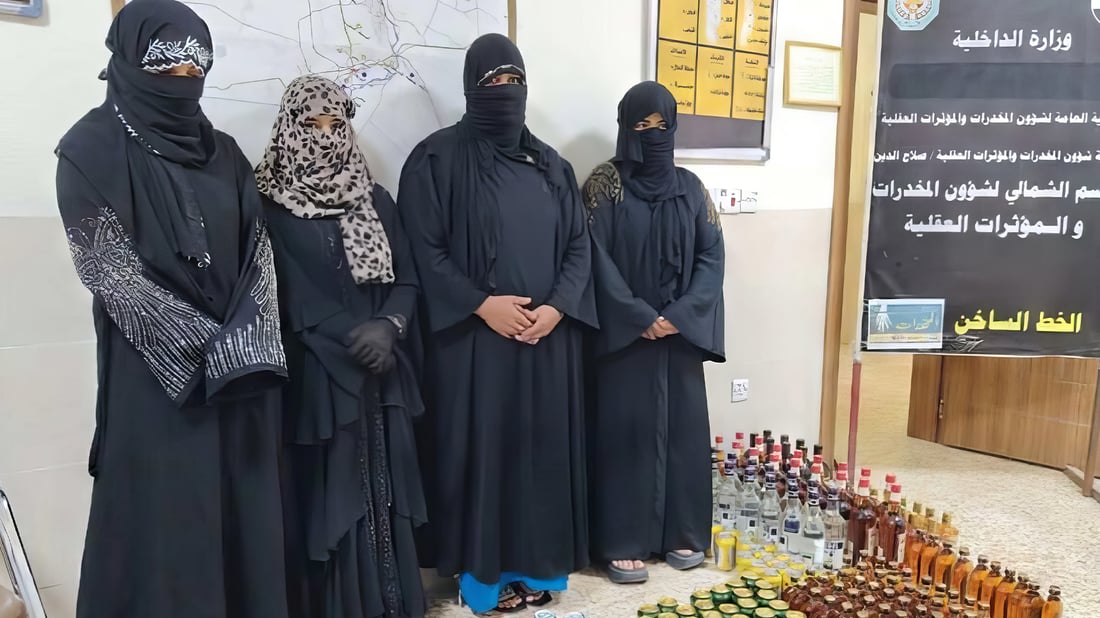
Four women stand in custody beside seized bottles of alcoholic beverages at a police station in Beiji, Salah Al-Din governorate, following their arrest during a raid on a suspected illegal alcohol distribution site.
Four women arrested in Salah Al-Din over alleged alcohol distribution
SALAH AL-DIN — Security forces in the Beiji district arrested four women on Thursday during a raid on a residence suspected of being used to distribute alcoholic beverages, according to local officials.
The operation followed a tip from a resident who reported unusual activity at the property, said Salah Al-Din Governorate Council member Yaseen Mohammed. “A citizen contacted the security forces and informed them that several suspicious women were in a house and possibly trading alcohol,” he told 964media.
Officers searched the home and seized a large quantity of alcoholic drinks. The four women were detained and taken to the Beiji district police station for questioning.
A police source said the suspects had allegedly changed residences multiple times and may have transported alcohol between the Kurdistan Region and Baghdad. Investigators believe the women recently returned to Beiji from Baghdad and could have been involved in alcohol distribution for an extended period.
The arrests come amid heightened enforcement efforts by Iraqi authorities against the sale and distribution of alcohol. On Feb. 26, the General Authority of Customs reported intercepting a large shipment of alcoholic beverages hidden inside a Scania truck in Nineveh. That operation, described as “unique and sophisticated,” was carried out in coordination with the National Intelligence Service and local security forces.
Similar seizures have occurred in Salah Al-Din. In December 2024, two smuggling attempts involving expired honey and alcoholic drinks were foiled at checkpoints in southern Tuz Khurmatu. Earlier this year, police there confiscated another alcohol shipment en route to Baghdad.
The crackdown follows implementation of a 2016 law banning the import, production and sale of alcoholic beverages — a measure that has drawn criticism from minority communities, including Christians and Yazidis, who have traditionally operated many of Iraq’s liquor businesses.