
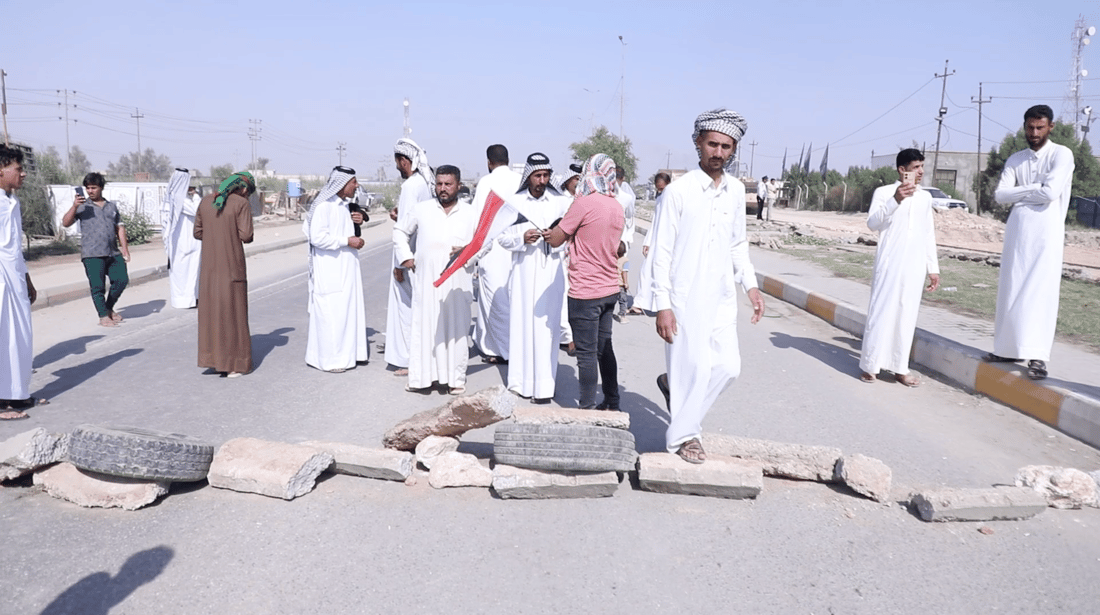
Residents of Al-Abtaniya village, Diwaniyah province, blocked the main road with tires and stones on Tuesday, demanding services
Delayed since 2012
Protesters in Diwaniyah block road over stalled infrastructure project
DIWANIYAH — Residents of Al-Abtaniya village, located in the southern Hamza district of Diwaniyah province, blocked the main road on Tuesday using tires and stones, protesting a lack of basic services. The protest was sparked by a delayed road paving project, which has been only 70% completed since 2012. Concerns have grown as the winter season approaches, exacerbating the already deteriorated road conditions.
“We have started an open sit-in because the village is in a dire state. All services are completely absent, from electricity to proper schools. In the winter, the teaching staff cannot reach the schools due to the condition of the road and the flooding from rain,” said Aqeel Abd Ali, a resident of the village, in an interview with 964media.
He added, “We live in a tragic situation and call on the central government to resolve our problems. We will not withdraw until our demands are met.”
Qasem Al-Marjani, another protester, highlighted the long-standing neglect: “We, the Albu Marjan tribe, have lived here since the 1940s. The road project has been 70% completed since 2012, yet it remains in a collapsed state. Our village has 3,000 residents across 400 houses, and the condition of the road affects everything, including the health of our patients who need to travel long distances to the hospital.”
The Hamza Municipality Director, Ali Saeb, said the road project falls under the Regional Development Program and is overseen by the Ministry of Planning. “We are making efforts to complete the road as quickly as possible and have contacted the Ministry of Planning to expedite the project before winter,” he added.
Since the beginning of summer until late July, over 50 protests have been recorded in Diwaniyah, many of which stem from dissatisfaction with inadequate essential services like water and electricity, as well as delays in project completion and corruption.