
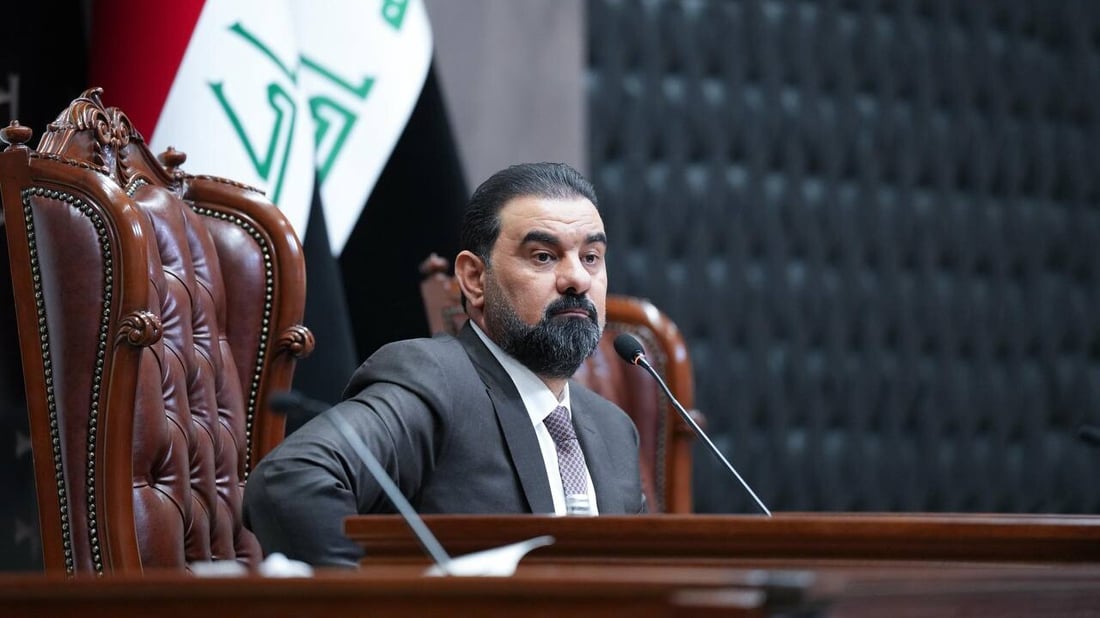
Iraqi Parliament Speaker Haibat al-Halbousi chairs a parliamentary session in Baghdad.
Iraq’s speaker orders inquiry into alleged Jurf al-Sakhar oil smuggling
BAGHDAD — Parliament Speaker Haibat al-Halbousi on Wednesday ordered a temporary committee of lawmakers to investigate an intelligence report alleging oil theft in Babil governorate’s Jurf al-Sakhar and a smuggling route running through Iran to Afghanistan.
The head of parliament’s Security and Defense Committee will chair the inquiry. Its members are the heads of the finance, oil and gas, integrity, legal and planning committees and of the committees on regions and governorates and on border crossings, the speaker’s media office said. It will submit its findings to parliament’s leadership.
Halbousi formed the committee after an expanded meeting with the heads of parliamentary blocs. The meeting reviewed the technical intelligence report on Jurf al-Sakhar, an area officially renamed Jurf al-Nasr in 2014, and intelligence on oil smuggled from the Kirkuk fields and the Kurdistan Region through Iran to Afghanistan, the office said. The committee will also examine the attack late Sunday on the Khor Mor gas field in the Kurdistan Region.
The report, which media outlets began circulating Monday, describes an active smuggling line in Jurf al-Sakhar. According to the report, oil is drawn from a pipeline through an unauthorized opening and carried away in tanker trucks that hold 36,000 liters each. The documents included images presented as evidence. 964media could not verify the report or the images, or confirm which agency prepared them.
Babil Governor Ali Turki rejected the allegations Tuesday after an unannounced visit with journalists to the site named in the report, which they located by its GPS coordinates. He said the site was an old fuel station called al-Madina al-Munawwara, which has been in official use for about four years to fuel Federal Police and Popular Mobilization Forces vehicles.
The PMF is the state-sanctioned umbrella of mostly Shiite armed groups formed in 2014 to fight the Islamic State group. Turki said checks made before the visit found no irregularities on the pipelines, and that some of the station’s tanks had stood abandoned since before 2012.
Security expert Sarmad al-Bayati disputed the governor’s account in an interview with presenter Yasser Amer. “This report was issued by a respected Iraqi government agency, the people behind it are professional officers, and they submitted it three months ago,” he said.
Bayati said the agency’s logo can be seen under the last images in the report. “If I said this is not true, they would say I am calling the state a liar,” he said.
Hussein al-Kinani, head of the al-Hadaf Center, questioned the report Monday in an interview on Al-Rasheed TV. He said the satellite images might be inaccurate and asked who had proven that Kataib Hezbollah, an Iran-aligned armed faction that the United States designated a terrorist organization in 2009, was responsible.
Moving oil by tanker would need a route permit from the Oil Ministry, sent to the army and police checkpoints along the way, Kinani said. “These documents are an operation of targeting and smearing,” he said.
Jurf al-Sakhar, in northern Babil, was renamed in 2014 as its Sunni residents were displaced, and it is widely regarded as a Kataib Hezbollah stronghold. Rockets seized last week in Latifiya, south of Baghdad, were bound for the area, where factions still negotiating over the government’s weapons plan are deployed, a source told 964media.
Oil theft through pipeline taps has been uncovered elsewhere in Iraq. In September, the National Security Service, Iraq’s domestic security service, broke up a network stealing crude through 270 meters of buried pipe on farmland in Muthanna governorate. Four people were arrested. The service estimated that the network made about 500 million dinars a month (about $380,000 at the time).