
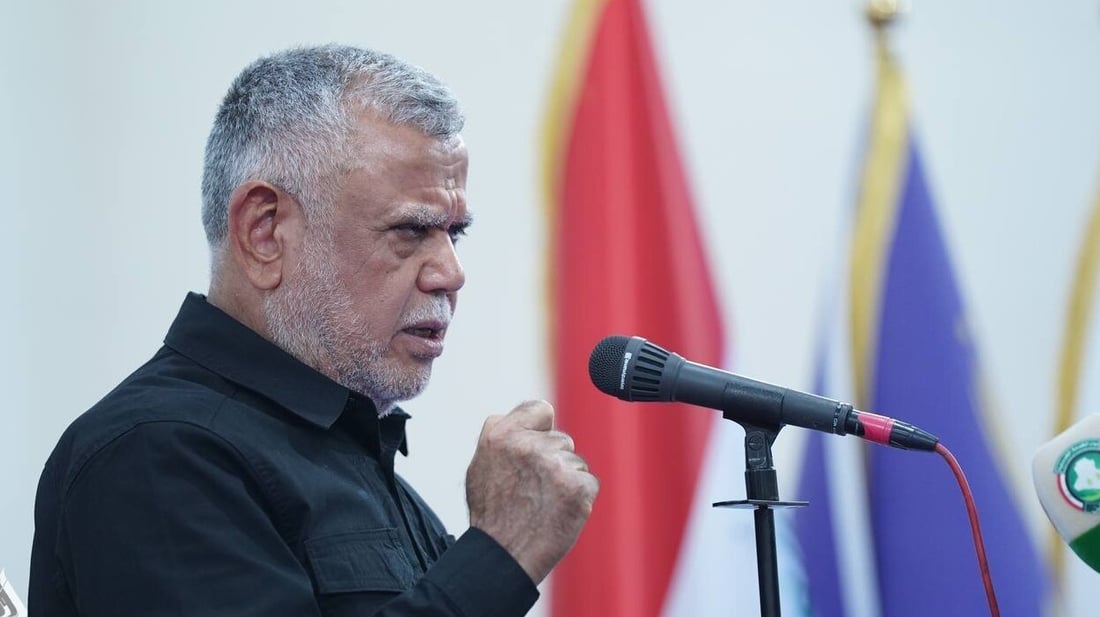
Badr Organization leader Hadi Al-Amiri
Badr bloc demands Iraq reopen Iran crossings, rejects US ‘dictates’
BAGHDAD — The Badr parliamentary bloc on Sunday rejected U.S. demands to close most of Iraq’s border crossings with Iran, urging Prime Minister Ali al-Zaidi’s government to reopen closed crossings immediately and stand up to foreign pressure.
The statement followed remarks by Foreign Minister Fuad Hussein, who told Al Jazeera on Saturday that the United States had formally requested that Iraq close all border crossings with Iran except two. Hussein did not name the two crossings or say how Baghdad had responded in the excerpts the Qatari broadcaster released Saturday. The government had not commented publicly on his account by Sunday afternoon.
In a statement sent to 964media, the bloc said it categorically rejected what it called U.S. “dictates,” arguing that Hussein’s remarks contradicted the technical reasons given earlier for the closures and exposed “agendas that target our mujahid (jihad-waging) south.” “Iraq is a fully sovereign state, and our people and their national forces will not stand idly by in the face of any violation of sovereignty or submission to foreign agendas that harm the country’s interests,” the statement said.
The bloc also rejected Iraqi participation in measures aimed at economically isolating Iran, citing ties it said had been forged in blood in the fight against terrorism, a reference to the war against the Islamic State group. “We categorically reject Iraq becoming an instrument in a project to besiege the Muslim Iranian people,” the statement said.
The bloc said the continued closure of border crossings, particularly the al-Sheib crossing in Maysan governorate, had caused economic hardship for residents.
It also criticized what it described as unequal treatment of southern border crossings compared with those elsewhere in Iraq, calling for an immediate review of the restrictions.
The bloc urged the government to maintain Iraq’s declared policy of staying out of regional conflicts and avoid involvement in what it called “hegemonic policies and illegal wars” that increase regional tensions.
It closed by calling on the government to reopen the closed crossings immediately and to put citizens’ interests and national sovereignty ahead of any foreign pressure. Iraqis and their national and tribal forces were resolute in defending citizens’ livelihoods and the country’s sovereignty, it said.
Badr, led by Hadi al-Amiri, belongs to the Coordination Framework, the ruling alliance of Shiite parties. Water Resources Minister Muthanna al-Tamimi is a Badr member, as is Maysan Governor Habib Zaher al-Fartousi.
The bloc urged the government on Oct. 26 to reopen al-Sheib, and in September it warned the government against enforcing U.S. sanctions on Iranian airlines.
When it shut al-Sheib to goods and travelers on Oct. 21 on Zaidi’s instructions, the government gave other reasons. Government spokesperson Haider al-Aboudi said the crossing’s technical and logistical facilities needed upgrading, while government adviser Abdul Amir Taiban said the closure was meant to stop drugs and counterfeit currency and ruled out U.S. pressure.
“We have many border crossings with Iran, and all of them are open. If the reason were related to a blockade, all crossings would have been closed,” Taiban said in a televised interview on Oct. 21.