
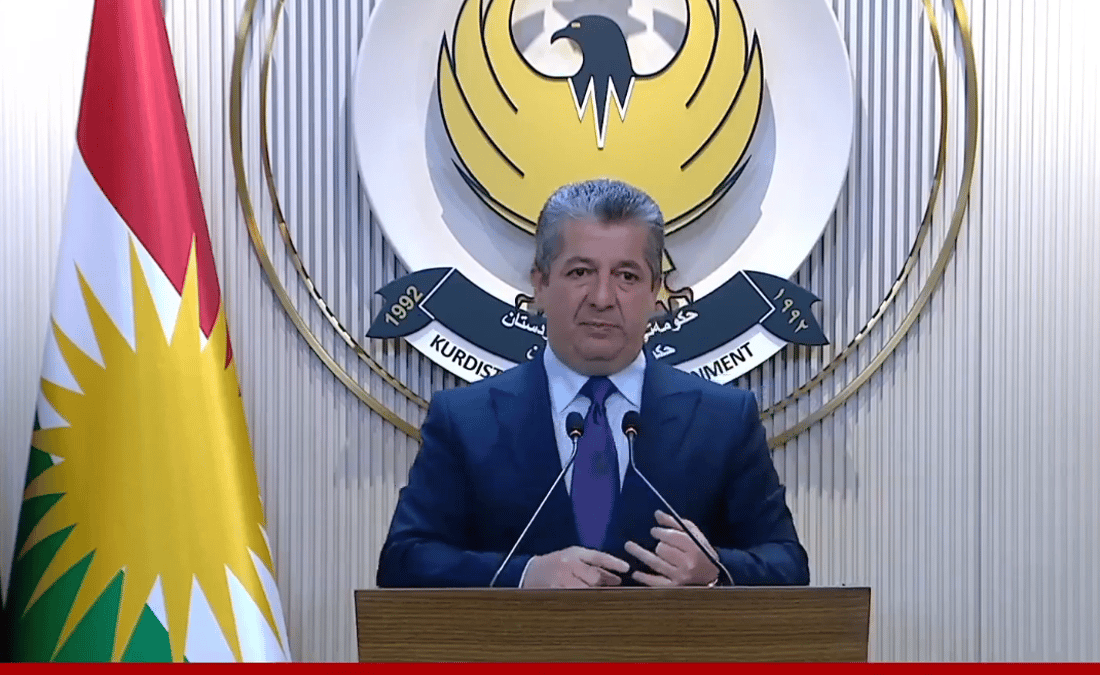
KRG Prime Minister Masrour Barzani
Drone attack on PM Barzani office draws condemnation
ERBIL — Iraqi and regional political figures and the UK Consulate General in Erbil condemned Monday’s drone attack on the private office of Kurdistan Regional Government Prime Minister Masrour Barzani, as the KRG Ministry of Peshmerga Affairs said the drones were launched from across the Iranian border.
Two explosive drones struck Barzani’s private office and the home of the head of the Parastin intelligence agency in Pirmam district early Monday, according to the Kurdistan Region’s Counter-Terrorism Directorate. No one was hurt.
The directorate identified the drones as Hadid-110 models and said they were launched from the Iranian side of the border at 12:28 a.m. It did not identify who launched them.
The KRG Ministry of Peshmerga Affairs separately said the attack came “from the Iranian border,” describing it as a violation of Iraqi and Kurdistan Region sovereignty and an attack on constitutional institutions. It called on the commander-in-chief of the Iraqi armed forces to act to prevent further attacks.
“The Kurdistan Region has always been part of the solution and has sought to resolve all problems through dialogue,” the ministry said. “This aggression poses a danger to the security and stability of Kurdistan and the region.”
The presidency of Iraq’s Council of Representatives described the attack as a “dangerous and unacceptable escalation” that infringed on Iraqi sovereignty and threatened citizens and state institutions.
“The security of the Kurdistan Region is an integral part of the security of Iraq, and targeting any part of its territory, officials or institutions is unacceptable under any circumstances or pretext,” it said, calling on federal authorities to investigate the attack and prevent a recurrence.
The UK Consulate General in Erbil also condemned the attack and called for de-escalation. “We will continue to urge de-escalation and to support efforts to protect stability in the Kurdistan Region of Iraq,” it said.
Former Iraqi Prime Minister Mustafa al-Kadhimi, who served from 2020 to 2022, said the attack represented a broader threat to Iraq amid the continuing regional conflict.
“The gravity of this attack extends far beyond the location of the attack or the identities of those targeted,” Kadhimi’s office said. “We are confronting a highly dangerous and complex development that cannot be separated from the ongoing regional escalation and attempts to bring its repercussions into Iraq.”
Kadhimi said an attack on official institutions in the Kurdistan Region from the territory of a neighboring country constituted an infringement on Iraqi sovereignty and national security and risked drawing Iraq into a regional conflict. He warned against “turning Iraq into an arena for exchanging messages and settling scores.”
He also noted that the attack coincided with the 80th anniversary of the founding of the Kurdistan Democratic Party and said the Kurdistan Region could use its relations with different parties to support dialogue and de-escalation, including between Tehran and Washington.
Syrian Democratic Forces commander Mazloum Abdi expressed solidarity with the Kurdistan Region and condemned the targeting of Barzani’s office.
“We stand in solidarity with the government and people of the Kurdistan Region and strongly condemn the targeting of the prime minister’s office,” Abdi said. “This attack is unacceptable and immoral and represents an assault on the will of the people of the Region and on an essential part of the institutions of the Iraqi state.”
The Al-Seyada Alliance, an Iraqi Sunni political alliance led by Khamis al-Khanjar, described the strike as a terrorist act and a violation of Iraq’s security and state institutions, calling on federal authorities to prevent further attacks.
Earlier Monday, Kurdistan Region President Nechirvan Barzani and party leaders across the political spectrum condemned the drone strikes.
The attack follows months of repeated drone and missile strikes across the Kurdistan Region targeting security and energy sites, diplomatic facilities, civilian areas and camps belonging to Iranian Kurdish opposition groups.
During the previous phase of the regional conflict before a June ceasefire, Community Peacemaker Teams–Iraqi Kurdistan documented 751 attacks across the Kurdistan Region between late February and late May, attributing them to Iran and Iran-backed Iraqi armed groups. The organization recorded 22 people killed and 112 wounded, including members of Iranian Kurdish opposition groups, civilians and Kurdish security personnel.
The attacks have intensified again since the ceasefire unraveled, with renewed security concerns prompting foreign energy companies to suspend operations or withdraw personnel from some sites in the Kurdistan Region.