
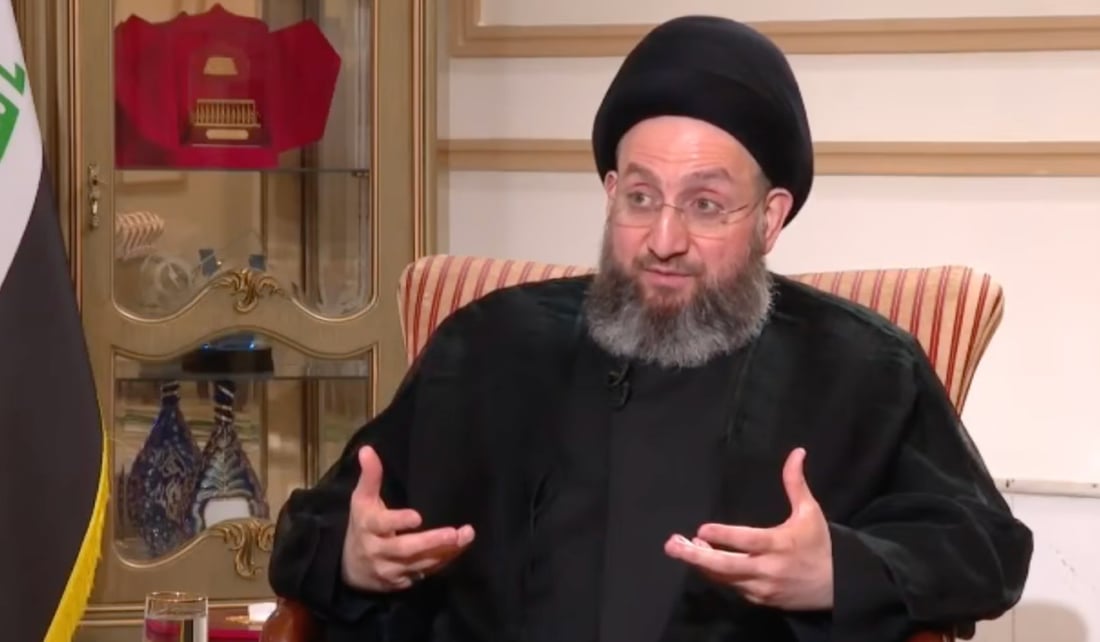
National Wisdom Movement leader Ammar al-Hakim speaks during an interview with Al Mayadeen TV discussing Iraq’s anti-corruption campaign.
Hakim says future corruption arrests need not involve tanks
BAGHDAD — National Wisdom Movement leader Ammar al-Hakim said Monday that future arrests in Iraq’s anti-corruption campaign could be carried out without tanks or armored vehicles, while reaffirming his support for Prime Minister Ali al-Zaidi’s crackdown and urging authorities to focus on major corruption cases.
“We may not need to move a tank or armored vehicles when we go to arrest a lawmaker, politician or someone accused of corruption,” Hakim said in an interview with Al Mayadeen TV, arguing that such deployments are better suited to terrorism suspects who may respond with violence than to political figures accused of financial crimes.
He said security agencies may have adopted heightened measures during the first phase because they feared suspects could flee, but that future operations “can be calmer in achieving the objective.”
Hakim said combating corruption, pursuing those responsible and recovering public funds remain “a top priority” backed by Iraq’s political leadership. Leaders supported the campaign’s overall direction, he said, but were not told in advance of its timing, targets or operational details. “When events accelerated, they surprised the country’s leaders in the first hours,” Hakim said, calling the campaign “blessed and correct” and saying it continued to enjoy full political support.
“There is no step without mistakes or consequences,” he said, adding that the campaign should continue “until the end” and concentrate on “the big heads” and “centers of corruption” rather than lower-level cases, which he said could distract from dismantling broader networks.
“The accused is innocent until proven guilty,” Hakim said, warning that publishing suspects’ names and images before court rulings could sway public opinion and pressure the judiciary. “The goal is not to embarrass citizens, lawmakers or officials. The goal is to reach the real thief and recover the money for the state and the people.”
He also cautioned that if investigations stopped after targeting suspects from a single political group, the campaign could appear politically selective even if the allegations were valid, saying it should extend across all political affiliations.
Hakim’s comments add to a wave of reactions from within the Coordination Framework, the Shia coalition behind the government, whose leaders have backed the campaign while raising concerns about the military hardware on display. State of Law Coalition leader Nouri al-Maliki said Monday he had first believed Iraq was facing a coup when tanks entered the Green Zone, before learning the deployment was part of the crackdown, describing the tanks as “not preparation for a battle, but rather a signal of seriousness and readiness.”
Days earlier, a senior National Wisdom Movement official, Hassan Fadam, said the Framework had supported the operation but objected to the armored vehicles. He said the coalition had deliberately not reviewed the list of suspects beforehand so its leaders could not be accused of tipping off wanted figures. “The Coordination Framework delegated Zaidi and did not want to review the details of the arrests of corruption suspects, fearing it would be said that its leaders ‘leaked the information’ if some suspects escaped,” Fadam told Dijla TV. Its one objection, he said, was the hardware: “The only observation on ‘Dawn Strike’ was the excessive use of tanks and armored vehicles inside the Green Zone, and people began asking: Is this a military or political coup?” He said there had been no need to alarm the public, particularly during the Islamic month of Muharram, and that Zaidi had accepted the coalition’s advice to avoid such displays while continuing the campaign.
His remarks follow the government’s June 28 operation known as “Dawn Strike,” in which armored vehicles and Counter Terrorism Service units sealed Baghdad’s Green Zone before carrying out coordinated corruption raids. Security and political sources previously told 964media the operation had been planned in near-total secrecy, with participating forces surrendering their mobile phones beforehand and commanders receiving their targets only shortly before deployment.
The campaign centers on former Deputy Oil Minister Adnan al-Jumaili, whose detention over alleged financial irregularities in the oil sector expanded into a broader investigation involving lawmakers and senior officials. Zaidi has described the campaign as only its “first phase.”