
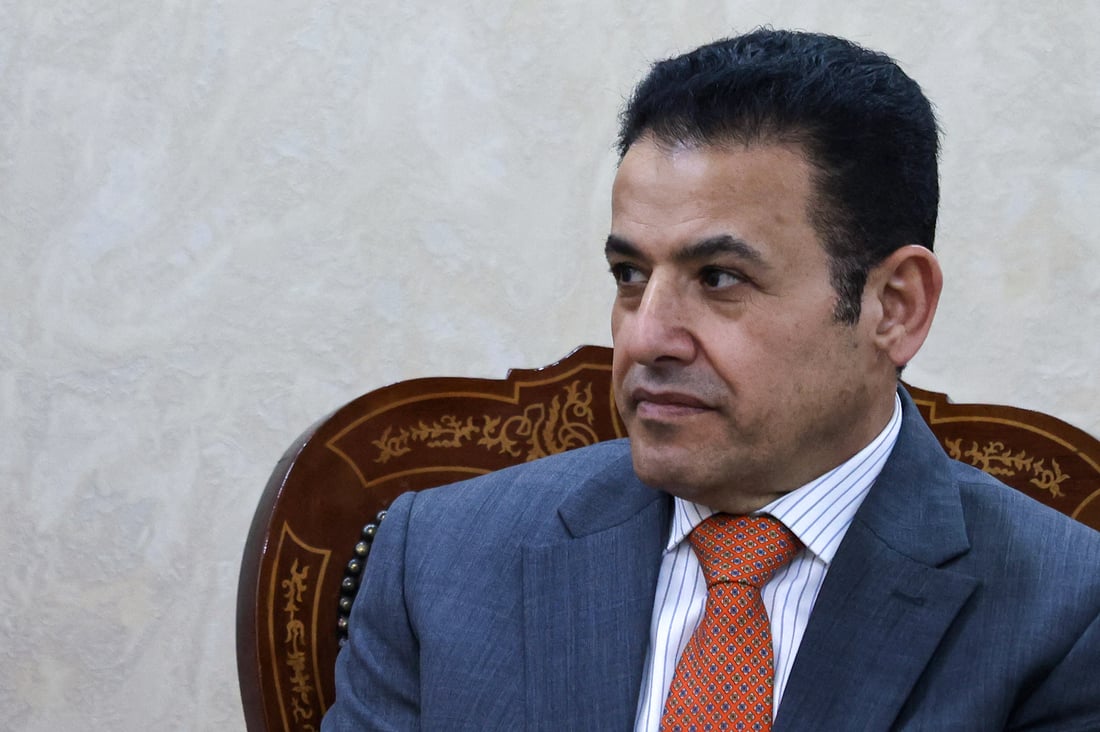
Iraq's National Security Adviser, Qasim Al-Araji, during interview with AFP. (Photo by AHMAD AL-RUBAYE/AFP)
National security adviser calls militia weapons handover a roadmap for state authority
BAGHDAD — National Security Adviser Qasim al-Ararji said Tuesday that support for Prime Minister Ali al-Zaidi’s government is a moral and national obligation, describing the current weapons handover process as a roadmap for both the Coordination Framework and the commander-in-chief of the armed forces.
Speaking to Al-Rabia TV, Ararji distinguished between two separate tracks: restricting weapons to state control and severing political ties to PMF formations. “The issue of restricting weapons and the issue of separation are two different matters, not one. Separation applies to everyone. Any political party that organized a PMF formation linked to it within the Popular Mobilization Forces should sever that connection, whether it belongs to resistance factions or not,” he said.
He rejected claims that the measures would weaken the PMF or the state. “Organizing our situation is not a denial of past efforts and is not a weakening of the state or the PMF. It strengthens both the PMF and the state by making our situation more organized, and so that we are not accused by brotherly countries, friendly countries or certain coalitions,” he said. Drawing on international precedent, he added: “Many countries possess nuclear weapons, but there is control over their use. The issue is not who holds the rifle; the issue is that the decision to use it must be held by one authority, and that authority is the state.”
Addressing factions that possess missiles and drones outside official institutions, Ararji said: “There are groups that have taken it upon themselves, based on what they believe, that there is an occupation that must be resisted, and therefore they possess drones and missiles. These must return to the state, and this is what is meant by handing over weapons and disarmament.”
He praised the Coordination Framework’s recent statement as “bold and wise” and said the long-term objective is for the PMF to operate entirely under the commander-in-chief while undergoing further internal restructuring. He acknowledged the reforms could have been implemented earlier but said they required political will and assurances previously absent.
Ararji’s remarks come as several factions move to comply. Asaib Ahl al-Haq has formed a committee to oversee its separation from PMF formations, the Imam Ali Battalions have announced plans to sever ties with the PMF, and Muqtada al-Sadr announced that Saraya al-Salam would integrate into state structures. The Coordination Framework on June 1 authorized al-Zaidi to take the decisions needed to implement the policy.
Not all factions have endorsed the initiative. Kataib Hezbollah, Harakat al-Nujaba and other Iran-aligned groups have rejected disarmament, arguing their weapons remain tied to Iraq’s security and the continued presence of foreign forces.