
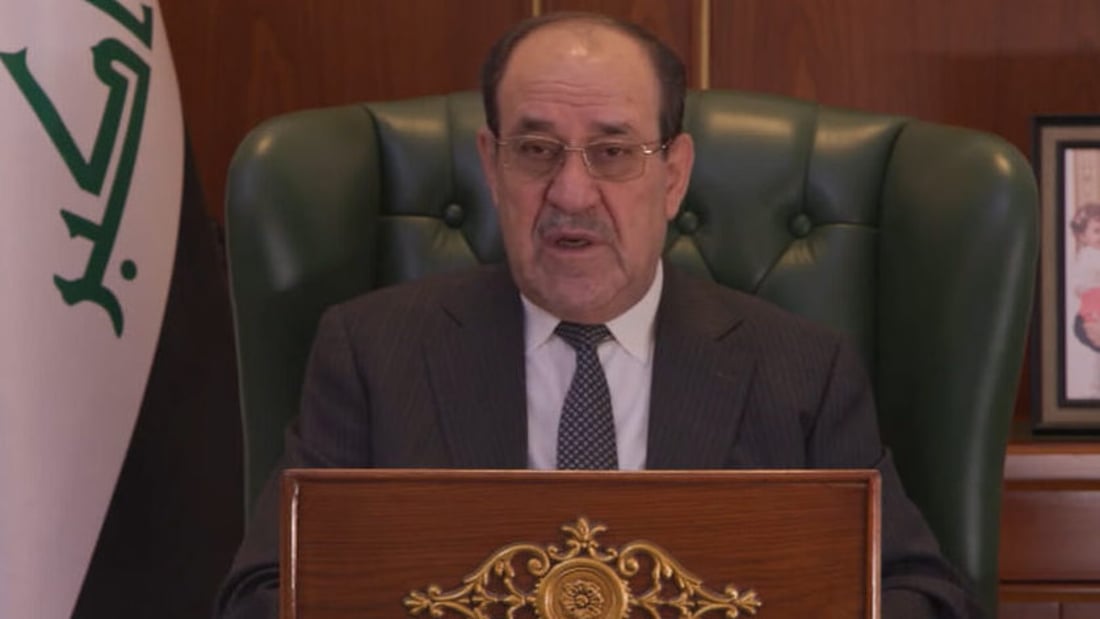
Nouri Al-Maliki, leader of State of Law Coalition
Media Monitor
Maliki urges swift government formation, says turnout driven by fear of political collapse
BAGHDAD — State of Law Coalition leader Nouri al-Maliki said political factions insisted on holding Iraq’s parliamentary elections as scheduled despite what he described as internal and external attempts to delay the vote. In an interview with Shams TV, Maliki attributed voter turnout to fears that a boycott would “collapse the political process.”
Discussing post-election negotiations, Maliki said forming a new government will depend on political consensus and could occur within a month of ratifying the final results. He urged Kurdish and Sunni blocs to expedite their nominations for the presidency and speakership to allow the process to move forward.
Iraq’s Independent High Electoral Commission on Monday released the final results of the Nov. 11 vote, confirming turnout above 56 percent and publishing the full distribution of all 329 seats.
Once the results are certified, the president must convene the new parliament, which then elects a speaker before choosing a president. The president tasks the nominee of the largest bloc with forming a cabinet, and the prime minister-designate must then present the government to parliament for a confidence vote.
Maliki also commented on regional politics, saying Iraq “does not want to be part of the confrontation between Iran and the United States” and would instead seek to act as a mediator. He ruled out joining the Abraham Accords or entering “any security agreements with Israel.”
Excerpts from Al-Maliki’s interview with Shams TV:
Anyone who tries to break Maliki will be broken, and many have exited the political process.
There was insistence from the political class to hold the elections on schedule regardless of the cost.
The reason for the high voter turnout was the feeling that a boycott would collapse the political process.
There were internal and external attempts to postpone the Iraqi legislative elections.
There are now many calls to reconsider the election law in light of the results achieved.
Iraq will not be stable unless every region within it is stable, wherever it may be.
I do not believe at all that the Sunnis in Iraq have been marginalized, and those who promote this idea are defeated people.
The Kurds in Iraq paid a heavy price due to the practices of the Baath Party regime.
The disputes between the region and the central government cannot be resolved with temporary agreements but through legislation.
The Shia in Iraq experience the Kurdish suffering from the Anfal and chemical weapons.
The political process after the elections requires me to go to Erbil to resolve many complications.
Forming the government is linked to consensus, and it is possible to form it one month after the results are ratified.
The Kurds must expedite the selection of a candidate for the presidency, and the Sunnis for the speaker of parliament.
We do not want to be part of the confrontation between Iran and the United States; we want to play the role of mediator.
The armed factions are willing to integrate into the state and hand over their heavy weapons.
The next prime minister will face major challenges, foremost among them the financial crisis.
The Coordination Framework has set specific characteristics and conditions for the next prime minister.
There is no decision within the Coordination Framework to exclude Sudani from the position of prime minister.
The developments and wars in the region have led to a reassessment of positions.
Iraq will not be part of the Abraham Accords or security agreements with Israel.