
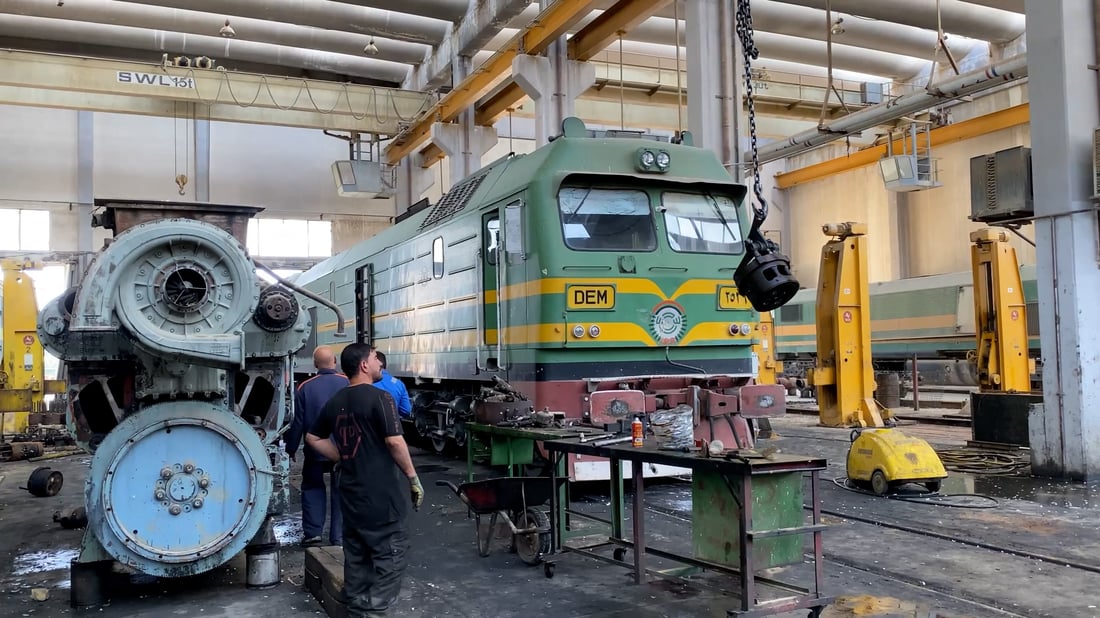
Workers at the Samawah train maintenance workshop repair a locomotive as part of ongoing efforts to keep Iraq’s railway fleet operational. Photo by 964media.
Muthanna
Samawah railway experts say they’re ready to maintain high-speed trains on Development Road
MUTHANNA – Iraqi railway technicians in Samawah say they are fully prepared to maintain the high-speed trains expected to run on the upcoming Development Road, a multi-billion-dollar transport corridor linking the Gulf to Turkey via Iraq. The line will carry both freight and passengers at speeds exceeding 300 kilometers per hour.
Staff at the Samawah facility—the largest train maintenance workshop in Iraq and possibly the Middle East—told 964media they are confident no mechanical failure will be beyond their repair capacity.
“The Middle Euphrates Railway Unit repairs all locomotives sent to us, whether from Baghdad, Basra, or the Middle Euphrates directorate,” said Baha Youssef, head of the locomotive unit. “We repaired 140 locomotives this year, including 40 passenger trains.” He added that locomotive 2405 had been out of service for over a decade before his team brought it back through a collective effort.
Current work includes locomotives 2539 and 2559, with the latter expected to return to service in the coming days. Youssef said the facility works with Russian, German, and Spanish locomotives, while Chinese units are mainly handled in Baghdad but occasionally sent to Samawah.
“There is no malfunction that we cannot fix,” Youssef said. “I have served in this field for more than 40 years, and our expertise makes me confident no locomotive is beyond repair.” He noted staff shortages remain a challenge, requiring the use of daily-wage workers, but emphasized that the team is fully capable of handling maintenance for trains on the Development Road if the line runs through Samawah.
Sabah Madhloom, head of the truck unit, said the workshop has repaired 205 trucks since January, including FZB tankers and grain carriers. “We’re currently restoring tankers damaged in accidents, including some that went out of service in Baiji due to terrorism,” he said. “We repaired them properly and returned them to service.”
Ibrahim Nashmi, deputy director of electrical-mechanical engineering for the Middle Euphrates railways, said the facility’s wheel turning and modification unit is also essential. “We receive wheels from locomotives, trucks, or passenger cars that are out of service, and we rehabilitate them according to global standards,” he said. “The process goes through five main steps until the wheel is ready for use again. This machine works according to precise international measurements.”