
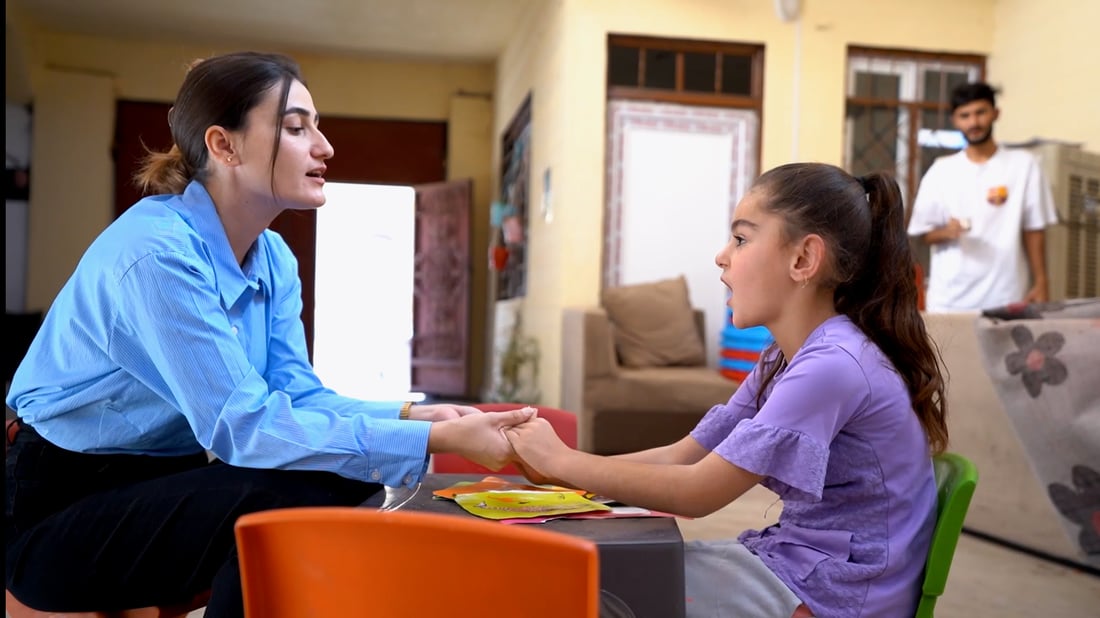
Marwa Murad works with a young girl at “We Are Hope,” the first free center in Sinjar dedicated to children with cochlear implants. Photo by 964media
'We are hope'
Young woman in Sinjar opens first free center for children with cochlear implants
NINEVEH — In the farming district of Sinjar, psychology graduate Marwa Murad has turned personal initiative into a lifeline for children learning to hear and speak after cochlear implant surgery.
Cochlear implants are electronic devices surgically placed inside the inner ear to help children perceive sound. But the operation is only the first step; children require months of training to learn how to interpret sounds as language. To fill that gap, Murad founded “We Are Hope,” Sinjar’s first training center dedicated to children with implants, which provides services free of charge.
“I am a psychology graduate and director of the ‘We Are Hope’ center for children with cochlear implants,” she told 964media. “The idea came when I met a family whose child had undergone surgery and they were forced to travel long distances to other governorates for therapy. That was difficult, costly, and even the language was different from ours. From here the idea came, so I opened this center a year and a half ago.”
Since opening, the center has welcomed more than 15 children, with nine currently receiving regular therapy. “We faced major challenges, including finding a suitable place for children with cochlear implants. Our center is free and open to all age groups. We are now in Sinjar’s agricultural district, but we call on the government to help us expand and open another branch in a different area,” Murad said.
Parents say the center has changed their children’s lives. “I am the father of one of the children with cochlear implants. At first, we faced a lot of difficulties until we found the ‘We Are Hope’ center,” said Kamal Khadr Kars. “We live in the north, in Sinuni subdistrict. The road takes an hour to reach the center, and we hope the government will support it so another branch can open closer to us.”
He added: “We thank the center for receiving our children. Thanks to it, they move from a non-hearing environment to a hearing one, which is very difficult without the center’s efforts. We also thank those running it because it is free and does not receive support from any local or government organization. The biggest challenge we face is the lack of suitable places for children, and we hope the government will allocate a proper location, even under the Ministry of Health or another state body.”