
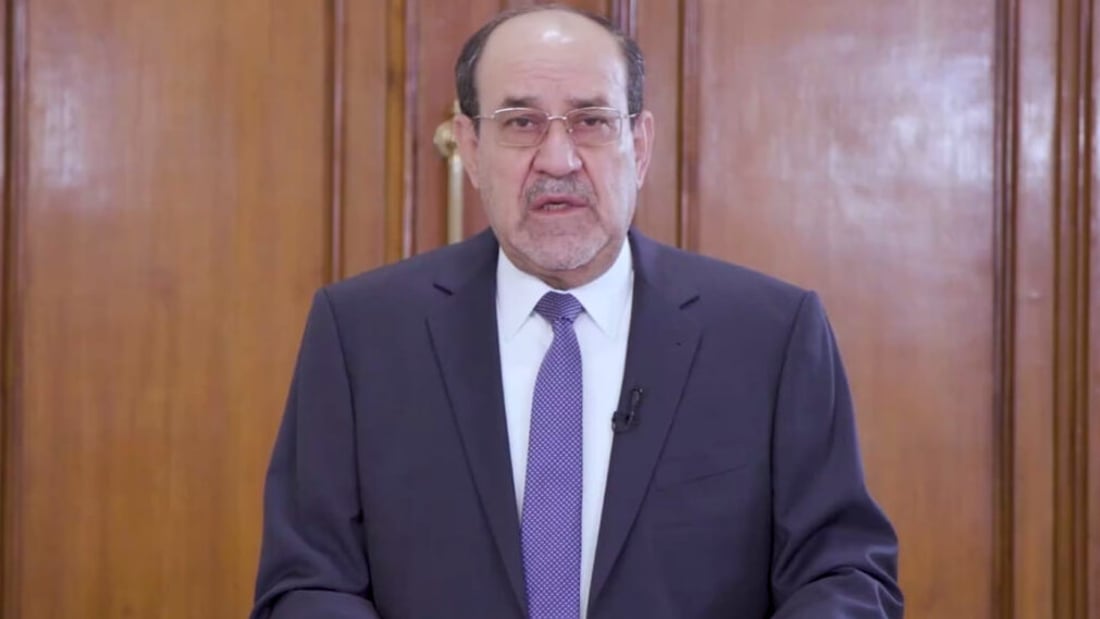
Nouri Al-Maliki, leader of Islamic Dawa Party
Monitor
Al-Maliki calls participation in elections a ‘democratic right’ and ‘historical responsibility’
BAGHDAD — Nouri Al-Maliki, leader of the Islamic Dawa Party, called on Iraqi employees to uphold integrity and resist political pressure in a televised speech, urging them to see public service as “a mission and national responsibility.”
“Public service… is not merely work in exchange for a salary, but rather a mission and national responsibility,” Al-Maliki said. He praised state employees, adding, “I am certain that millions of employees, men and women, in state institutions, and teachers in the educational sector, are characterized by honesty, integrity, and dedication.”
He cautioned against broad anti-corruption campaigns that he said unfairly stigmatize workers. Such actions, he argued, would be “a grave offense against the Iraqi employee who provides daily services to citizens with diligence and trustworthiness.”
Al-Maliki also addressed Iraq’s Nov. 11 parliamentary elections, describing participation as both “a democratic right” and “a historical responsibility.” He stressed the need to safeguard ballots against “interference and fraud.”
Excerpts from Nouri Al-Maliki’s speech:
First, I congratulate you on the Prophet’s birthday. In the Messenger of Allah you have a good example; he is the truthful and trustworthy, whom Allah sent as a mercy to the worlds, carrying the message and fulfilling the trust.
I am certain that millions of employees, men and women, in state institutions, and teachers in the educational sector, are characterized by honesty, integrity, and dedication. Whoever works to generalize the accusation of corruption against employees aims primarily at distorting the image of the employee, the state in general, and the democratic system and political process.
I wish to emphasize here that the campaign to combat corruption and achieve integrity must fundamentally avoid the phenomenon of generalization, which is a grave offense against the Iraqi employee who provides daily services to citizens with diligence and trustworthiness.
Public service, brothers and sisters, is not merely work in exchange for a salary, but rather a mission and national responsibility. The employee is the backbone of institutions, the pillar of the state, and a partner in economic, political, and cultural development. His effectiveness reflects the capacity and competence of state institutions to provide services to citizens.
Despite the difficult circumstances Iraq faced after the fall of the Baathist regime and the outbreak of sectarian war caused by remnants of the regime and terrorist organizations, we managed to open specialized institutes to build and qualify administrative and technical cadres. These supplied ministries with rare specializations, and thousands of students and employees were sent abroad to keep pace with global developments. We also established many security agencies and modern state institutions tasked with protecting the country and safeguarding citizens’ rights with confidence, honesty, and competence.
In the state we are working to rebuild on sound foundations, it is essential to keep the employee away from political pressures, which would otherwise weaken his institutional role and turn the government apparatus into a burden instead of a productive force.
Protecting the employee from political pressures or partisan interference, and providing a fair work environment and decent salaries, will turn the employee into a constructive element who places the interests of the nation and the citizen above personal or partisan considerations.
Our pluralistic democratic system needs the official and the employee who preserve people’s rights, promote proper conduct, safeguard public funds, and implement the law.
Our society today needs courage to reject negative and degrading behaviors and to display the true face of men and women, away from vulgarity intended to insult Iraqis.
Participation in elections is a dual act: exercising a democratic right on one hand and reinforcing the legitimacy of the state on the other. It is a historical responsibility for you to be an important factor in rebuilding the state.
Elections are not a station for paralyzing state institutions or for serving this individual or that faction. State institutions must remain above political conflicts and electoral competition.
Your role will be decisive in maintaining the integrity and success of elections through broad, conscious participation and by protecting them from interference and fraud. The votes of the people are a trust that must be safeguarded from manipulation or negative influence on voters.